When political protest crosses into endangerment, European standards demand clarity, factual precision, and unconditional accountability — not selective regret.
by Ardit Bido
The European Union distinguishes clearly between the right to protest and the use of violence. One is a protected democratic freedom. The other is a breach of public order and, when lives are endangered, a matter of legal responsibility.
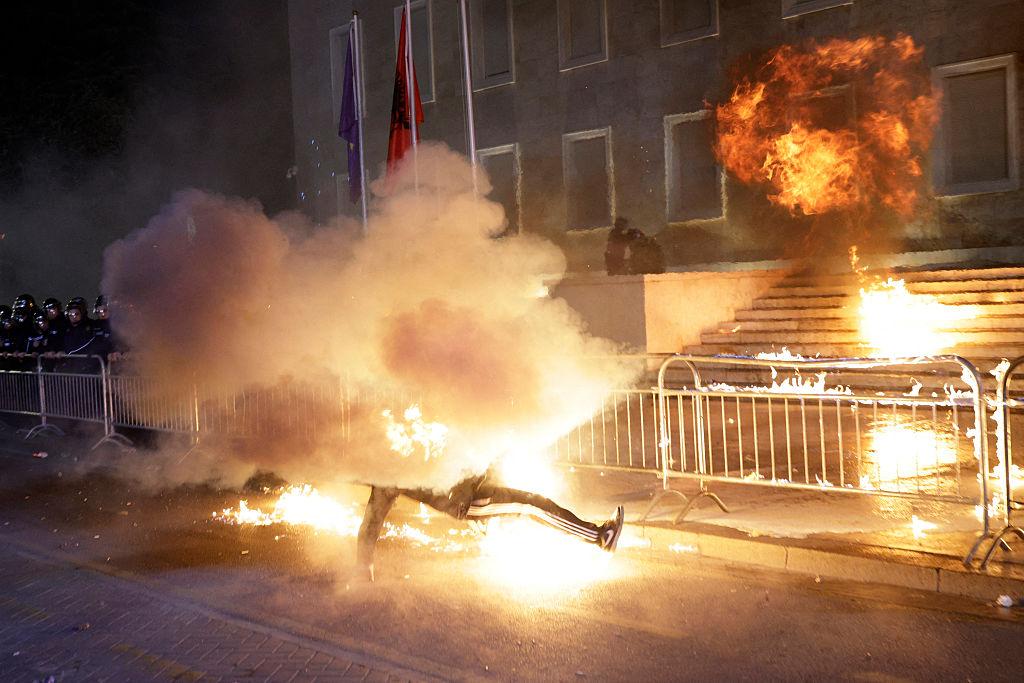
Following the attack on “Vila 31” in Tirana — where incendiary devices were thrown at an occupied cultural residency — opposition leader Sali Berisha offered what he described as an apology. Speaking outside SPAK, he stated:
“We apologize to those two foreigners and express regret because this should under no circumstances have happened, and had it been known that it is a cultural center and that there were foreigners there, this could not have happened. I learned that it had been turned into a cultural center absolutely after the event occurred.”
Two institutional concerns arise from this statement.
First, factual accuracy. Organizers of the residency operated by Art Explora have confirmed that 13 individuals were present inside the building at the time of the attack: 10 foreign artists and three Albanian staff members. Precision in public communication is not a secondary matter when public safety is involved.
Second, the conditional nature of the apology. Regret was expressed on the basis that the building was a cultural center and that foreigners were present. In a European legal and democratic framework, the protection of life and property does not depend on nationality, diplomatic visibility, or symbolic status. It is unconditional.
The status of Vila 31 as a cultural residency was publicly established in October 2023 during the visit of French President Emmanuel Macron to Tirana, when bilateral cooperation on the site was formally announced. The inauguration in January 2025 and the arrival of international artists were conducted through official and public channels. The institutional character of the site was neither obscure nor informal.
Berisha further stated:
“They did not know they were there. There was no one there; they did not see anyone there; they thought there was no one.”
Video material available publicly indicates movement within the compound during the attack. From a rule-of-law perspective, what matters is not subjective belief but objective risk. The use of incendiary devices against an occupied structure constitutes a serious endangerment regardless of perception.
Leadership responsibility in a democratic system does not end at mobilization. When political protest escalates into actions that create foreseeable risk to human life, responsibility cannot be disclaimed on the basis of ignorance. Due diligence is an inherent obligation of political leadership.
For Albania, which is engaged in the process of European Union accession, such episodes are not isolated domestic incidents. They intersect directly with the Union’s assessment of rule of law, fundamental rights, public order, and democratic maturity. Credibility in accession negotiations is shaped not only by legislative alignment but by political conduct.
This is not a question of partisan advantage. It is a question of institutional integrity. European integration requires a political culture in which facts are stated precisely, responsibility is acknowledged clearly, and violence is rejected without qualification.
In a European democracy, accountability is not conditional. It is structural.
About the Author:
Ardit Bido is a Member of the Albanian Parliament and a historian by training. He previously served as Director General of the General Directorate of Archives and has written extensively on institutional reform, historical accountability, and Albania’s European integration process.