When the judiciary sets its own pay, enforces it through its own courts and looks to Brussels for cover, independence has crossed into power.
Renada Bici (Legal Desk)
On 11 September the Tirana Administrative Court ordered the Ministry of Finance to process the payrolls of the Special Anti-Corruption Court at a salary reference that appears in no law. The suit was filed that morning. The judges who granted it are paid on the reference they ordered paid.
That reference was fixed by the High Judicial Council on 26 August, after parliament missed the 31 July deadline set in Constitutional Court judgment 15/2026 for a new pay law. The judgment was addressed to parliament, and paragraph 76 says why: the basic rules of magistrates’ pay must be set “by law”, adopted by the Assembly, so that neither legislature nor executive can move a judge’s salary by discretion. Law 115/2016 lets the Council administer pay, propose the budget and be consulted on draft laws. The level sits in Law 96/2016. The basis the Council gave at its session was the judgment’s reasoning. No reasoning, however sound, is a statute.
Parliament’s default was a breach of duty, and the Court had provided for it: a fallback formula, expressly for arrears, to be channelled through the new law. The Council took a rule written for the past and made it the pay scale for every month to come.
The judges say they went to the forums the law provides. Every one of those forums is staffed by beneficiaries, and when no unconflicted bench exists a court may still hear the case; what it may not do is treat that as permission to award itself the claim. Interim relief exists to prevent serious and irreparable harm while the merits are decided. Non-payment could have been ended on Friday by ordering salaries at the pre-dispute level and leaving the increment for judgment. The court ordered payment at the reference whose legality was the question before it. Nothing in the law compelled that choice. The bench that made it stood to gain from it.
One court behaved otherwise. The Constitutional Court filed its August payroll at the old parameters and waited for parliament. It proves nothing about the law, only that the judgment’s own authors did not find in it what the Council found.
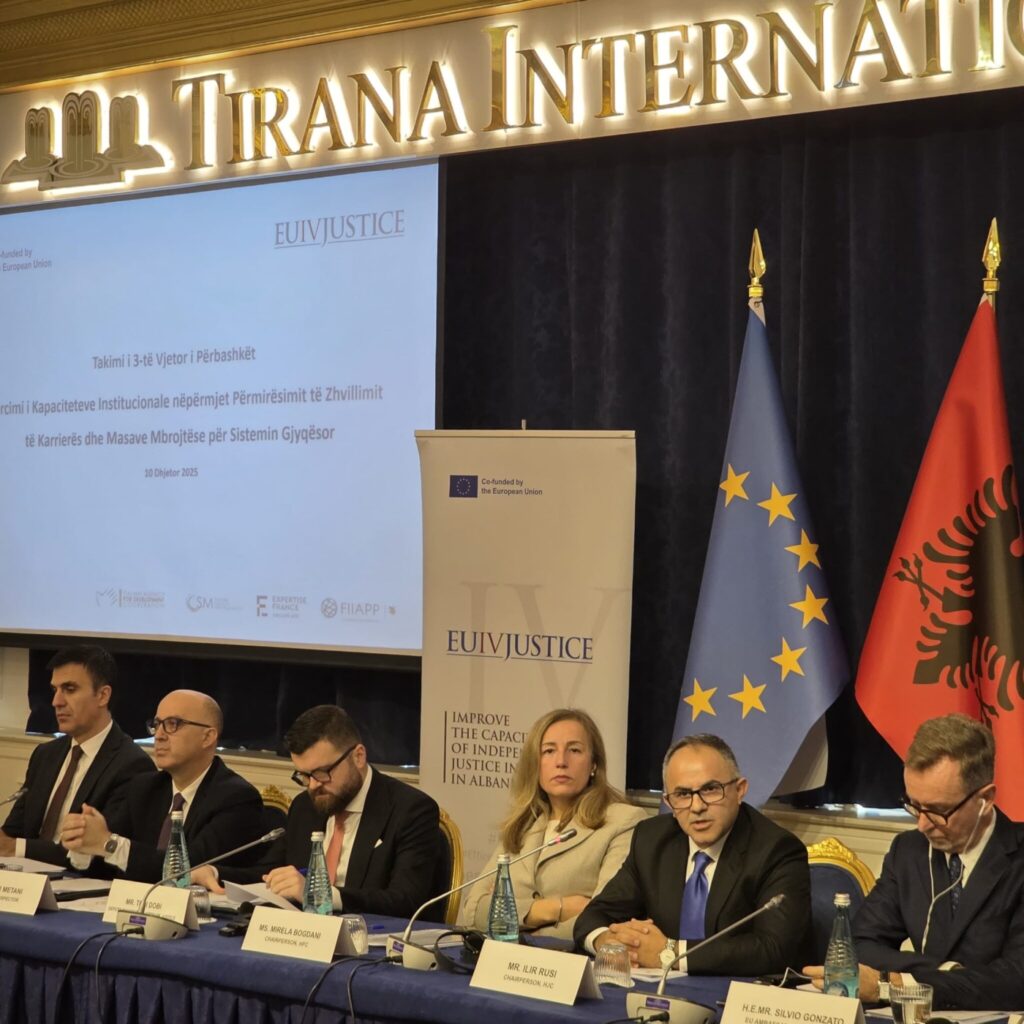
Why the Council felt entitled to act, and why another court was prepared to give the act provisional effect, has an answer in the public record. In November 2025 Ambassador Silvio Gonzato was asked on television whether he had seen any threat from parliament to the justice institutions. No, not really, he said. He then said the reform’s foundations, architecture and governance structure could not be touched, and that if parliament used its constitutional power to alter them, Albania’s membership prospects would be compromised. The Delegation had said in July 2016 that its role would be “limited”, that it had “never suggested having any executive power”, that ownership had to remain Albanian. In February 2022 it and the US Embassy asked every Member of Parliament to “vote accordingly” on extending the vetting. In February 2026 Gonzato said the Delegation closely follows government initiatives concerning the rule of law, including to ensure they do not affect the justice reform. On 8 May he met the president of the Prosecutors’ Association, Gëzim Spahiu, and said the EU supports the Association’s work in preserving the reform’s spirit. Spahiu’s name is on the criminal complaint filed against the Finance Minister four months later.
No ambassador drafted Friday’s order. A judiciary whose sponsors attached Albania’s accession to the inviolability of its institutions will assume the protection covers its own pay. The judges’ declaration of 10 September undertook to take the dispute to the Commission and the diplomatic missions. The missions have not said a word about what independence does not permit.
Parliament sits on Thursday and can pass a law. The precedent survives it: a branch decided its own claim, in its own court, against the state, and the sponsors of the reform looked away. The reform of 2016 was sold as the abolition of impunity. You do not replace one class of alleged abusers with another by changing branches.
Renada Bici is a Tirana-based lawyer practicing in civil, criminal, and administrative law. She holds a law degree from the University of Tirana and has experience in both private legal practice and public administration. She writes for the Tirana Examiner Legal Desk.