The EU Delegation’s April 15 Discrepancy
Editorial Board, Tirana Examiner
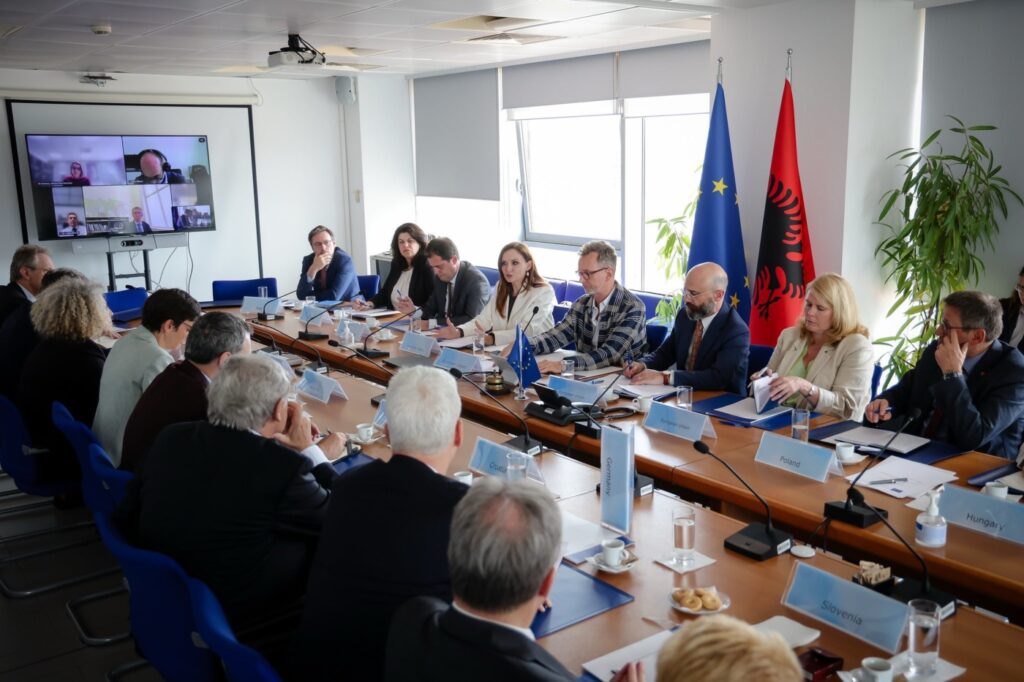
On April 15, the Ambassador of the European Union to Albania, Silvio Gonzato, hosted a meeting at the EU Delegation in Tirana between the ambassadors of EU member states and two Democratic Party MPs, Jorida Tabaku and Oerd Bylykbashi. The readout, published on the Ambassador’s X account, was calibrated in the register the Delegation reserves for such events: frank and open discussion, bipartisan reforms, democratic participation in the integration process, “transparent and inclusive legislative process.” Within hours, Ms Tabaku quote-posted the readout in Albanian with her own commentary. Parliament had been turned into a notary. The opposition was being suppressed. Corruption was not a problem but a system. The more propaganda, she wrote, the farther from Europe.
The first layer of what happened on April 15 is a familiar rhetorical technique. Opposition actors across the region have long attached maximalist domestic claims to calibrated diplomatic statements and let adjacency do the work of endorsement. An ambassador’s neutral readout becomes, in the quote-post, the apparent validation of claims the readout does not contain and cannot contain, because if it did the ambassador would have written them. Ms Tabaku is entitled to her claims. She is not entitled to the Delegation’s implied agreement with them, and readers of both posts in sequence are not obliged to grant her that implication.
But the first layer is not the serious one. The serious problem is what the Delegation itself did, and what the Delegation’s conduct now places on the diplomatic record that every member-state capital will read.
The context matters. The Commission’s 2025 Enlargement Report on Albania, published on November 4, 2025, documented a year of substantive forward motion on the accession track. Five of six negotiating clusters had been opened in the reporting period, with the sixth opened in December 2025, giving Albania the unusual distinction of having opened all thirty-three chapters in the space of thirteen months. The Commission characterised SPAK’s record in plain institutional language: the specialised prosecution had “further consolidated its positive results in fighting high-level corruption.” The Reform and Growth Facility released funds to Albania in October 2025. By the Commission’s own account, Albania was on track toward the 2027 target of concluding negotiations, subject to sustained reform momentum.
The Commission’s technical Interim Benchmark Assessment Report, a product of the Commission itself rather than the member states, was positive. Ambassador Gonzato has said so publicly. In an interview broadcast this month, he described the process as merit-based, the Commission’s assessment as a positive technical finding, and claims of blockage in the Council as speculation. Nine member states have nonetheless been reported in the Albanian media, citing diplomatic sources, to hold reservations in the Council Working Group on Enlargement. COELA exchanged views on the IBAR on March 13, again on March 20, again on April 7, and again on April 9. Capitals are still reading the file. The Presidency has yet to produce a compromise text that COREPER can endorse.
This is the window in which the Delegation convened the member-state ambassadors to hear an opposition argument that the Parliament of Albania has become a notary, that the opposition is being suppressed, and that corruption is systemic. These are not passing claims. They map directly onto the substantive benchmarks of IBAR: rule of law, judiciary, democratic institutions, fundamental rights. Providing a platform for those claims, at that moment, without a corrective either in the room or in the public readout, places them on the diplomatic record that every member-state mission in Tirana will now carry to its capital. What the capitals do with that record is a separate question. That they will now have it is not.
Measured against the Commission’s own record, none of the opposition’s three categorical claims can be sustained in the terms in which they were made. This is the point on which care is required. The Commission’s assessment of Albania is not flattering on every metric, and the Commission’s concerns about parliamentary oversight, political polarisation, and weaknesses in corruption prevention are real and documented. They are, however, calibrated and specific. Ms Tabaku’s are neither. The difference between calibrated and categorical is what this editorial is about.
The Parliament that is alleged to have become a notary is the same Parliament whose output, across the reporting period covered by the 2025 Report, adopted the Intersectoral Strategy Against Corruption, the Cross-Cutting Strategy on Public Administration Reform, the Medium-Term Revenue Strategy, amendments to the Law on Strategic Investment, and the legislative package that enabled the opening of five clusters within a single year. That is not the output of a notary. A rubber stamp does not move a file from screening to five opened clusters in twelve months. The Commission has written, in measured language, that parliamentary oversight of the executive remains limited, and that finding carries weight. But “moderately prepared with some progress” is a different statement from “turned into a notary,” and the two readings cannot be reconciled without discarding one of them.
The claim that the opposition is being suppressed collides with the Delegation’s own documented position on opposition conduct in the Albanian Parliament. In a 2024 interview, Ambassador Gonzato was explicit. The way part of the opposition had been behaving in Parliament, he said, was “damaging actually the reputation of the institution and of the country.” He welcomed the return to structured parliamentary work. That was his public position then. The opposition to which he now extends a platform at the level of member-state ambassadors, to broadcast the claim that it is being suppressed, is the same opposition whose prior conduct the Delegation itself criticised. If the suppression thesis were true, the Delegation would presumably address it in the same register in which it addressed the earlier disruption. It has not, because the record does not support it. SPAK proceedings against individual opposition figures advance through due process in the same specialised architecture that proceeds against ruling-party officials, which is the textbook signature of a system working rather than a system capturing.
The claim that corruption is a system rather than a problem requires the most careful handling, because it is here that the opposition’s concern has its strongest foothold. SPAK has indicted Belinda Balluku, a former deputy prime minister and senior figure in the ruling party’s inner circle, on alleged interference in public tenders reportedly worth more than two hundred million euros. The Socialist majority’s subsequent refusal to lift Ms Balluku’s immunity is a legitimate object of opposition critique and of Commission concern, and it is read that way in Brussels. The evidence in that episode does not run all in one direction.
But the opposition’s claim is not that Albania has a parliamentary majority shielding a former minister. That claim would be defensible. The opposition’s claim is that corruption is a system. A systemic reading requires both the enforcement architecture and the political architecture to be captured, not only the political architecture. SPAK’s capacity to indict Ms Balluku in the first place, in a case that has produced the most politically costly immunity vote of the current parliamentary cycle, cuts against the systemic reading. So does what followed. In March, at precisely the moment Prime Minister Rama confirmed that the Socialist majority would refuse to lift Ms Balluku’s immunity, Ambassador Gonzato was recalled to Brussels to brief the Council Working Group on Enlargement on the Albanian file, including the Balluku case. That recall confirms that Brussels reads the episode as consequential for IBAR and engages the file at institutional level. A captured system does not produce a prosecution that forces a parliamentary majority into a politically damaging vote while its Delegation is simultaneously in consultation at Council level about the fallout. Contested is not the same as captured, and the opposition’s categorical framing does not survive the distinction.
Set alongside the Delegation’s conduct during a comparable IBAR window elsewhere in the region, the April 15 event reads differently still. Montenegro’s IBAR approached in a different political context, with broader cross-party consensus on the accession goal than Albania currently has, and that context matters. But the Delegation’s own institutional posture is a Delegation choice, not a function of host-country politics. When Montenegro approached its IBAR in June 2024, the Ambassador of the European Union to Montenegro, Oana Cristina Popa, described the process repeatedly in the language of partnership: the technical level, the political level, the diplomatic level, all working together in what she called an unprecedented show of unity. The Delegation in Podgorica did not, in the IBAR window, convene the resident diplomatic corps of the Union to hear opposition claims that Montenegrin institutions were in crisis. The absence of that posture was not a function of what the Montenegrin opposition happened to be saying. It was a function of what the Delegation chose to broadcast.
The institutional problem this creates is not a problem for the Albanian opposition. The opposition has done what opposition does. It has pressed its claims, attached them to a diplomatic readout, and amplified them in the channels available to it. That is political speech, and whatever one thinks of its accuracy, it is legitimate. The institutional problem is the Delegation’s, because the Delegation is not a political actor. It is the resident representation of the Commission and the European External Action Service. When it convenes member-state ambassadors to host claims that contradict the Commission’s own written assessment, and publishes a readout that contains no corrective to those claims, it produces output incompatible with the institution it represents. Brussels says Albania has made substantive progress. The Delegation’s April 15 meeting implies that substantive progress is contested at the core. Those two signals cannot both travel to already-sceptical capitals without consequence, and the consequence will be felt by Albania, not by the Delegation, and not by the opposition.
There is a narrower version of this finding that the Delegation itself may prefer: that April 15 was intended as evenhanded engagement, that meeting the opposition on reforms is legitimate practice, that the Delegation’s post was neutral in its own language, and that the opposition’s framing is not the Delegation’s responsibility. Each of those propositions is defensible on its own. None of them, individually or together, answers the question of what the April 15 meeting communicated to the capitals reading it. In diplomatic communication, the question is never what one intended. It is what one produced. The Delegation produced, on April 15, a document that enabled and amplified the most damaging opposition narrative available in Albanian politics, at the single moment in this accession cycle in which that narrative carries most weight in Brussels. A sophisticated communications actor anticipates such outcomes. The Delegation is a sophisticated communications actor. The inference that the outcome was unforeseen is not available.
The broader concern is not about April 15 alone. Ambassador Gonzato has in recent weeks responded publicly to accusations of bias. He has rejected the charge of acting as an advocate for the government and emphasised his mandate as a representative of the European Union. These are normal defensive responses, and they are entitled to be treated as such. But they leave the Delegation with a communications pattern: episodic public reassurance that the process is on track, episodic public engagement that signals the opposite. The consistency required of an accession-stage resident representation is not easy to maintain under political pressure in the host country. It is also non-negotiable. Member states reading both signals will believe the one that coincides with their own scepticism.
What is at stake is not the Delegation’s comfort in Tirana. What is at stake is the credibility of the institutional voice on which Albania’s accession depends. The Commission has assessed. The Council is deliberating. The Delegation’s function, during that deliberation, is to transmit the Commission’s findings accurately into the receiving environment, to support the Council’s orderly process, and to maintain, in public and in private, a posture consistent with the institutional position of the Union. The April 15 meeting fell short of that standard. The shortfall is not fatal. It is, however, readable. The member-state ambassadors who sat at that table will now write. Their capitals will now read. Some of those capitals were already inclined to reservation. The Delegation has given them a fresh data point, sourced from the opposition, validated by proximity to the Delegation’s own readout.
The verdict that follows is institutional, not personal. Ambassador Gonzato is a serious diplomat with a long record of service to the European institutions, and this editorial is not a personal complaint. It is a record of a discrepancy, for the benefit of the reader and for the attention of the Delegation itself. The Commission’s assessment of Albania and the Delegation’s posture on April 15 are not the same document. They cannot be the same document. The question now is which one the member states will act on, and the Delegation has, on one day, made the wrong question the live one.
Brussels and Tirana cannot both be right about Albania at the same time. The Enlargement Report said one thing. The Delegation’s conduct on April 15 said another. That is a question the Delegation has to answer. The answer is not owed to the opposition, which will continue to do what opposition does. It is not owed to the government, which has its own accounts to give. It is owed to the member states whose ambassadors the Delegation convened, and to the capitals those ambassadors serve, and through them to the institution the Delegation exists to represent. Until the question is answered, the discrepancy stands in the record.