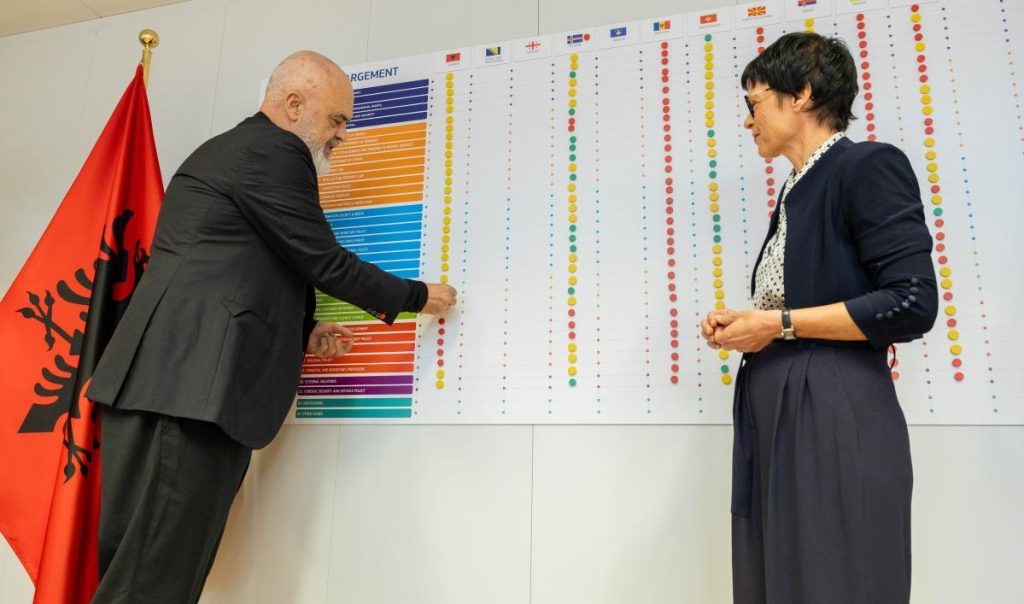
Rama Derangement Syndrome is the conviction that one man is behind everything wrong with Albania, a conviction the Prime Minister has helped feed by casting himself as a marathon runner with 2030 as the finish line. The case for his staying is not that Albania should remain dependent on him for another four years, but that it needs a transition to institutions that work without him. The 2027 package can open the way to an Economic Justice reform and become the first leg of that relay, if institutions that outlast its author carry the bargain forward.
by Keler Marku (Washington, D.C.)
Charles Krauthammer coined Bush Derangement Syndrome in 2003 for the acute onset of paranoia in otherwise normal people in reaction to George W. Bush. The Trump version arrived in 2015 and later became Trump’s label for anyone who opposed him. Both rested on the fear that a fool was running the country. Albania’s version reverses it: “fool” sits low on the list of insults thrown at the Prime Minister. The fear is that he is an evil mastermind and that every tender, tower and traffic jam carries his signature. You can outvote a fool and forgive him his results; a mastermind you can only remove. That helps explain why “resign” was the whole programme on the first day of the student marches and remains non-negotiable. Most of my friends, otherwise normal people, have caught it. They are aghast that I, usually the first to worry about authoritarianism, keep saying he should stay. I should be clearer about what I mean.
Rama has asked for dialogue, and that matters. Yet his first explanation of the unrest also narrowed the terms of that dialogue. He found antifa and foreign mercenaries in a crowd of twenty-year-olds, and within a weekend he had fines and a police register of protesters. The invitation to talk is real; so is his instinct to define the conversation before it begins. These were quick reactions from a man with ministries on fire, a hose turned on the nearest flame. The hose has worked on the small group that did the burning, and the molotovs have thinned to a Saturday habit. It has done less for the larger crowd that watched a kid throw a stone at a ministry and felt represented. This week he called the chorus that justified the violence the most scandalous and shameful thing of the autumn. That, too, misidentifies the problem. Justifying violence is a problem because it can incite more of it. But the public identification with the stone-thrower is also political information the government should not mistake for a foreign plot. The answer is not to excuse the stone, but to give that anger something larger than one man’s resignation to argue about. The 2027 package offered a beginning.
The government’s 2027 package changes both sides of the ledger: what the state spends and who pays for it. On the spending side, the pensioner bonus would double and a monthly benefit for children under five would begin in the summer of 2027. On the tax side, if Parliament approves the measures, the ceiling of the 13 percent wage-tax bracket would rise from 200,000 to 300,000 lek a month, lowering the tax bill for roughly 32,000 salaried workers. A new 30 percent marginal rate would apply to the portion of pay above 700,000 lek. The dividend tax would rise from 8 to 15 percent. Company advances to shareholders that do not represent genuine transactions and instead distribute profits would be taxed as dividends. VAT on fifty-four basic foods would fall from 20 to 6 percent, while the standard rate would rise to 21 percent and roughly 17,500 smaller firms would enter the VAT system. The corporate profit tax would stay at 15 percent after a leaked proposal to raise it was dropped. In plain English, pensioners, families with young children and some middle earners gain. Households may gain further if the food VAT cut reaches shelf prices. Very high wages and distributed profits face higher statutory rates. VAT and excise still do much of the revenue work: 62 percent of the projected increase in 2027 tax receipts is booked under those two taxes, whose burden often falls heavily on consumption.
This is good. It is an appropriate step toward rebalancing who pays what in an economy that has grown faster than expected but whose gains have flowed disproportionately to a few. It is the opening move in an Economic Justice agenda, not its completion. Rama did not call it leftist, and the label obscures more than it explains. It has a practical redistributive core: a limited shift toward households with less, coupled with more consistent taxation of different forms of income. Economic Justice has three parts: fair contribution, fair competition and fair remedy. The package begins with contribution. Its tax measures can tax dividends more consistently; they cannot uncover hidden wages, police price-fixing or give thousands of consumers a practical remedy for small losses. Those are questions of markets and institutions. Social cohesion depends on a practical belief that sacrifice is reciprocal, that the rules will still be there tomorrow and that they apply whether the taxpayer owns a kiosk or a tower. The package can put the first terms of that fair-share bargain on paper. It cannot complete it.
Daron Acemoglu, the Nobel laureate best known for asking why nations fail, devoted much of a long Bloomberg interview last week to both halves of that problem, taxation and the shared values that make it legitimate. He was careful not to prescribe rates. His point was that income should be taxed at source whether it is called capital or labour, because the gap between the two lets an owner relabel a wage as a dividend. Businesses will threaten to leave; most of them, he says, are sticky, and flight becomes harder to defend once a society agrees on what is fair. The warning is procedural as well as fiscal. Rules imposed without consent produce backlash. But consultation is not private pre-clearance, and consent is not a business veto. A proposal should be made public, argued over, revised where the evidence warrants and then enacted.
The business magpies gathered within forty-eight hours: the Tirana Chamber of Commerce, the American Chamber, the producers’ union, the industrialists and others issued eight statements in quick succession. Their screeching was revealing: the package had put pressure on interests accustomed to being heard first. By then the proposal was public, so the chambers were not being denied a voice; they were being denied the privilege of shaping the terms before everyone else saw them. To make advance access the test of consultation is to reproduce the intimacy between big business and government that Rama’s critics otherwise identify as the problem. Some of their arithmetic relied on the leaked 17 percent profit-tax proposal, which the government dropped within a day. Their reaction showed that Rama was asking the right question: why should those who benefited most from the old model not contribute more? The test now is whether the consultation genuinely includes workers, consumers, small firms and civil society as well as big business. Albania has built that kind of public bargain once before.
A person cannot corrupt a system, the Prime Minister said in 2013 and again this May; a system corrupts anyone. The justice reform he helped launch translated that sentence into constitutional amendments drafted with outside help and approved unanimously by all 140 members of Parliament in July 2016. SPAK, the special anti-corruption prosecution established under the reform, now commands more trust than the political parties. The institutions created by the reform have reached his former deputy prime minister, his former intelligence chief, a close associate and his mayor. That history does not prove Rama clean or vindicate every choice. It proves something more useful: an institution becomes credible when it can investigate the governing circle that launched it without asking permission. Its success lies precisely in the distance it created between the author and the institution.
That history is the argument for Rama staying. It shows the one defensible use of his present indispensability: converting personal leverage into institutions that no longer need his permission. The question is whether he can now do for economic power what Justice Reform began to do for prosecution: put distance between political authority and enforcement. I do not see another political actor who currently combines a parliamentary majority, political ownership of the growth model and leverage with the firms and sectors that benefited most from it. The European Union negotiations add an external discipline. That makes Rama, for now, the only plausible convener of this bargain. Those same relationships are why he cannot be its permanent enforcer. His task is to bring the beneficiaries of the old model to the table, bind the bargain into law and hand enforcement to institutions he cannot direct. If he centralises another reform around himself, the relay has not started.
Post-communist Albania emerged with institutions designed neither for an independent rule of law nor a competitive market and has spent three decades building both unevenly. The 2016 Justice Reform strengthened independent prosecution and adjudication. The natural next step is Justice Reform 2.0, and its subject should be Economic Justice. Economic harm is often dispersed rather than embodied in a single bribe or shipment: a wage declared at half the amount actually paid, a sham shareholder loan, a cartel price, a market unlawfully closed to a rival or a contract no consumer can realistically contest. Such cases cross tax, labour, competition and civil law. They require economists, auditors and data as much as prosecutors. The analogy with SPAK is one of institutional design, not jurisdiction. Where conduct is criminal, prosecutors need a protected specialist economic-crime arm, staffed by forensic accountants and able to analyse linked tax, ownership and banking data under judicial safeguards. But Economic Justice cannot rest on one super-agency. Courts and the Competition Authority need decisional independence; tax and labour administrations need professional autonomy, transparent risk rules and reviewable decisions; consumers need collective redress when individual losses are too small to pursue. Justice Reform began making public power answer to law. Economic Justice must make market power answer to rules.
The order of enforcement will decide how the bargain is read. The lower VAT threshold pulls thousands of smaller firms into the system. In 2023 inspections, one worker in five was reported at the minimum wage, not proof of evasion but a warning signal, and some 37,000 taxpayers were later flagged for wage-under-declaration risk. The hose should not turn first on the smallest, easiest targets. The state wrote and enforced new protest fines in a weekend after acknowledging envelope wages for years. That is not an argument for leniency toward violence. It is an argument for equal urgency and sustained capacity, with due process, even when economic investigation takes longer. This is what fair share means in practice: the employee whose tax is withheld automatically should not subsidise the owner whose income is negotiable, and the honest firm should not lose to the firm that pays half the wage in an envelope. That is also the pro-business position, because stable rules are a public good the honest firm cannot buy alone.
The same test applies to European integration. When Rama described the European Commission’s report as the start of the last kilometre, he held the blue folder and treated each chapter opening or closing as a personal achievement. That is not where an indispensable leader should make himself indispensable. Rama has also argued that his departure would disrupt an accession process that he says involves a thousand lawyers and a vast coordination effort. Perhaps he alone can coordinate it. If so, he should explain why a highly technocratic process depends on him personally. If not, the folder should pass to an excellent technocrat such as Adea Pirdeni, or whoever is doing the brunt of that coordination, so that responsibility and credit begin to extend beyond one person. Rama should reserve his political capital for the work in which he may truly be indispensable: bringing competing actors together and using his leverage to deliver substantial institutional reforms.
The student revolt has given him an opportunity to make the argument about the model rather than the man. My bet, and it is a bet, is that an immediate resignation would replace one face while leaving the dependence intact. But staying can no longer mean another four years as the only runner. It must mean a transition: a fair-share bargain, institutions he cannot direct, successors with room to act and a timetable by which the next budget, audit and party contest no longer wait to learn what he wants. Those who would receive the baton must start running now instead of trying to trip the runner carrying it, so that they are ready four years from now. Rama’s final success will come when he has made his own indispensability false. For now, I fear, he is indispensable.
Keler Marku, PhD, is an economist based in Washington, DC.