As NATO’s southeastern flank hardens and Europe’s strategic map shifts, Albania is emerging not as a peripheral state, but as a decisive hinge in the contest over alignment, infrastructure, and regional stability.
by Alban Bici, Publisher
For too long, Albania has been confined to the tired vocabulary of transition — “emerging,” “reforming,” “catching up.” It has been treated as a development file, a corruption index, a Balkan afterthought.
That lens is obsolete. And increasingly, it is dangerous.
Albania now stands at the intersection of converging strategic realities. A NATO ally on the Adriatic. A stabilizing force in a region prone to political theatrics and geopolitical friction. A contributor to Europe’s southern security perimeter at a time when that perimeter is under strain.
Geography has returned as destiny. Albania has chosen its alignment.
The Adriatic is not a quiet sea. It is a hinge — linking Central Europe to the Mediterranean and, eastward, toward the Black Sea. Ports, energy corridors, fiber routes, and transport arteries are not incremental upgrades; they are instruments of statecraft. In a Europe marked by eastern aggression and hybrid pressure, connectivity is not development policy. It is strategic leverage.
Albania’s relevance does not derive from size. It derives from clarity.
Across parts of the Western Balkans, strategic ambiguity is often marketed as pragmatism — hedging between transatlantic anchors and revisionist temptations. Albania has not taken that path. It has locked into NATO. It has aligned decisively with the United States. It has pursued Euro-Atlantic integration without oscillation. In a region where fence-sitting is frequently mistaken for sophistication, consistency carries weight.
This is not a claim of perfection. No democracy earns that indulgence.
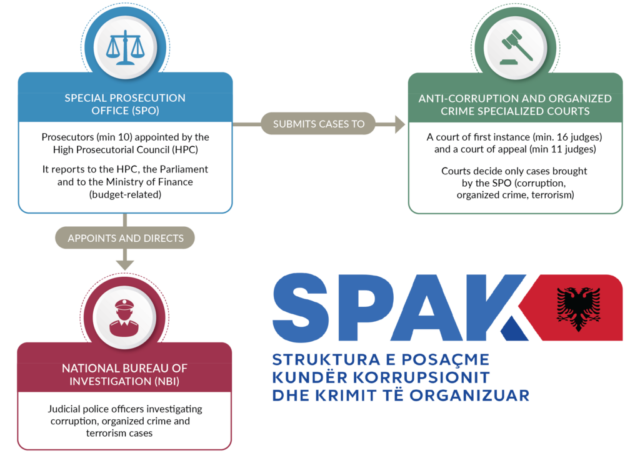
The real test lies within: sustaining institutional rigor without eroding democratic legitimacy. Anti-corruption frameworks must function. Judicial independence must remain credible. But elected mandates and prosecutorial independence must coexist — not collide. Reform that devolves into spectacle weakens the very institutions it claims to fortify. The Western Balkans offer enough examples of what follows when governance becomes performative or weaponized.
Albania has not drifted into that pattern. It has held course. That distinction matters.
For Washington and Brussels, the risk is complacency. The Western Balkans are too often treated as an administratively managed space — governed through benchmarks, compliance reports, and procedural checklists. Necessary tools, but insufficient strategy. The region is contested terrain: militarily, economically, digitally, and informationally. Energy diversification, cyber resilience, migration routes, and the stability of Kosovo are not isolated concerns. They form an interlocking security architecture on NATO’s southeastern flank.
Recent developments underscore this reality. Corridor VIII — the Adriatic-to-Black Sea artery anchored in Albanian ports — has been designated NATO-critical military infrastructure, integrated into Alliance planning for mobility and resilience. The subsequent Tirana Joint Declaration, signed by Albania alongside regional partners, explicitly framed the corridor as essential to EU-NATO coordination: enhancing logistics, protecting critical infrastructure, and strengthening Europe’s southeastern defense posture. Connectivity has moved from aspiration to doctrine.
To describe Albania as peripheral in this context is to misread the strategic map.
Albania is not a project to be supervised indefinitely. It is a frontline state whose decisions reverberate — shaping Adriatic-Black Sea connectivity, reinforcing NATO’s southern flank, and anchoring stability in a fragile neighborhood.
The Tirana Examiner exists to examine this reality without sentiment and without illusion. We will not flatter power. We will not indulge reflexive opposition. We will not reduce complex alignments to personalities or tribal scorecards. Our focus is alignment, institutions, and strategic consequence — analyzed with rigor and addressed to an international audience.
Alignment, not ambiguity, is the defining currency of small states in an era of fractured power. Albania has made its choice.
The question now is whether the transatlantic community fully understands what that choice entails.
This is not a footnote.
It is a frontline test of strategic seriousness.