by the Editors (Tirana)
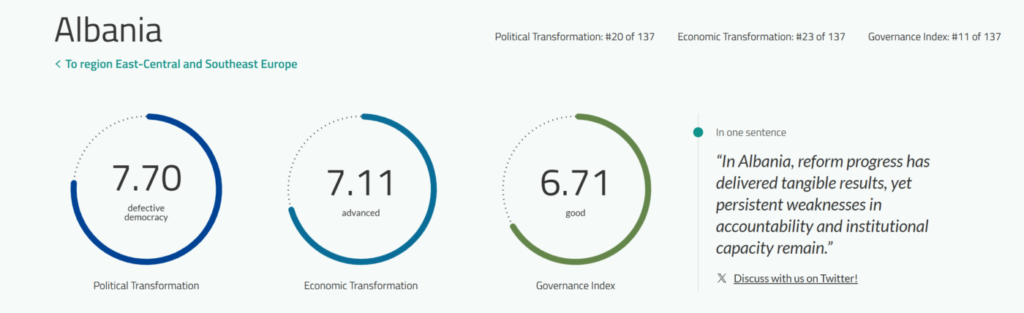
Albania is the best-performing democracy in a region where democracy is failing.
That is not a political claim. It is the conclusion of the 2026 Transformation Index of the Bertelsmann Stiftung. In a comparative field that includes Serbia, now classified as a “moderate autocracy,” and a set of systems described as “defective” or “highly defective” democracies, Albania ranks first in political transformation and governance.
It is, by the numbers, the most functional state in the Western Balkans.
It is also, by the same measure, a defective democracy.
The contradiction is not incidental. It is the story.
Across the region, states fail in different ways. In Bosnia and Herzegovina, governance is constrained by a constitutional design that fragments authority before it can act. In Kosovo, political energy is consumed by recurring crises and an unresolved conflict that keeps the state in a reactive posture. In Serbia, the system functions precisely because it no longer disperses power: institutions exist, but they no longer limit the executive that dominates them. North Macedonia and Montenegro remain formally democratic, but their reform trajectories oscillate—advanced one year, stalled the next, contingent on fragile political alignments.
Albania does not oscillate.
It executes.
Over the past decade, Albania has undertaken a judicial overhaul unmatched in the region. Judges and prosecutors have been vetted out of the system. Specialized anti-corruption structures have been empowered to investigate at levels that were once politically untouchable. Cases are opened. Files move. Outcomes, even when incomplete, are produced with a consistency that other Western Balkan systems have not sustained.
This is what the rankings capture.
They capture a state that still has the capacity to act on itself.
But capacity is not the same as autonomy.
The same report that places Albania at the top of the regional table describes a system still marked by internal fractures: inconsistent rulings in high-profile cases, stagnation in key investigations, insufficient accountability within the judiciary, and the leakage of sensitive information into political and media channels. These are not anomalies. They are signals.
They point to a structure in which reform is real, but not fully insulated.
The distinction matters because Albania’s transformation is not occurring in a neutral institutional environment. It is occurring within a system of concentrated political power.
This is the difference that defines the region.
In Serbia, centralized power suppresses accountability. In Bosnia and Herzegovina, fragmented power prevents it. In Kosovo, power is repeatedly redirected by crisis. In North Macedonia and Montenegro, power shifts often enough to interrupt reform before it consolidates.
In Albania, power drives reform.
In Serbia, power stabilizes control; in Albania, it destabilizes the system that produced it.
That is the advantage.
It is also the design.
A system that produces reform through concentrated authority can move faster than one that disperses it. It can restructure institutions, align policy, and deliver outcomes with a coherence that fragmented systems cannot match. This is why Albania leads. It is why negotiations with the European Union advance. It is why, in comparative assessments, Albania appears as the most credible candidate in a region where credibility is scarce.
But a system that depends on concentration to produce reform must eventually confront a harder question: whether the reforms it creates can survive without it.
That question remains open.
Europe has, for now, chosen not to resolve it.
Enlargement policy has always been pragmatic. It rewards direction as much as destination. In a region where one country is an autocracy, another structurally immobilized, and others politically unstable, Albania’s ability to act—to legislate, to investigate, to align—meets the threshold that matters most.
Functionality.
It is a low threshold.
It is also the one that defines the current stage of enlargement.
This is what the Western Balkans has become: not a region divided between democracies and non-democracies, but a hierarchy of systems that fail in different ways.
At one end are those that cannot govern. At the other are those that govern without constraint. In between are systems that oscillate, advancing and retreating without settling.
At the top of that hierarchy stands Albania.
Not because it has resolved the tension between power and accountability.
But because it has found a way to operate within it.
That is its achievement.
It is also its limit.
Albania is the closest thing the Western Balkans has to a functioning democracy—and the clearest indication of how far the region still is from becoming one.