Albanian Landings in Italy in the Early 1990s. Life Stories
21.03.26
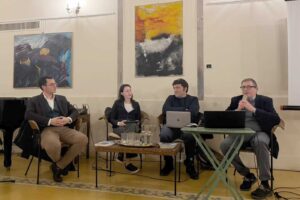
The volume by Mario Calivà was presented at Villa Ardizzone. Vincenzo Asero and Hajdi Xhixha joined the author in discussion.
by Carmela Finocchiaro and Carlotta La Terra
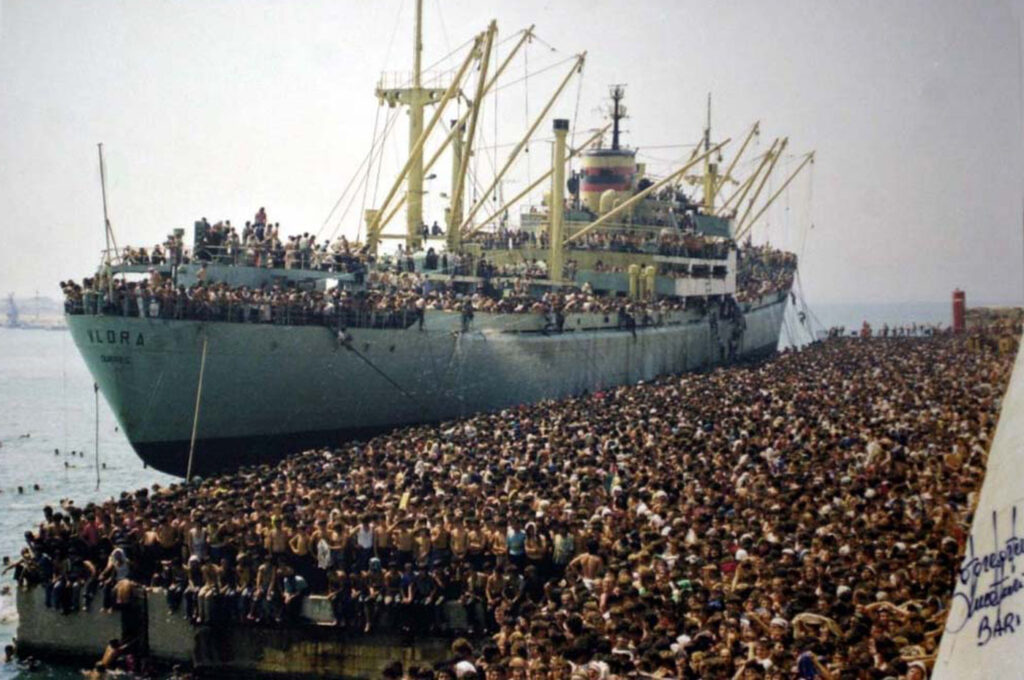
Thirty-five years after the arrival of the ship Vlora and the first great waves of Albanian migration to Italy, Villa Ardizzone hosted an event of profound symbolic weight: the presentation of the book Memory, Migration and Freedom: The Albanian Landings in Italy in the Early 1990s by Mario Calivà.
The book — published by Besa Muci (2024) — brings together 21 firsthand testimonies of the Albanian exodus of 8 August 1991, when 20,000 Albanians disembarked at Bari in search of a better life. The volume retraces the dramatic crossings of the Adriatic, weaving together hopes and lived experiences of those who fled the post-communist regime — journeys often described through the metaphor of the “ships of hope.”
Joining the author were professors Hajdi Xhixha of UBT–University for Business and Technology in Pristina, Kosovo, and Vincenzo Asero of the University of Catania, with Professor Diana Kastrati participating via video link.
The event was moderated by journalist Luigi Provini, who opened the proceedings: “It is always a pleasure to come together to talk about books, especially when the stories are as significant as those we are addressing today. This is not only about history — it is about real lives, about people who passed through extraordinarily difficult moments and who can now, at last, tell their stories.”
The event grew out of an academic collaboration between Professors Asero and Xhixha, developed through faculty mobility programmes between European universities.
“I must thank the University of Catania,” Professor Asero explained, “because it was precisely through these faculty exchange programmes that this encounter became possible. Last year I had the opportunity to be a guest at the University of Pristina, where I met Professor Hajdi Xhixha.”
It was during that trip that Asero came across Calivà’s book almost by chance. “I was at the airport, waiting for my flight to Tirana, and I stepped into the bookshop looking for books on the country’s history,” he recalled. “Among the various titles, the blue cover of this book caught my eye. I began leafing through it and immediately realised the author was an Arbëreshë.”
That reading opened a window onto lives shaped by one of the most closed and repressive regimes in twentieth-century Europe. “These are direct testimonies,” Asero continued, “spanning the full arc from tragedy to hope, from the deprivation of freedom to the desire for dignity. Running through all these accounts is a profound sense of self-respect and a genuine recognition of the welcome they received.”
Professor Hajdi Xhixha
Professor Hajdi Xhixha offered a personal and generational perspective on those events. “For me, as an Albanian, this book is not merely a historical account — it is a life,” she said. “In the 1990s, many Albanians crossed the Adriatic to reach Italy, carrying with them the hope of freedom. Behind the images we so often see in documentaries, there are no statistics — there are people, and there are stories.”
Hajdi also recalled the symbolic role Italy played for Albanians during the years of dictatorship: “I belong to the generation that learned Italian by watching Italian television. For us, it was not simply entertainment — it was a window onto the world, and a cultural and spiritual connection with Italy.”
The book also engages with questions of identity and roots. “These territories,” moderator Luigi Provini observed, “represent a propulsive force for Europe as well. The valorisation of origins and identity can become a resource for building the future.”
Author Mario Calivà, in his remarks, underlined the value of memory: “This is a historical book, but above all it is a book of memory. Nearly thirty-five years have passed since the events it recounts, and I believe these lived experiences must be preserved through storytelling.”
“Albania existed in almost total isolation,” Calivà explained. “Even receiving a guest at home required registration and official authorisation. In many cases, a single ill-chosen phrase was enough to be arrested.”
Italian television played a decisive role in eroding the regime’s propaganda. “When certain antennas managed to pick up Italian channels, many citizens began to doubt the prosperity the state had been proclaiming.”
“One of the emblematic episodes recounted in the book,” Calivà added, “is that of 22 June 1990, when a group of young people broke through the gates of the Italian Embassy in Tirana with a truck to seek asylum. A few days later, on 26 July, 4,813 people departed from the port of Durrës for Italy. Of these, 805 chose to remain, finding shelter at the Restinco camp.”
Alongside the harrowing moments, the book also captures memories of cultural shock during those first arrivals: “Many Albanians,” Calivà recalled with a smile, “had never seen a banana and ate it without peeling it.” On a darker note, he added: “There are also more bitter stories — among them, that of a migrant who was swindled by a fake Italian ‘friend’ who promised to help him and then made off with everything he owned.”
From Emigration to Integration: Stories, Challenges and the Growth of the Albanian Community in Italy
Following the main presentations, the panel elaborated on several of the themes that had emerged during the event.
How has the economic trajectory of the Albanian community in Italy evolved since the arrivals of the 1990s?
“In recent years Albania has made significant progress, both economically and socially. The country is working towards European Union membership, which speaks to the path of development it has undertaken. Central to this process have been its relationships with other countries — Italy among them — which are deeply embedded in the shared history between the two peoples,” said Vincenzo Asero.
“If history is any guide, Albanians have integrated very successfully into Italian society. Many have found employment and opportunity and have woven themselves into the country’s economic and social fabric. Challenges remain — for both Albania and Italy — but the integration has been a meaningful one,” added Hajdi Xhixha.
How were the testimonies gathered, and by what criteria were they selected?
“I used the snowball method, standard in qualitative research,” Mario Calivà explained. “I contacted one person, who then connected me with others, and so on — gathering the most significant accounts in that way. The interviewee is a qualified witness, an expert in their own personal history.”
“Some of the accounts also reveal the cultural shock of those first arrivals in Italy — for instance, many Albanians had never seen a banana and ate it without peeling it,” he added. “A friend of mine, having watched television serials on Italia 1, thought a ‘pastor’ was someone who worked in a church. And there is the story of an Albanian man who was conned by a fake Italian ‘brother’ who took everything he had in his camper van, promising to bring him new things the following day.”