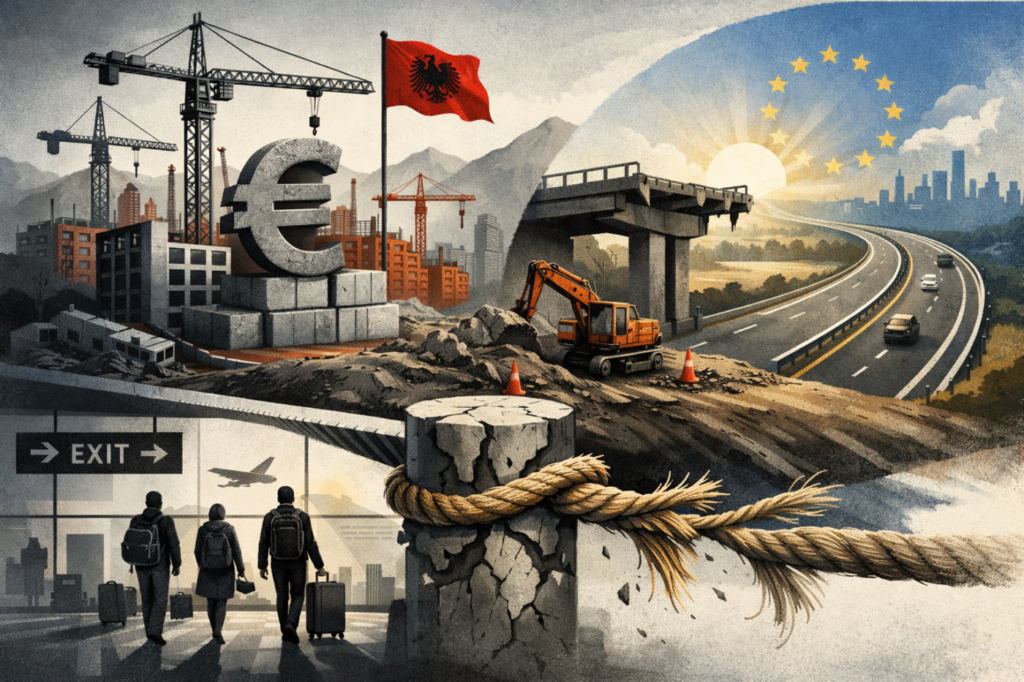
The country spent €10 billion on investment and produced a fiscal model that depends on the people it is losing
by Xhenis Kuçi (Tirana)
In 2025, for the first time in Albania’s post-communist fiscal history, wages overtook consumption as the primary engine of state revenue. Taxes on salaries and labor contributions — once a secondary line — now account for 34.6% of total budget receipts. VAT, long the backbone of Albanian public finances, has slipped to 30.1%. The crossover was not announced. It arrived as an accounting fact: the teacher, the doctor, the engineer now carry more of the state’s weight than the economy they work in.
This shift has multiple drivers — improved formalization of labor contracts, a structural expansion of the services sector, tighter wage reporting under the 2023–2024 administrative reform. But the dominant force is simpler and more precarious: wages were raised by decree. The public sector pay reform pushed salaries up administratively; the private sector followed. The state collected a larger share of a base that expanded by political decision rather than productive output. Seventy-eight percent of last year’s revenue growth — in a year when total receipts rose by just 6.2%, the lowest post-pandemic increase on record — came from taxes on work. The construction boom is maturing. Tourism, despite record arrivals, contributes to the treasury at a fraction of its turnover, a gap the World Bank has attributed to evasion and informality concentrated in short-term rentals and hospitality. Industry and agriculture are contracting.
Economist Oltion Rrumbullaku has described this as a structural break: a system historically sustained by consumption now resting on labor. The World Bank’s 2025 Public Finance Review confirmed the exposure, warning that revenues remain below potential due to wage underreporting, informality, broad exemptions, and enforcement gaps — meaning the labor base itself is partly fictional, a floor whose solidity depends on compliance that has not been fully established.
The mechanism of waste
Since 2014, Albania has spent approximately €10 billion on public capital investment, consistently allocating more than 17% of its budget and approaching 6% of GDP to this line — among the highest ratios in the Western Balkans. The question economists have begun asking openly is what was built, and how the building happened.
The answer to the second question is more illuminating than the first. Between 2015 and 2019, Albania’s legal framework for public-private partnerships included a provision granting unsolicited proposals — bids submitted by private firms at their own initiative rather than in response to competitive tenders — a scoring bonus of up to 10 percentage points in the procurement process. The effect was predictable and documented: tenders effectively pre-selected their winners before they opened. The IMF called for the practice to be eliminated as early as 2018. The EBRD’s Tirana office described the structure bluntly: “The vast majority do not contain any cash flow generation from the project, they are simply an agreement between the government and the construction company.” The European Commission’s 2019 report flagged that most PPP contracts had been selected through unsolicited proposals, generating contingent fiscal liabilities and near-absent competition. By mid-2017, over 200 PPP and concession contracts had been signed, with an estimated value approaching 37% of GDP.
One illustration of how this translated into outcomes is the incinerator program — financed, contracted, and partially paid, yet failing to deliver the core functionality it was designed to provide. It is not an outlier. It is a product of the same procurement architecture.
The result is visible in the cost ledger. Construction of Albania’s Nation’s Route — the highway connecting Tirana to Kosovo — came in at approximately €11 million per kilometre on the Albanian section. The same corridor on the Serbian leg of the regional Peace Highway, financed through the European Investment Bank and EBRD, is being delivered at under €9 million per kilometre, including 88 bridges and 35 tunnels. North Macedonia’s Corridors 8 and 10, contracted through a competitive process, benchmark at roughly €6 million per kilometre. Croatia, a comparable mountain-terrain market, has averaged €6.7 million. Albania, in terrain no more structurally prohibitive, paid nearly double.
Public investment that fails to translate into productivity is not neutral. It adds fiscal exposure while crowding out private capital and delaying the accumulation of growth-generating assets. The gap between what was spent and what functions is not a secondary inefficiency. It is the central constraint on Albania’s growth model.
What the neighbors built
Kosovo, operating on a budget 2.2 times smaller than Albania’s, allocated 26% of its 2025 spending — approximately €930 million — to capital investment and has closed its motorway connections with Albania and North Macedonia. North Macedonia, with a total budget nearly 20% below Albania’s, contracted Bechtel Enka for Corridors 8 and 10 and is in active construction at internationally competitive rates. Serbia, spending roughly 7% of GDP on public investment, is building high-speed rail. These countries face their own governance failures. But the infrastructure exists.
The engine and the exodus
What makes this fiscal model structurally precarious is the nature of the base it now rests on. The people paying for Albanian public finances through their labor taxes are the same people most likely to leave — and at the precise income and skill level where their departure has the largest fiscal consequence.
Albania has lost approximately 40% of its educated workforce to emigration, according to the EBRD’s 2025 Transition Report. Nearly 100,000 Albanians emigrated to the EU in the past two years alone. The Westminster Foundation for Democracy has estimated that each departure of a working-age Albanian costs the economy approximately €14,000 in foregone human capital — implying an annual loss equivalent to roughly 5–6% of GDP.
The pension arithmetic compounds this exposure. Only 46% of the working-age population currently contributes to pensions. By 2060, up to 34% of Albanians could be above retirement age. Pensions already absorb 25% of total budget expenditure — over €2 billion annually. Early childhood education, the one investment that would begin to close this demographic gap from the other end, receives 0.08% of GDP, ten times below the OECD average.
The IMF, in its December 2025 Article IV conclusion, projected positive primary balances through 2030 and described the growth outlook as robust. In the same document, it called for comprehensive productivity reforms and linked SPAK’s operational independence explicitly to macro-fiscal credibility. This is not a contradiction. It is a conditional forecast: a baseline that holds only if the reforms the IMF simultaneously identifies as missing are actually implemented.
The World Bank’s November review reached a starker conclusion: at the current pace, it could take nearly a generation for Albania to reach half the EU average income. That projection assumes a labor base that remains intact, an investment framework that improves, and an accession process that enforces discipline. All three are uncertain.
What is not uncertain is the record of the decade just closed: €10 billion spent, infrastructure priced at twice the regional rate, a fiscal engine now running on the wages of people who are leaving, and no structural decision yet taken that would change any of it.
The model did not drift into this outcome. It was built — and it has not yet been rebuilt.
Xhenis Kuçi is an economist and analyst with a background in accounting and public finance. She contributes to the Tirana Examiner on fiscal policy and public finance.