Albania’s energy system runs on rainfall. The infrastructure pipeline that could change that is years away. In the interval, the vulnerability is structural.
By Besart Ruka (Tirana)
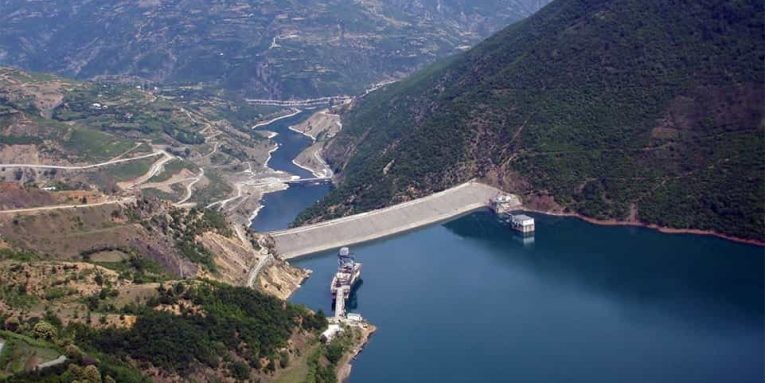
In October 2021, Albania declared a formal energy emergency. Drought had depleted the Drini cascade to the point where Fierza was operating at minimum capacity; the government established a EUR 100 million liquidity fund for the power distribution operator and braced for a prolonged import season. By 2022, as spot prices across Europe spiked on the back of the Russia-Ukraine conflict, the crisis deepened: KESH received a capital injection of EUR 168.1 million to keep domestic tariffs unchanged despite expensive energy imports. OECD The episode was not an aberration. Albania’s three major hydropower plants on the Drini cascade — Fierza, Koman and Vau i Dejës — form the backbone of the system, providing not only the majority of annual energy but almost all dispatchable flexibility. There is no meaningful domestic thermal backup capable of covering prolonged hydrological deficits. Serbia-energy The 2021-22 emergency made that exposure fiscal. It has not been structurally resolved.
In 2025, inflows at Fierza averaged 145 cubic metres per second — 21 per cent below the long-run mean of 183 m³/s. Output from the Drini cascade fell to roughly 3.4 million MWh against a thirty-year historical average of 4.35 million MWh, a shortfall of nearly a quarter. Albania has crossed that threshold — a 20-per-cent-or-greater deficit against long-run averages — in five of the past nine years. What was once called a drought year is increasingly called a year.
The Korporata Elektroenergjetike Shqiptare closed 2025 in better shape than the raw generation numbers suggest. Energy reserves at Fierza rose from 477 GWh at the year’s start to 727 GWh by December, and the reservoir itself ended the year roughly 1.7 metres above its historical level. These are real operational achievements. They do not, however, change the underlying exposure: what makes this exposure increasingly difficult to manage is that hydrological volatility is no longer cyclical in a predictable sense. Climate-driven shifts have altered both the timing and intensity of precipitation. Longer dry spells, followed by short periods of intense rainfall, reduce the system’s ability to refill reservoirs optimally. Serbia-energy Solar generation is expanding, but incrementally; the climate pressure is not.
It is against that backdrop that the Energy Community’s ongoing public consultation — open through 17 April — carries particular weight for Tirana. Of the eight infrastructure projects shortlisted for inclusion on the 2026 Projects of Energy Community Interest list, at least three have direct Albanian implications. A fourth, the east-west corridor linking Kosovo and North Macedonia, bears on Albania’s established role as a regional electricity transit hub. Together, they describe a transition whose logic is precisely calibrated to the vulnerabilities the 2025 data expose.
The most consequential project is the expansion of pumped-storage hydropower at Moglicë, an extension of Statkraft’s Devoll cascade. At up to 1,620 MW of installed capacity and approximately 30 GWh of storage, the facility would function as a large-scale buffer — absorbing surplus renewable generation during periods of low demand and releasing it at peak. The pumping facility would be activated when there is excess electricity in the national system, so that the company can run the water through turbines to make power when needed. The goal is to increase the uptake of solar and wind power plants and improve energy security and grid stability. Balkan Green Energy News The irony embedded in the project’s design is also its argument: Albania’s most promising flexibility asset would be built on the bones of the same hydropower infrastructure whose climate vulnerability drives the need for flexibility in the first place. A pumped-storage facility is not dependent on river inflow in the way a conventional hydropower station is; it operates on the arbitrage between generation surplus and demand peak. That distinction — and the decoupling from hydrology it implies — is what makes Moglicë structurally important rather than merely large.
The second project addresses a different but related constraint. The reconfiguration of the 400 kV grid and the construction of new interconnection infrastructure linking Fierza to the Prizren area in Kosovo would relieve existing congestion on the 220 kV network. The immediate commercial logic is straightforward: easing the bottleneck expands capacity for cross-border energy trading in a corridor where Albania is already a net exporter in favourable years. But the project’s longer-term significance lies in what it unlocks. Planners estimate the new infrastructure would enable integration of more than 1 GW of wind capacity in northeastern Albania — projects in various stages of permitting under the country’s renewable energy auction framework but whose grid access has remained constrained. The Fierza-Prizren link is, in that sense, less a transmission upgrade than a prerequisite for the next generation of Albanian energy investment.
The third project directly affecting Albania is the rehabilitation of the ageing 220 kV line linking Trebinje, Peručica, Podgorica and Vau i Dejës. The corridor spans three countries and carries significant cross-border flows, but does so through equipment that is in places decades past its intended service life. Elevated losses, reduced capacity and reliability concerns along this route limit the efficiency of energy exchange in the Bosnia-Montenegro-Albania triangle. Rehabilitation would reduce losses, increase throughput and improve supply security — outcomes that matter to Albania both as a consumer in stress years and as a transit and export economy in years of surplus.
There is a regulatory dimension to this story that is easy to underestimate. Albania is among six Energy Community contracting parties that have fully transposed REMIT, the EU regulation governing integrity and transparency in energy trading. The Energy Regulatory Authority holds investigation powers covering market manipulation, insider trading and the non-disclosure of price-sensitive information, exercised through a dedicated market monitoring department. Albania’s electricity exchange, ALPEX, is the institutional expression of this framework.
The significance of full transposition sharpens as Albania’s energy role grows more complex. For Albania, which becomes structurally dependent on imports in drought years, any reduction in available import capacity during stress transforms import dependence into price crisis. Serbia-energy The integrity of price formation — the confidence of counterparties that prices reflect supply and demand rather than manipulation — is a material condition for investment. Albania’s regulatory alignment does not eliminate that risk, but it reduces it in ways that foreign capital will notice when the next round of infrastructure financing is structured.
The honest read of Albania’s energy position in early 2026 is one of genuine ambition weighted by genuine exposure. The infrastructure pipeline is serious: Moglicë, the Fierza-Prizren interconnection and the Trebinje-Vau i Dejës rehabilitation are not aspirational entries on a wish list but projects under active Community consultation, moving toward a December 2026 approval decision. The regulatory framework is more coherent than it was. But the projects that most directly address Albania’s structural vulnerability — Moglicë above all — remain years from completion, and the consultation process is only now beginning.
In the interval, Albanian electricity security is a function of what falls from the sky over the Drini basin. The 2021 emergency demonstrated what happens when it does not. That is not a policy failure. It is the state of fact that the coming infrastructure decade is designed, at considerable cost and over considerable time, to change.
Besart Ruka is Executive Director of Bindi Shpk, a Tirana-based consultancy specialising in energy and telecommunications. He holds degrees in business management from Kingston University and Regent’s University London.