Albania’s new Gender Equality Law formally acknowledges the economic value of unpaid care work and advances gender parity in public decision-making — aligning the country more closely with evolving European policy frameworks while testing the state’s capacity for implementation.
by Rexhina Bici (Tirana)
Albania has taken a policy step that many European economies only began to address seriously in the past decade: formally recognizing unpaid care work as part of the country’s economic reality.
Under the new Gender Equality Law, unpaid work and the care economy — including activities such as childcare, eldercare, and household labor — are acknowledged as genuine contributions to the functioning of the economy. The measure marks a conceptual shift in how the state understands labor, productivity, and social policy.
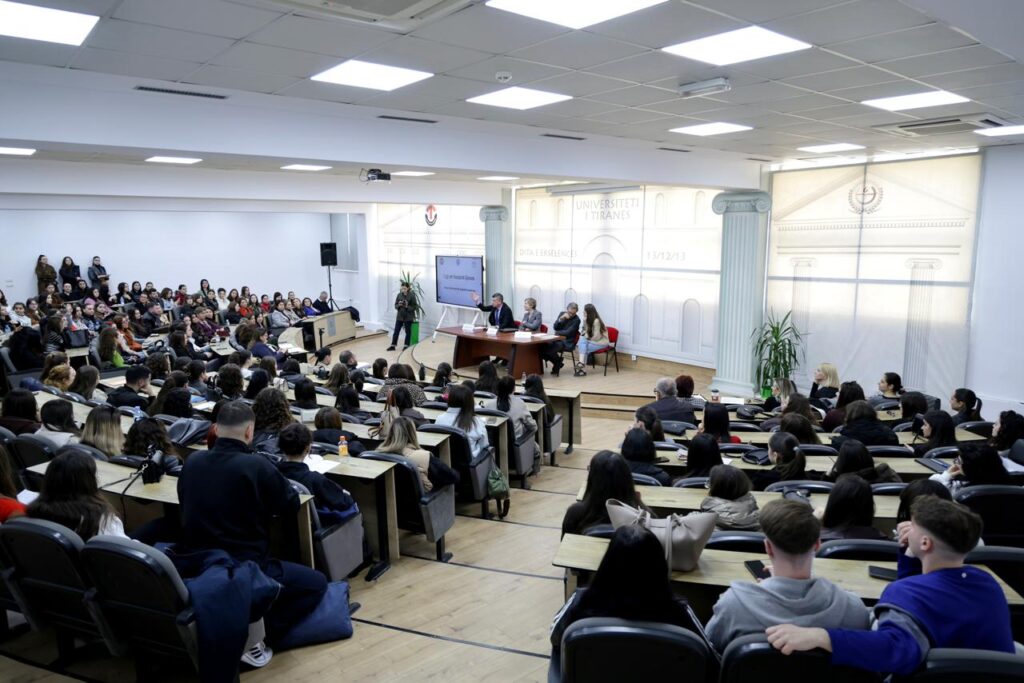
Presenting the reform during a discussion with students and academics at the Faculty of Social Sciences in Tirana, Minister of Health and Social Welfare Evis Sala framed the law as both a modernization of policy and a broader political commitment.
“Equality on paper is not equality in life,” Sala said, arguing that the legislation represents “a political choice to place gender equality at the center of development and democracy.”
The law expands obligations for both public institutions and the private sector, introduces mandatory gender mainstreaming across public policy, and outlines a gradual transition toward balanced representation — 50 percent for each gender — in decision-making structures.
Yet the recognition of unpaid work carries the greatest structural significance.
Making the Care Economy Visible
For decades, economists have pointed out that a large share of socially necessary labor remains outside formal economic measurement. Domestic work, caregiving, and household management — responsibilities that fall disproportionately on women — are rarely reflected in national accounting systems despite their profound impact on labor markets and economic productivity.
Recognition in law does not mean that such work will be directly remunerated. Rather, it establishes the principle that care work constitutes an economic activity whose effects must be considered in policy design, from labor market participation to social protection and family policy.
In Albania, the imbalance is particularly pronounced. As in much of the Western Balkans, women continue to perform a disproportionate share of unpaid domestic labor while participating in the workforce at lower rates than men.
Government officials argue that recognizing the care economy provides a framework for addressing these structural disparities through future reforms.
Albania’s Progress — and Its Gaps
Over the past decade Albania has made measurable progress in gender representation within political institutions. Women currently hold approximately 36 percent of seats in the Albanian Parliament, placing the country above several European democracies in terms of legislative representation.
At the policy level, the government has also introduced gender-responsive budgeting, with roughly 10 percent of the national budget now planned using gender-sensitive analysis.
But structural inequalities remain visible across the economy.
Women’s labor-market participation remains significantly lower than that of men, wage disparities persist in multiple sectors, and caregiving responsibilities continue to limit economic opportunities for many women.
The new legislation attempts to address these imbalances by integrating gender considerations into policy development across government institutions and by encouraging more balanced participation in decision-making.
Following an Emerging European Policy Direction
Albania’s move reflects broader policy debates across Europe and within international institutions.
Over the past decade, organizations such as the OECD, UN Women, and the International Labour Organization have increasingly emphasized the importance of recognizing the “care economy” as a central component of modern economic systems.
Several European countries have adopted policies designed to address the unequal distribution of unpaid care work.
Nordic states such as Sweden and Denmark have long integrated parental-leave policies, childcare systems, and labor-market incentives intended to reduce the economic penalties associated with caregiving responsibilities. Countries including Spain, Germany, and France have expanded family policy frameworks and workplace protections aimed at redistributing care responsibilities more evenly between men and women.
These policies do not eliminate unpaid care work — an inevitable feature of any society — but they aim to ensure that the burden of such labor does not disproportionately restrict one segment of the population from full economic participation.
By incorporating the concept of the care economy into its gender equality framework, Albania aligns itself with this evolving European policy approach.
The EU Integration Dimension
The reform also intersects with Albania’s broader European Union accession process.
During the same event in Tirana, Michele Ribotta, representative of UN Women in Albania, noted that drafting and implementing the Gender Equality Law forms part of Albania’s obligations within the EU integration framework.
“Drafting and implementing the new Gender Equality Law is an obligation stemming from Albania’s European Union integration process,” Ribotta said, adding that the legislation ultimately aims to expand opportunities for women and girls.
Gender equality has become a core component of the European Union’s social policy architecture. Through initiatives such as the EU Gender Equality Strategy and directives on pay transparency, work-life balance, and anti-discrimination, Brussels increasingly expects candidate countries to align their legal frameworks with these standards.
For Albania, this alignment forms part of broader negotiations related to social policy and employment, where convergence with EU norms extends beyond legal adoption to include institutional implementation.
The Implementation Test
As with many governance reforms across the Western Balkans, the success of the new law will ultimately depend less on legislative ambition than on institutional execution.
Minister Sala acknowledged that the next stage will require secondary legislation, stronger institutional mechanisms, and the reorganization of the National Council for Gender Equality.
Implementation — from labor-market policy to social services — will determine whether the recognition of unpaid work translates into meaningful changes in economic participation and opportunity.
In that sense, Albania’s new Gender Equality Law reflects a broader dynamic shaping the country’s reform trajectory: alignment with European norms increasingly depends not only on adopting modern legislation, but on demonstrating the institutional capacity to make those laws function in practice.
About the author
Rexhina Bici is a health policy specialist based in Tirana. She holds a PhD in Health Management from the University for Peace, a United Nations-mandated institution, with research focused on health system governance, institutional reform, and public-policy development. Her work examines health-system modernization, institutional transparency, and the alignment of Albania’s health governance framework with European Union standards.