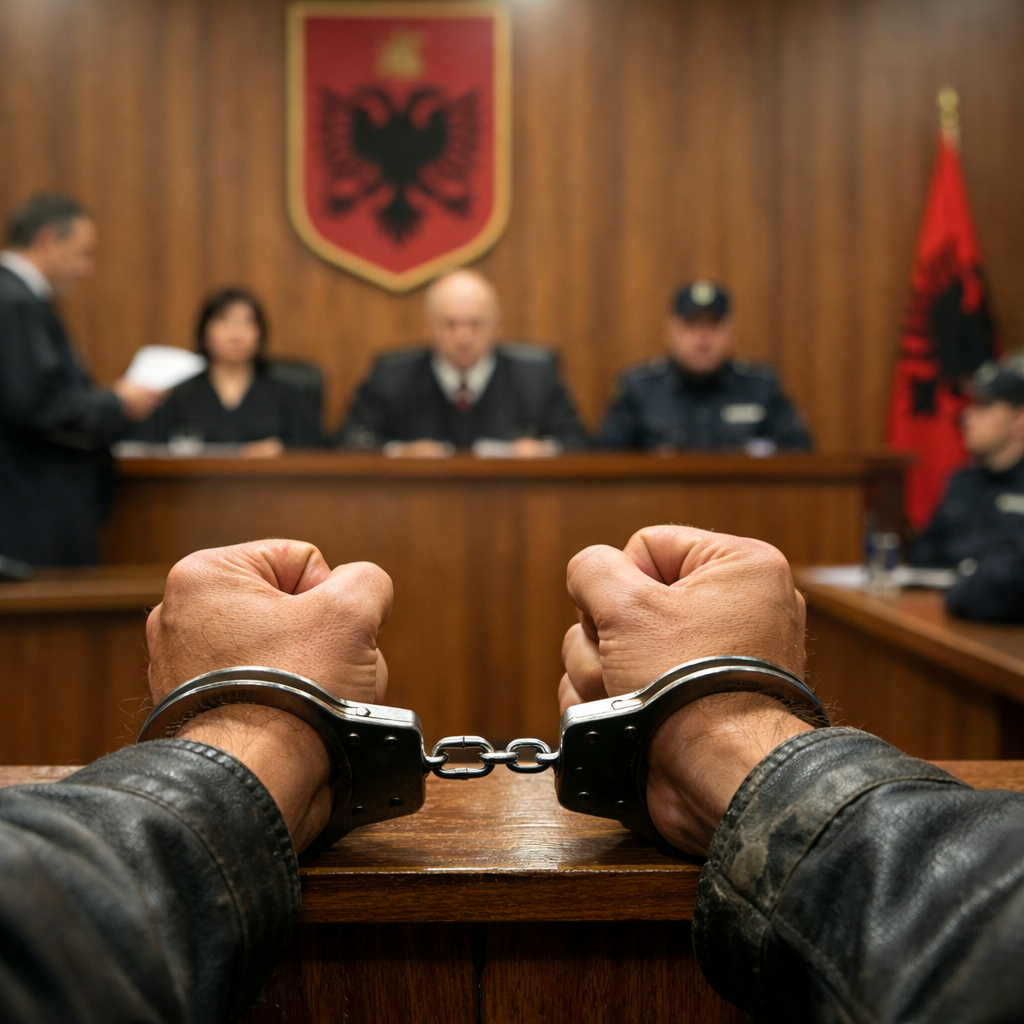
A pending Supreme Court decision could determine whether pre-trial detention remains an exceptional safeguard — or continues to function as a default investigative tool.
By Ylli Manjani (Tirana)
Albania’s Supreme Court has launched a process that deserves careful attention. Its initiative to review judicial practice on pre-trial detention — particularly the frequent use of detention as the first measure of security — touches one of the most sensitive questions in any constitutional democracy: the balance between criminal prosecution and personal liberty.
In principle, the initiative deserves strong support. Few institutional tools are more important for safeguarding equality before the law than consistent judicial interpretation. When courts apply the same legal standards to similar situations, citizens can expect predictability rather than arbitrariness. That is precisely the role the Supreme Court is meant to play.
Several stages of the criminal process directly affect constitutional rights, especially the right to liberty. These moments require clear and unified interpretation. When judicial practice is harmonized, every citizen can expect the same standard of treatment before the law.
For that reason, initiatives that seek to discipline and clarify judicial practice should be welcomed. In many cases, courts are better positioned to correct distortions in practice than legislators. Parliament can amend statutes, but it is the courts that ultimately shape how those statutes function in daily legal life.
Still, caution is necessary. Until the Supreme Court delivers its final decision, the outcome remains uncertain. Judicial clarification can correct a problem — but it can also unintentionally deepen it. Much will depend on how precisely the Court defines the limits of pre-trial detention.
What should already be clear, however, is a principle that current practice sometimes appears to forget: pre-trial detention is neither the first nor the only measure available under the law.
Detention before trial is an extreme measure, designed for extreme circumstances. The logic of criminal procedure is sequential. Less intrusive measures should be considered first, and only when they prove insufficient should detention be imposed. The law does not treat imprisonment as the default tool of investigation.
Equally important is the evidentiary threshold required to justify such a measure. Pre-trial detention cannot be based on assumptions, speculation, or prosecutorial intuition. It must be grounded in evidence. Liberty cannot be removed simply because investigators believe a crime may have occurred; it must be justified by concrete proof that the legal conditions for detention are met.
In practice, this means restricting pre-trial detention primarily to situations such as flagrante delicto, when a suspect is caught committing a crime, or to cases in which prosecutors have assembled substantial evidence supporting a serious criminal charge and the case is effectively ready for trial.
Even in such circumstances, courts should still consider whether alternative measures — bail, reporting obligations, travel restrictions, or other forms of supervision — can adequately protect public safety. The purpose of criminal procedure is not to satisfy prosecutorial anger or the emotional climate surrounding a case. It is to apply the law proportionally and rationally.
One area where clearer limits may be particularly necessary concerns the detention of individuals who are under investigation but have not yet been formally charged. Prolonged detention without indictment weakens the presumption of innocence and places excessive pressure on constitutional guarantees.
A more balanced framework would allow such detention only in narrowly defined circumstances — most notably when a suspect is arrested in flagrante — and for a strictly limited period, perhaps around forty days, giving prosecutors sufficient time to review the facts and formulate charges. Beyond that point, the legal status of the suspect must be clarified. No individual should remain indefinitely imprisoned merely as a subject of investigation.
Another practice that requires stricter limits is arrest in absentia — detention orders issued without the presence or knowledge of the individual concerned. Such measures should be reserved for situations in which a suspect is clearly evading justice or deliberately concealing themselves from authorities. Otherwise, the basic principle of procedural fairness is at risk.
The guiding principle, ultimately, is straightforward: pre-trial detention must remain exceptional.
In a functioning justice system, imprisonment before conviction is justified only under exceptional conditions — when someone is caught committing a crime, when there is compelling evidence of a serious offense that threatens public safety, or when all other measures have demonstrably failed.
If the Supreme Court clarifies these principles decisively, it could correct a long-standing distortion in Albania’s criminal justice practice. Done properly, such a decision would not weaken the fight against crime. On the contrary, it would strengthen its legitimacy — by ensuring that the pursuit of justice never comes at the expense of the constitutional freedoms it is meant to protect.
About the author
Ylli Manjani is an Albanian lawyer and former Minister of Justice (2015–2017). Since his dismissal from government — after which he publicly accused the Rama administration of protecting corruption — he has returned to legal practice and become one of Albania’s most persistent critics of prosecutorial overreach and judicial dysfunction.