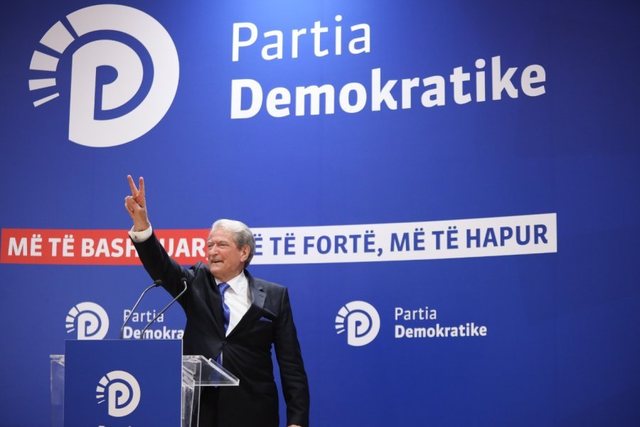
The Democratic Party’s May 23 leadership race is taking shape as a contest over whether the party can renew itself — or whether its rules exist only to protect the incumbent.
by Aurel Cara (Tirana)
The Democratic Party’s internal leadership race hardened into open confrontation this week, as former MP Ervin Salianji declared his candidacy against Sali Berisha despite the party leadership’s insistence that he is not a member and therefore ineligible to run — while a widening circle of critics, from within and without the party, converged on a single diagnosis: that the process is being designed not to produce a result, but to prevent one.
Salianji made his announcement in an interview with Kjo Javë, framing his entry not as a rupture but as a procedural challenge. Before dates were set, he argued, voter rolls should have been published and candidacy conditions established — the standard applied in general elections, where lists are released six months in advance. “PD has not properly defined the process,” he said. The sequence, in his telling, was reversed deliberately.
The leadership’s response came within hours. Flamur Noka, appearing on A2CNN’s Off the Record, was categorical: the first condition for running is party membership, and Salianji does not meet it. The argument was procedurally tidy. It was also self-sealing. Salianji’s non-member status is not a pre-existing condition — it is the leadership’s own retrospective determination, issued after he began organizing parallel meetings and publicly challenging Berisha. The party declared him self-excluded, and now bars him on the basis of that declaration. To invoke the statute against a challenger whose exclusion the leadership itself decreed is not rule enforcement. It is rule fabrication dressed in institutional language. Berisha’s own Article 46 — requiring the chairman to resign after a lost parliamentary election, a provision he authored — has never been applied. The rulebook, it turns out, has a preferred reader.
Salianji was direct about this. “You don’t choose your opponent. The opponent is determined by the support he has. Why should someone with 35 years in politics be afraid of a race?” He was careful to keep the dispute within legal channels — a return to court, he warned, would be “a service to Rama.” His preferred resolution is a race on platforms and ideas, with membership lists made public and no member excluded from voting. Whether the leadership concedes that terrain is the only question that matters before May 23.
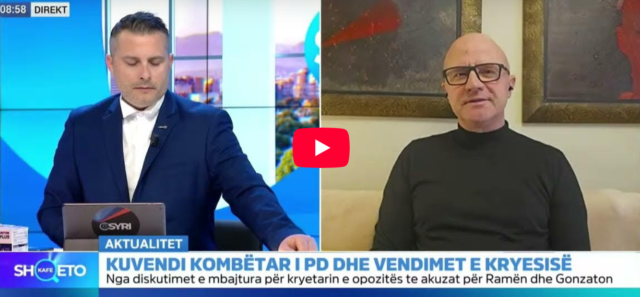
It may not. Ilir Alimehmeti, a member of PD’s National Council, confirmed on Frontline that a commission will be established to manage the race — and acknowledged, without apparent discomfort, that it will apply filters. “Not every level of candidate can run for this kind of post,” he said. Only Berisha has formally declared so far. Alimehmeti added, almost in passing, that he personally holds a pluralist view and that no candidacy should be blocked “by any small artifice” — a qualification that sits uneasily alongside his confirmation that filters will exist. Commentator Mentor Kikia was less delicate about what those filters mean in practice: “The captain says: when I jump in the pool, everyone else must get out, because I will swim alone.” Kikia estimated that Salianji, if allowed to run, could take as much as 35 percent of the vote — which, he suggested, is precisely why he will not be allowed to run. “If Salianji is not allowed to run, the elections will not be elections, and that will produce costs.”
Those costs are not hypothetical. Former senior police official Shemsi Prençi, who has watched Albanian institutions from the inside, framed the succession question in terms the party leadership prefers to avoid. “A good father prepares the conditions for his heir,” he said. “But for the heir not to receive it as a gift, he must ensure a race — to prove who is most capable, not hand it over. Otherwise we’ll say: father died, the family died, society died, Albania died.” Prençi’s verdict on Berisha’s cycle was unambiguous: it is over, and the longer the party delays acknowledging that, the higher the price.
Journalist Reldar Deda placed that endpoint earlier and more precisely. Berisha’s political cycle, he argued, closed in 2013. What has followed is not leadership but incumbency sustained by the absence of a permitted alternative. “A democratic party should not see its opponent as an enemy but as a rival,” Deda said. “The concept of enemy does not represent PD.” The paradox he identified is the sharpest thing said about PD’s condition this week: Berisha is a man whose cycle ended over a decade ago, yet remains the most indispensable figure in Albanian opposition politics — not because of his strength, but because the party has been organized around preventing anyone else from becoming strong enough to replace him.
That organization has a foreign dimension that the leadership has been unable to explain away. For nearly a year, PD invested heavily in lobbying Washington and London to lift Berisha’s non grata designations — and produced nothing. Both the Biden and Trump administrations have maintained the blacklisting, a continuity that dismantles the standard PD argument that the designation was a product of Soros-aligned Democratic pressure. It persists across two administrations with opposing ideological orientations, which points to something more durable than partisan score-settling. A party whose candidate for prime minister cannot enter the United States or the United Kingdom is not carrying an embarrassment. It is carrying a disqualification that any voter weighing June’s parliamentary elections will have to price in.
That disqualification compounds a longer pattern of decline. From 1.2 million votes at its founding to roughly 400,000 today, PD has shed approximately 70 percent of its electorate under Berisha’s leadership. Twenty-one parties have broken from its ranks. The founding statute capped the chairmanship at two terms; that provision was discarded without ceremony. If Berisha wins May 23, he will have led the party for 36 years — and 40 by the mandate’s end, drawing level with Enver Hoxha. The comparison has been made before. At this point it is arithmetic.
The question May 23 will answer is a narrower one than the party’s supporters would like: not whether PD can become a credible alternative to Edi Rama, but whether it can conduct an internal election that its own members recognize as legitimate. A process that excludes the field’s strongest challenger by administrative decree, filters candidacies through a commission with undisclosed criteria, and applies the statute selectively cannot produce that legitimacy — regardless of the margin by which Berisha wins. What it will produce, as Kikia noted, is costs. The party has been paying them for over a decade. May 23 will determine whether it has decided to stop.
Aurel Cara, an engineer by training, is devoted to writing on the policies and events that shape Albania’s EU trajectory.