A party that normalizes Molotov cocktails is not a credible guide to European standards
By Ardit Rada (Tirana)
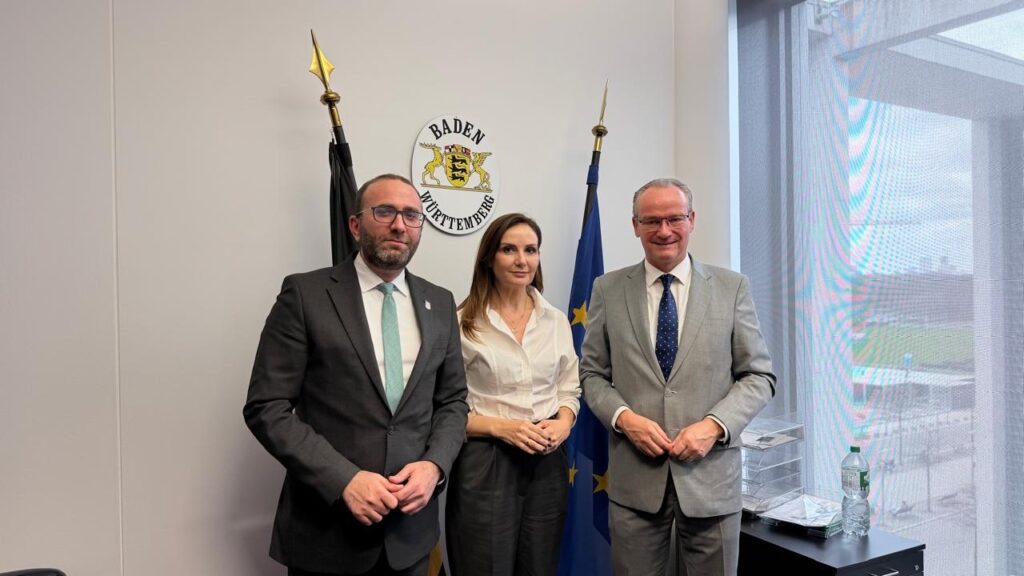
When Washington closed its doors to Sali Berisha — sanctioned by both the United States and the United Kingdom on corruption grounds — the Democratic Party needed a new capital to court. It found one in Berlin. Last week, a senior PD delegation led by parliamentary group chairman Gazment Bardhi worked through an intensive schedule in the German capital: the President of the EU Affairs Committee, the Chairman of the Foreign Affairs Committee, the Foreign Policy Spokesperson, multiple Bundestag members with Albania portfolios, and — at the top of the list — Günther Krichbaum, Minister of State for Europe at the Federal Foreign Office. That last meeting is not a parliamentary courtesy call. Krichbaum is a serving member of the Merz government, the CDU’s principal architect of European affairs policy, and the official most directly responsible for Germany’s position on EU enlargement.
The PD did not lobby the Bundestag. It reached the German executive.
What it brought with it was a selective truth.
An immunity vote is not a verdict
On March 12, Albania’s parliament voted to reject SPAK’s request to lift Deputy Prime Minister Belinda Balluku’s immunity. Berlin reacted within hours. The German Embassy in Tirana warned that effective prosecution of high-level corruption is a condition for progress. Reports followed of pressure within EU working groups over Albania’s IBAR, the gate that must open before any accession chapter can close.
The PD arrived in Berlin carrying that vote as proof of impunity. It was not.
An immunity vote does not stop a case. It does not stop a prosecution. It does not determine guilt. The SPAK file against Balluku continues. Every instrument short of pre-trial detention remains in place. The government did not argue to end the case. It argued that parliament acted within its constitutional role, a position consistent with every European system that still recognizes parliamentary immunity.
What Berlin heard was not false. It was incomplete.
The asymmetry
Here is what was left out.
For years, the Democratic Party has described SPAK as a political instrument of Edi Rama. When the prosecution targets its own leadership, the institution is illegitimate. That is its consistent line.
The Socialist Party has never made that claim. Not when SPAK arrested Tirana’s mayor. Not when a former deputy prime minister fled the country rather than face charges. Not for Balluku. Not for any former minister prosecuted under the same framework. The government has accepted SPAK’s authority even when it cuts into its own ranks. Its position on March 12 was constitutional, not a rejection of the court.
One party treats the justice system as legitimate only when it serves it. The other accepts it even when it hurts.
That is the central fact of Albanian politics. It is also the fact the Berlin meetings were designed to obscure.
What the streets show
The part Berlin chose not to see is visible in the streets.
January 25: stones and Molotov cocktails thrown at police near parliament.
February 10: sixteen officers injured, twenty-two unexploded Molotov cocktails seized.
February 20: two hours of clashes around the legislature, thirty arrests.
March 10: incendiary devices again at the Prime Minister’s Office.
March 22 — today — Molotov cocktails at Socialist Party headquarters, a police vehicle burned, fireworks and flamethrowers deployed near Tirana City Hall and government ministries.
Five protests. Five times.
This is not a fringe the party cannot control. It is a pattern it has normalized. The same leadership calls it a peaceful uprising. The same delegation arrives in Berlin to speak the language of European standards.
No one in those meetings addressed the contradiction.
Krichbaum did not. Laschet did not. Beyer did not. Abraham did not.
A party that arrives with Molotov cocktails in its political repertoire was received at the level of the German government, and the violence did not enter the conversation.
That silence is not incidental. It is a decision.
What Germany is choosing
Germany’s scrutiny of Albania’s rule of law is legitimate. But scrutiny built on selective truth produces selective pressure, and selective pressure rewards the actor that controls the narrative, not the one that sustains the institutions.
Albania’s justice reform has no parallel in the Western Balkans. A judiciary rebuilt through vetting. Independent structures in SPAK and GJKKO. A prosecutorial record that has reached ministers, a deputy prime minister, and the mayor of the capital. No other candidate country has constructed a system like this. The region is watching what Europe does with it.
If the conclusion is that institutional reform carries no weight, that a single parliamentary vote can erase years of structural change, and that a party that normalizes political violence can define the terms of engagement in Berlin, the lesson will travel fast.
Germany is not being misled. It is choosing what not to see.
That choice will shape the outcome.
Ardit Rada is a Tirana-based journalist covering Albanian politics, governance, and institutional developments. His work focuses on the intersection of domestic political dynamics and Albania’s European trajectory.