While other Balkan aspirants are disciplined by the rules of accession, Serbia has learned something more valuable: that the EU now needs Belgrade more than Belgrade needs the EU.
by Elmi Berisha (New York)
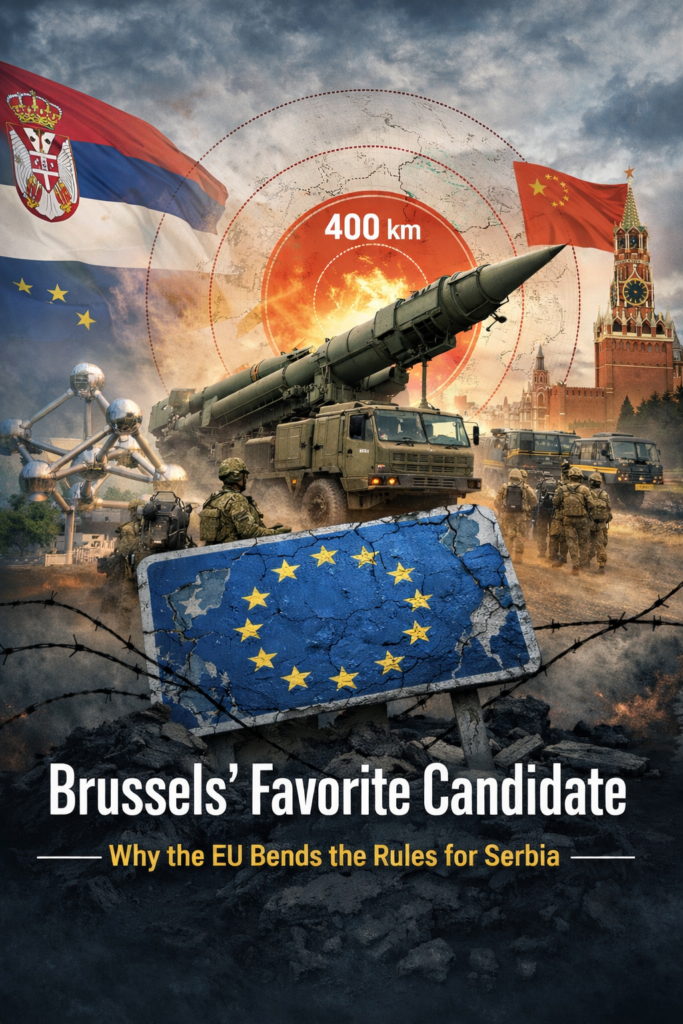
On the evening of March 12, Aleksandar Vučić sat before the cameras of Serbia’s state broadcaster and described, in some detail, his country’s air-to-ground missile arsenal. The weapons weigh up to 950 kilograms. Their range extends to 400 kilometers — enough to reach Budapest, Bucharest, Zagreb, Sarajevo, and Tirana from Serbian territory. As proof of their effectiveness, he cited the recent India-Pakistan exchange, in which Chinese systems of comparable design had, he said, destroyed an S-400 radar installation.
“Chinese weapons proved extremely effective,” the president of a European Union candidate country told his nation, in prime time, on a Thursday evening.
The broadcaster carrying this announcement is the same one whose editorial subordination to the Serbian executive branch Brussels’s own progress reports have documented for years.
Brussels did not say anything.
The European Union’s renewed push for Western Balkans enlargement rests on a logic that its officials now state openly: accession has become a security instrument. Russia’s invasion of Ukraine clarified the map. Serbia’s non-membership appears as a gap. Gaps invite pressure. Enlargement closes them.
The practical consequence of this logic is visible to the government it is meant to attract. Brussels now needs Serbia inside the framework more urgently than Serbia needs to behave as if it wants to enter it. Vučić has priced his conduct accordingly.
Consider the standards imposed on Serbia’s neighbors in exchange for cautious progress. Albania built an independent special prosecutor’s office from scratch. It subjected its entire judiciary to an externally monitored vetting process that removed hundreds of judges and prosecutors. Reform was measured against precise benchmarks. Progress reports read like audits. Chapters moved only when compliance was demonstrated in detail.
Serbia operates under a different rhythm. It has more open accession chapters than Albania. It has nothing resembling SPAK. Its judiciary has never faced a comparable vetting process.
The December 2023 elections produced an OSCE/ODIHR report unusually blunt for a European election observation mission: documented media bias, misuse of state resources, pressure on voters. The report generated concern. It produced no meaningful consequences in the accession process.
In late 2024 a railway canopy collapsed in Novi Sad, killing fifteen people. The disaster raised immediate questions about procurement oversight and political responsibility — the kind of systemic governance failure that, under a strict application of Chapter 23 standards, would normally trigger significant scrutiny from Brussels. Instead it triggered protests inside Serbia.
Brussels did not move.
What made Thursday’s broadcast striking was not any single statement but the sequence. A president who describes Albania, Kosovo, and Croatia as participants in a hostile military alliance. Who publicly announces a missile capability whose range he himself frames in relation to those neighbors. Who pledges to maintain good relations with Russia while simultaneously promising improved relations with the United States. Who cites Chinese battlefield performance as a benchmark for military procurement.
And who does all of this while speaking comfortably about Serbia’s European future.
No other candidate government behaves this way. Not Tirana, not Skopje, not Podgorica. None describes neighboring states as existential military threats on national television. None advertises weapons systems whose range covers large portions of EU territory as domestic reassurance.
The asymmetry is structural. The accession process was designed for governments that want membership badly enough to discipline themselves in pursuit of it. It is less well equipped to deal with a government that treats the process as a resource — a source of international legitimacy that can be drawn on while the underlying political system remains largely unchanged.
Brussels understands this perfectly well. It has decided that the cost of confronting Serbia directly exceeds the cost of not confronting it.
This calculation has a long historical pedigree. During the Cold War, Western governments routinely accommodated authoritarian allies whose strategic position outweighed concerns about their internal conduct. The arrangement was always framed as pragmatic and temporary, justified by the demands of a larger geopolitical contest.
What it reliably produced were governments that quickly learned the precise dimensions of their indispensability — and occupied that space with growing confidence.
Brussels is not Washington in 1962, and Serbia is not any of the governments that comparison might summon. But the structure is familiar: a framework of standards applied rigorously to most participants and cautiously to the one whose defection would be most expensive.
Vučić demonstrated that structure on Thursday evening without naming it. He described Chinese missiles, warned of hostile neighbors, affirmed continued friendship with Russia, and did so on a broadcaster whose independence the EU itself has repeatedly questioned. Then he spoke about Serbia’s European future as if nothing in the preceding hour complicated that ambition.
He is not wrong to speak that way. Nothing in Brussels’s recent conduct suggests he should speak differently.
The missiles he described have a range of 400 kilometers. From Belgrade, that circle covers most of the Western Balkans and significant portions of European Union territory. He presented this not as a threat but as reassurance — proof that Serbia can defend itself against the alliance he believes is forming against it.
The country whose president says these things on state television is also the country the European Union now treats as the indispensable anchor of its Balkan enlargement strategy.
These facts are not contradictory. They are the same fact.
And they carry a consequence Brussels rarely states openly: if the Union relaxes its own rules whenever geopolitics demands it, enlargement stops being a process of transformation and becomes a negotiation over leverage. The governments that understand this first are rarely the ones most eager to change.
About the author
Elmi Berisha is a prominent Albanian-American community leader and businessman based in the New York area, best known as the President of the Pan-Albanian Federation of America “Vatra”, the oldest Albanian American organization in the United States, founded in 1912.