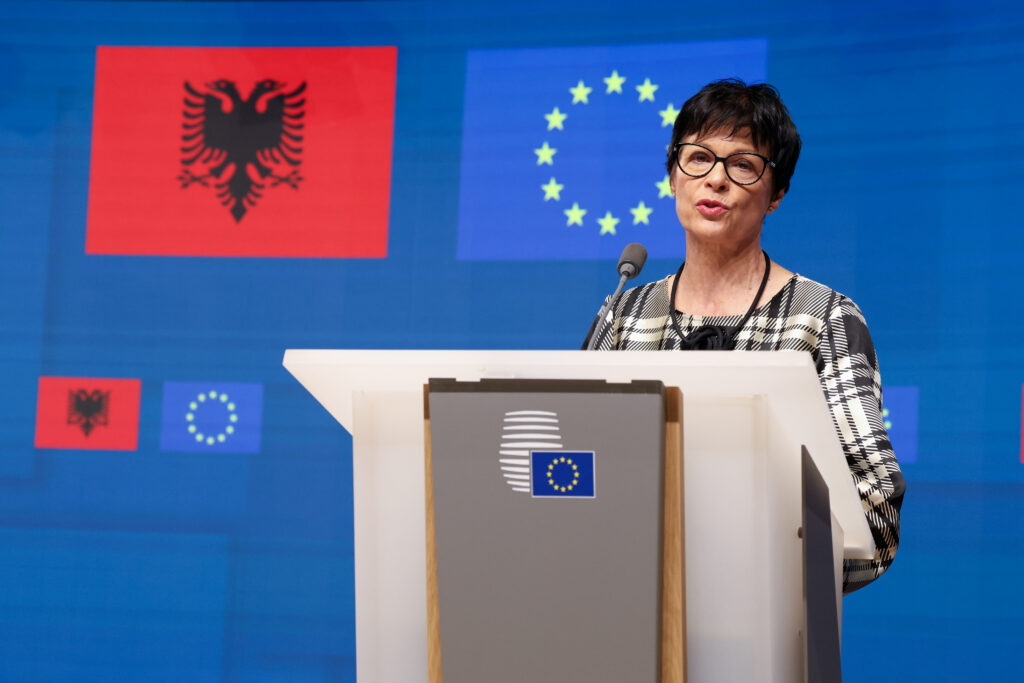
Danijel Apostolovic, Serbia’s EU accession chief, says member state ambassadors welcomed the Rama–Vučić proposal. Marta Kos spoke too soon.
by Ardit Rada (Tirana)
When Marta Kos responded to the joint Frankfurter Allgemeine Zeitung proposal by Edi Rama and Aleksandar Vučić, she was direct. She was not sure, she said, whether the two leaders understood how much they would need to achieve before either country could be part of Schengen.
The implication was clear: the proposal was premature, perhaps naive, and the Commissioner was there to restate the distance.
That response is now being contested from within the EU’s own system.
Danijel Apostolovic, Serbia’s Ambassador to the EU and head of its Operational Team for EU Accession, said this week that Kos’s statement was inappropriate and reflected a personal view, not an institutional position. The distinction matters. It is the difference between a Commission line and a Commission voice.
Apostolovic is not dismissing conditionality. He is reframing sequence.
Nothing prevents candidate countries from beginning to meet Schengen conditions now, during a process whose endpoint remains politically indeterminate. Phased integration into the single market and Schengen, he argues, would benefit the Union as much as the candidates. More importantly, it would align incentives with outcomes.
He adds something more consequential. In conversations with EU member state ambassadors in Brussels, the proposal did not meet resistance. It met interest.
This is not commentary from the margins. Apostolovic runs the operational structure Serbia created to accelerate accession. When he reports receptivity in Brussels, he is describing the room in which the process is managed.
The Rama–Vučić proposal, published in one of Europe’s most influential newspapers, was never a regional appeal. It was a structural critique.
Candidate countries that meet reform benchmarks remain exposed to veto dynamics and domestic politics inside member states that bear no relation to their performance. Edi Rama made the point explicitly. Some member states, he said, cannot make the case for enlargement to their own publics. The consequence is externalized. The candidates wait.
Apostolovic’s account suggests that critique is registering.
He goes further. The concept of “reverse membership,” now circulating in Brussels, would invert the traditional sequence: entry first, rights later. No veto, no commissioner, limited participation — with full rights acquired progressively as integration deepens. Apostolovic supports it for a simple reason. Membership changes incentives in a way candidacy never has.
The record supports the argument. Romania and Bulgaria entered the Union in 2007 without having met all benchmarks. Compliance continued after accession under monitoring mechanisms that lasted more than a decade. Enlargement has never been purely technical. It has always been political, structured around timing, risk tolerance, and strategic need.
The current methodology pretends otherwise.
The Rama–Vučić initiative does not ask to remove conditionality. It asks the Union to acknowledge how it already operates, and to formalize it. Economic integration ahead of full political accession. Reduced exposure to veto blockages unrelated to performance. A sequence that reflects practice rather than doctrine.
The Commission’s Growth Plan already moves in that direction. Gradual integration is no longer theoretical. The question is whether the Union is prepared to extend that logic beyond funding and into structure.
That is where Kos’s response becomes consequential.
Because if Apostolovic is right, the issue is not disagreement. It is misalignment — between the Commission’s public posture and the internal mood among member states.
Kos retains institutional authority. She will visit the region, issue reports, and shape the tempo of negotiations. None of that is in doubt.
What is now in doubt is whether her initial reaction reflected the balance of thinking inside the Union she represents.
Apostolovic says it did not. The ambassadors he spoke to suggest the same.
That gap matters. It is the space in which policy shifts begin.
Rama and Vučić did not misread the moment. They moved into it.
And Brussels, quietly, is listening.
Ardit Rada is a Tirana-based journalist covering Albanian politics, governance, and institutional developments. His work focuses on the intersection of domestic political dynamics and Albania’s European trajectory.