SPAK’s independence is non-negotiable. So is the constitutional standard it must meet.
Editorial Board | Tirana Examiner
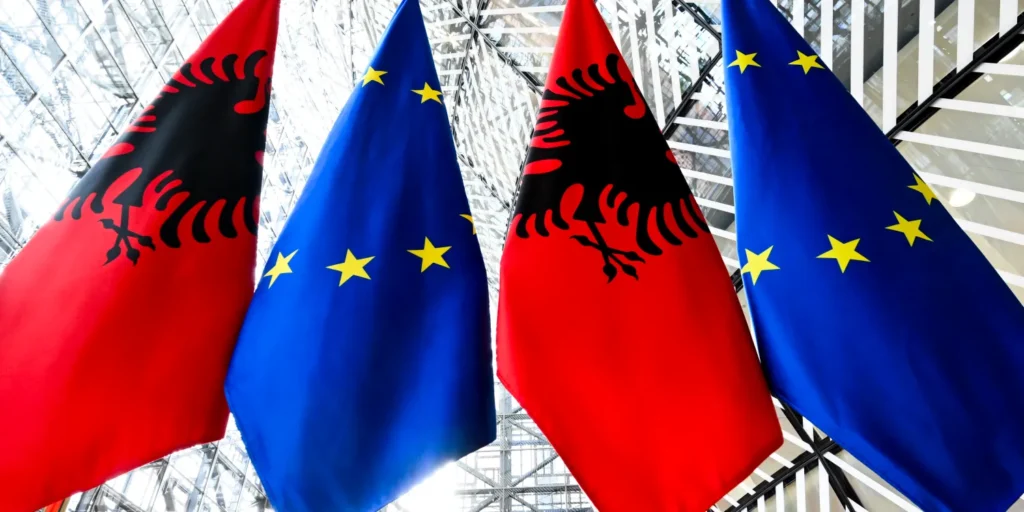
When asked this week about Albania’s parliamentary majority blocking SPAK’s request to arrest MP Belinda Balluku, the European Commission responded with characteristic brevity.
“We do not comment on ongoing cases. It is up to the Parliament of Albania to handle requests for lifting the immunity of its members.”
At first glance, it reads like bureaucratic neutrality. In fact, it signals something more consequential.
For most of the past two decades, Albania’s relationship with Brussels was defined by supervision. Progress reports resembled report cards. Reform benchmarks arrived like assignments. Political crises in Tirana often triggered commentary — and occasionally pressure — from European officials concerned about the country’s democratic trajectory.
The Commission’s response this week is different. It reflects a quiet but meaningful shift in how Albania is treated inside the EU enlargement framework: less as a supervised candidate, more as a state expected to manage its own institutional responsibilities.
That assumption was not granted automatically. It was earned — through years of judicial reform, the creation of SPAK, and the slow consolidation of institutions meant to demonstrate that the rule of law in Albania could operate without external guardians.
Which is precisely why neither SPAK nor the majority is well-served by treating this as a test of whose side history is on.
SPAK’s independence is not in question here. This editorial board has defended it consistently, and we do so again. An anti-corruption prosecution structure that bends to political pressure is no prosecution structure at all. Albania’s reform credibility depends on SPAK remaining exactly what it was designed to be.
But independence is not the same as infallibility. And institutional strength is not measured only by what prosecutors demand — it is measured equally by whether those demands meet the constitutional threshold required to justify them.
The Special Prosecution has alleged that Belinda Balluku used individuals with criminal profiles to threaten witnesses and attempt to destroy evidence. That is a serious allegation. It deserves to be taken seriously. It also deserves to be proven to the standard that pre-trial detention of a sitting member of parliament requires — a standard that exists not to protect the powerful, but to protect the integrity of the process itself.
Parliament’s role in immunity decisions is not a loophole. It is a constitutional mechanism — one that places a deliberate check on prosecutorial power precisely because unchecked prosecutorial power is its own category of institutional risk. The majority exercising that scrutiny is not inherently obstruction. It becomes obstruction only when the scrutiny is pretextual — and that remains to be seen.
Thursday’s vote will be interpreted in Brussels regardless of how it goes. But the interpretation that should concern Albania’s institutions most is not the external one. It is whether prosecutors are making cases that hold, and whether parliament is applying a constitutional standard rather than a political one. That is the only scorecard that matters.
The Commission’s restraint this week is an act of institutional respect. Brussels is treating Albania as a country capable of managing its own constitutional balance without external arbitration.
That is the privilege of being taken seriously. It comes with an obligation that runs in both directions — toward SPAK, and toward the parliament that scrutinises it.