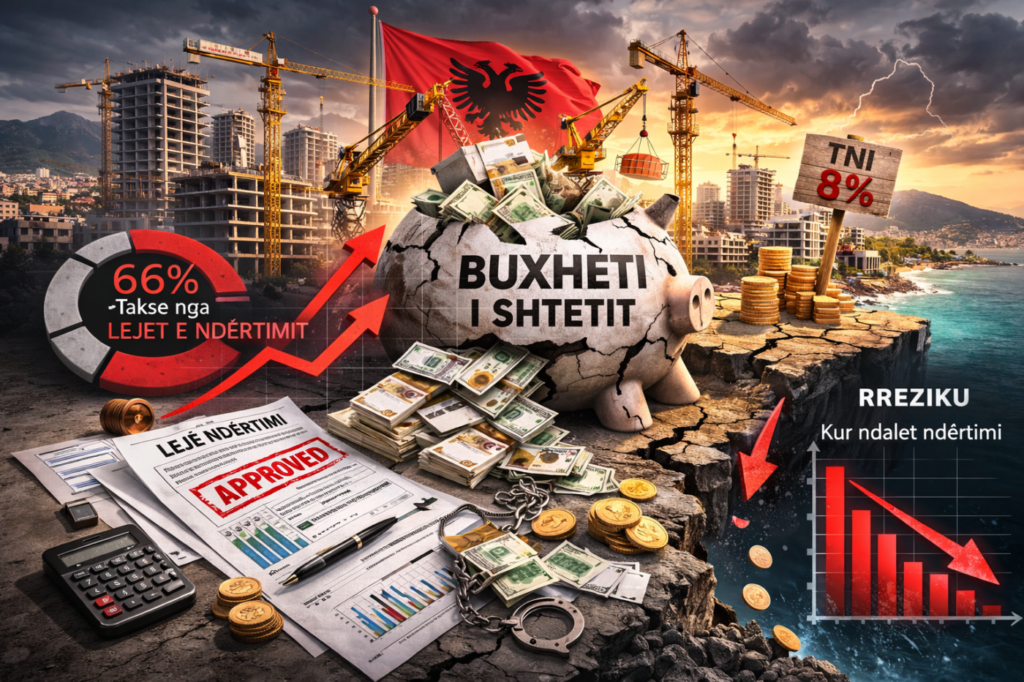
Albania’s public finances look stronger than they have in years. The guaranteed debt is falling. The tax receipts are surging. What the numbers don’t say is that both trends trace back to the same thing: concrete being poured on land that can only be permitted once.
by Redion Karriqi (Tirana)
In the first two months of 2026, two lekë in every three of additional revenue entering the Albanian state budget came from a single source: fees paid by developers when construction permits are issued. Not VAT. Not income tax. Not customs. Permit fees.
That figure — buried in Ministry of Finance data that attracted no official comment — is the starting point for understanding something the government has not said aloud: Albania is not financing its budget from economic growth. It is financing it from the act of turning land into concrete — once.
The clean side of the ledger
The same data also shows something that looks, at first, like fiscal progress. State-guaranteed domestic debt fell for the fourth consecutive year in 2025, dropping 39.5 percent to 8.56 billion lekë. The headline is real. The interpretation requires care.
The bulk of the decline traces to a single transaction: loans held by the energy distribution and supply operator, originally borrowed from three domestic commercial banks, refinanced through the EBRD. As of July 2025, a sovereign guarantee of approximately 46 million euros transferred to the EBRD in their favor. Domestic liabilities fell; the balance sheet looked cleaner.
This is accounting, not deleveraging. The debt moved — it did not disappear. Energy sector loans still account for 75 percent of total domestic guaranteed debt after the transfer. The structural concentration survives the refinancing intact. The state is winding down emergency commitments from one era while the next dependency is already embedded in the revenue side of the ledger — quieter, and on the wrong side of the balance sheet to attract scrutiny.
The side that isn’t being counted
The infrastructure impact tax — TNI, levied at eight percent of reference sale price per square meter of permitted construction in Tirana — is the most accurate real-time indicator of construction activity the Albanian fiscal system produces. It is paid at permit issuance and scales directly with volume.
In January and February 2026, it generated 11.2 billion lekë. In the same two months of 2025: 2.586 billion. The fourfold increase is not explained by price inflation alone. It implies a fourfold increase in permitted surface area — against the 1.3 million square meters INSTAT reported for all of 2025, and double the 2.6 million that made 2022 a record year.
The discrepancy has a known structural cause. INSTAT does not include permits issued by the National Territorial Council, the body that now controls approvals for high-rise towers and large tourist developments. The gap between reported and actual construction volumes is not a statistical accident. It is a consequence of institutional design — and it is a design that suited someone.
Drive south from Tirana toward Durrës and Golem, or down the Ionian coast, and the data becomes visible. Cranes on coastline that had none two years ago. Tower foundations on plots that planning maps still show as green. The cranes are the statistic the state does not publish — and the TNI receipts confirm what they are building toward: a volume of construction substantially larger than anything the official record admits.
The structural problem
The infrastructure impact tax is one-time and front-loaded: collected at permit issuance, not over the life of a building or its occupants. When permitting slows — because demand softens, credit tightens, or developable land exhausts itself in any given corridor — revenue falls immediately.
Strip out the construction levy and Albania’s budget growth in early 2026 was not 11.5 percent. It was closer to four. If TNI receipts returned to 2025 levels tomorrow, more than half of current revenue growth would vanish. That is not a stress scenario. That is a return to twelve months ago.
No public institution has modelled this. The Ministry of Finance publishes no scenario analysis of TNI revenue under alternative permitting trajectories. No budget document acknowledges the gap between INSTAT data and KKT flows. The silence is not bureaucratic inertia — construction-led urban expansion has been a deliberate policy choice, and the revenue it generates has made that choice self-financing. Questioning the dependency means questioning the strategy.
The parallel with the energy sector guarantee story is structural. In both cases, a single sector came to dominate a major fiscal category: guaranteed liabilities on one side, revenue growth on the other. The energy sector had an EBRD refinancing available as an exit. There is no equivalent mechanism for a budget that has priced in a construction surge and then watches it slow.
What remains
Albania has not built a financial bubble. It has built a fiscal dependency on an activity that cannot repeat indefinitely. When the permits slow — and they will — the revenue disappears at the same speed it arrived. What remains is a budget calibrated to a moment that has already passed, and a balance sheet that looks cleaner precisely because the risk moved somewhere the budget no longer admits exists.
Redion Karriqi is a Tirana-based analyst focusing on the intersection of infrastructure, economic activity, and public finance. His work examines how sector-level dynamics — particularly in energy and construction — translate into broader fiscal outcomes.