From the lynx-haunted forests of the Albanian Alps to the free-flowing Vjosa River and flamingo-filled Adriatic lagoons, Albania remains one of Europe’s last intact wilderness frontiers—raw, biodiverse, and still largely undiscovered.
by Livia Brunga (Tirana)
At dawn in the Munella mountains of northern Albania, frost clings to beech leaves and the forest holds its breath. A small camera trap, strapped to a trunk with fraying webbing, blinks once and goes still. Weeks later, when conservationists retrieve its memory card, they will find what they have been waiting for: a pale, ghostlike shape moving between the trees. A Balkan lynx. One of perhaps a few dozen left in the world.
You do not come to Albania to see the lynx. You come to know that it is still possible.
In a continent where highways stitch together once-remote valleys and rivers are measured in megawatts, Albania feels like a misplaced fragment of an older Europe. Roughly the size of Maryland, the country contains more than 3,200 species of vascular plants—about a third of Europe’s flora—compressed into a landscape that runs from alpine peaks to Mediterranean lagoons in a matter of hours. Forests cover more than a third of the territory. Brown bears, wolves, and chamois move across mountain corridors that remain largely unbroken.
For travelers accustomed to curated wilderness, Albania is something else: continuous habitat.
The Accursed Mountains
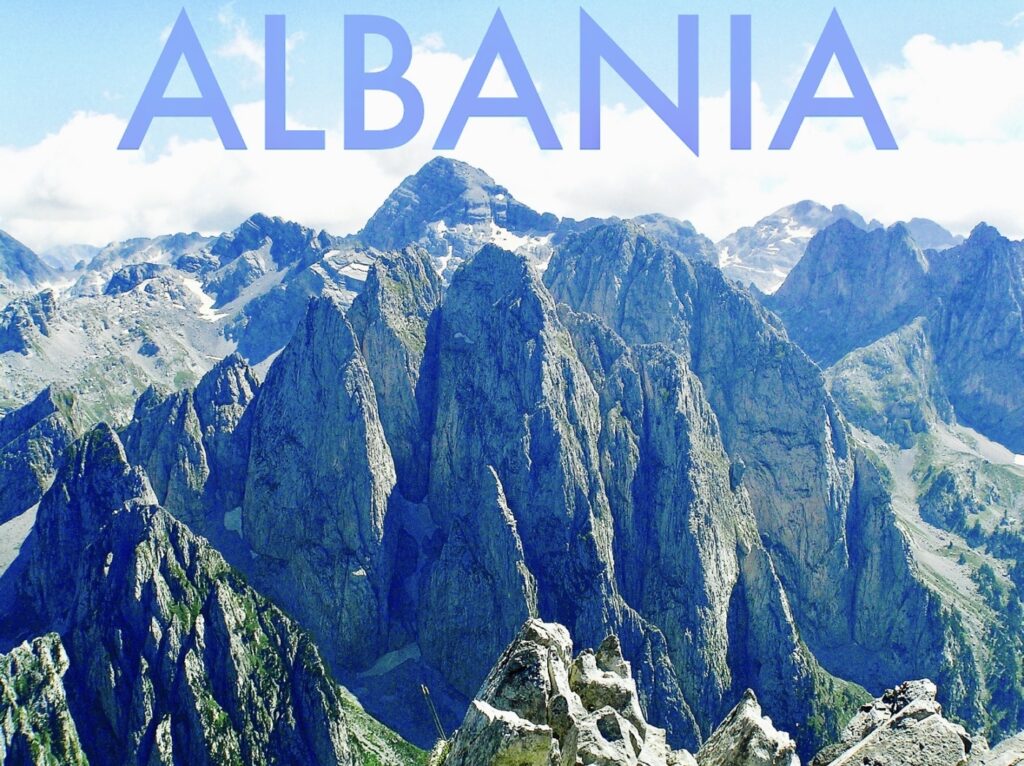
In the Albanian Alps—known locally as the Accursed Mountains—limestone towers rise above glacial valleys carved into improbable geometries. The trail from Valbona to Theth climbs steadily through beech forest before breaking into high pasture. Goatherds still move their flocks across the slopes in summer, bells clanging softly in the thin air.
By midday, the wind shifts. Clouds snag on the ridgelines. The only sound is water slipping through stone.
These mountains form part of the Dinaric Arc, one of Europe’s most important ecological corridors. Here, wolves cross borders without passports. Golden eagles ride thermals above the tree line. And somewhere beyond the next ridge, the lynx continues its patient, solitary patrol.
Conservationists monitoring the subspecies estimate fewer than 50 mature Balkan lynx survive across the western Balkans. Albania holds one of its last viable pockets. Each confirmed photograph is not just evidence of presence—it is a small reprieve.
A River That Still Runs Free
Further south, the Vjosa River cuts a different kind of defiance. Rising in Greece and flowing 167 miles to the Adriatic Sea, the Vjosa remained undammed while much of Europe’s river network was engineered into submission. In 2023, Albania declared it Europe’s first Wild River National Park, protecting not just the channel but the braided floodplains, gravel islands, and tributaries that allow a river to behave like a river.
Standing on its banks in early spring, the water is glacier-blue and numbing to the touch. Otter tracks crease the mud. Overhead, white-tailed eagles circle. Scientists have recorded dozens of fish species here, some endemic to the basin, along with rare insects that depend on shifting sediments.
For years, more than 40 hydropower projects were proposed along the Vjosa and its tributaries. The park designation halted many of them, transforming what could have been another fragmented watershed into a continental precedent.
Europe has few rivers left like this. Albania now holds one.
Where the Continent Pauses
On the western edge of the country, the land flattens into lagoons and salt marsh. At Narta and Karavasta, shallow waters glow under a low Adriatic sun. In winter and spring, flamingos gather in pale pink clusters, sometimes numbering in the thousands. Recently, they have begun nesting—an ecological milestone for a coastline better known for beaches than birdlife.
Albania sits along the Adriatic Flyway, a migratory artery connecting Africa and Europe. Pelicans, herons, marsh harriers, and terns feed and rest here before moving on. The wetlands are restless, seasonal, alive with arrival and departure.
At sunset, the water reflects wings in motion. The horizon disappears into light.
A Country at Decision Point
Albania’s wilderness is not mythic; it is measurable. Protected areas now cover roughly a quarter of the country’s land, and forests still cloak entire mountain ranges. But development pressures are real—coastal expansion, infrastructure, energy demands. The next decade will determine whether Albania becomes another Mediterranean corridor of resorts or a European model of ecological restraint.
For now, the balance holds.
You hike for hours without seeing another traveler. Rivers still change course. Predators still shape the silence of forests. In a Europe increasingly defined by what has been tamed, Albania remains defined by what has not.
At dusk in Munella, the forest darkens into shadow. The camera trap waits. Somewhere beyond the beech trunks, unseen and unbothered, the lynx moves again.
And that is reason enough to come.
About the Author
Livia Brunga is a prominent Albanian media personality and digital creator whose work bridges storytelling, culture, and the natural world. A long-time advocate for sustainable travel and environmental awareness, she explores Albania’s landscapes through a lens that blends curiosity, visual sensibility, and a deep personal connection to nature.