Renada Bici | Tirana Examiner
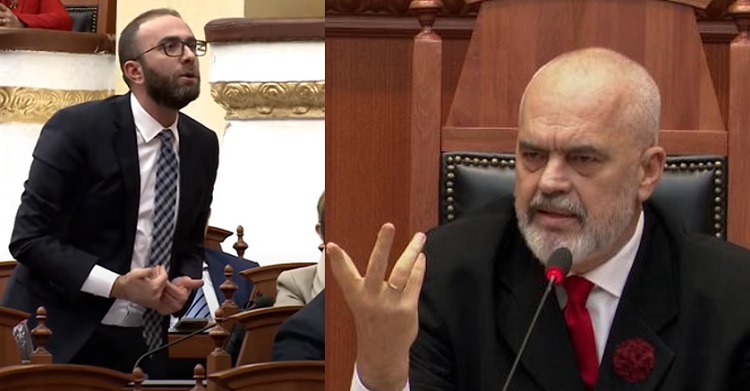
The exchange was quick and telling. Prime Minister Edi Rama, speaking in Tirana’s Unit 12, called the claim that corruption has risen “a great lie” and rejected it with disgust. Gazment Bardhi, leading the Democratic Party’s parliamentary group, responded that the denial itself is the problem, that it shields those responsible, intimidates the justice system, and turns every refusal to acknowledge reality into lost time for Albania.
Bardhi’s response sounds reasonable. It is not an argument.
What he offered was a structure without analysis. The claim that denial deepens a problem is only true if the problem exists in the form being denied. Bardhi never establishes that it does. He says corruption is real and rising. He does not show it. He lists the consequences of denial without demonstrating that the denial is factually wrong. In a political debate, that passes. In any serious accounting of Albanian public life, it does not.
The logic underneath Bardhi’s statement is circular. Rama denies corruption. Bardhi says the denial is evidence of how serious the corruption is. By that construction, no denial could ever be legitimate. The denial itself becomes proof. That is not argument. That is unfalsifiable accusation dressed as political commentary.
Rama’s position is more substantively grounded, though imprecise in its own way. His equation, that economic growth, rising wages, and EU accession progress make the corruption narrative implausible, mistakes correlation for rebuttal. Growth and corruption coexist across many jurisdictions, often in the same sectors, simultaneously. Pointing to GDP figures does not disprove procurement irregularities.
His instinct is politically understandable but analytically weak. Economic growth can coexist with deep governance distortions, particularly in sectors like construction and public procurement. To rely on macroeconomic performance as a proxy for institutional integrity is to avoid the harder question: not whether Albania is growing, but how cleanly that growth is produced.
Rama holds the line that Albania is a story in progress. He has a point. Progress, in this context, does not mean the absence of corruption. It means the gradual construction of a system capable of detecting it, prosecuting it, and making it visible. And that visibility is precisely what is now being misread as escalation.
Start with what Albania built. The Special Anti-Corruption Structure, SPAK, is not a rhetorical reform. It produces results that were structurally impossible before it existed. Prior to its establishment, there were few prosecuted corruption cases at senior levels. Officials operated in a zone of effective immunity because the system did not function as a constraint on them.
That zone has contracted. SPAK has secured convictions against a former Attorney General and a former Interior Minister, confiscated over two hundred million euros in criminal assets, and brought indictments against mayors, ministers, members of parliament, and a former president. Transparency International’s own 2024 regional analysis attributed Albania’s five-point jump in its Corruption Perceptions Index, the largest single-year improvement in the Western Balkans, directly to SPAK’s track record of convictions at the highest levels of public life.
Then there is the judiciary itself. Between 2017 and 2024, Albania’s Independent Qualification Commission vetted 805 judges and prosecutors. More than half were dismissed for unexplained wealth or ties to organized crime, or resigned before scrutiny reached them. This was not a procedural exercise. It was a structural purge of a judiciary that international assessments had long identified as one of the weakest points in the country’s governance. No comparable process exists anywhere else in the Western Balkans, where asset declarations either require judicial consent to be published or are subject to checks by institutions with no capacity to enforce consequences.
Then there is the financial architecture. In October 2023, the Financial Action Task Force removed Albania from its grey list of jurisdictions under increased monitoring. FATF delisting is a technical determination made by an independent international body, not a government self-assessment. Countries do not exit the grey list through political optics. They exit by meeting specific, audited standards. Albania met them.
Then there is the administrative layer. The eAlbania platform now delivers over 1,200 public services digitally, eliminating the face-to-face contact between citizen and official that has historically been the primary vector for petty administrative bribery. The procurement complaints system, operational since 2021, halved both the rate of late decisions and the rate of appeals to court within two years of its introduction. These are not indicators of a system moving toward greater corruption. They are indicators of a system deliberately engineering accountability into its own processes.
None of this is a frictionless story. The vetting of the judiciary created a severe backlog. Average civil case resolution time rose fivefold during the process, and the Supreme Court now carries a caseload that may take over a decade to clear. Reform at this scale produces institutional strain. That strain is real and worth acknowledging. Strain, however, is not corruption, and the disruption of a purge is not evidence that the purge was wrong.
What has increased in Albania is not corruption. It is exposure. A system that conceals corruption appears cleaner than it is. A system that investigates it appears more corrupt than it may actually be. The increase, in such cases, is not in the phenomenon but in its visibility. When more cases enter the public domain, more names enter the news cycle, and more political actors harvest that visibility as evidence of systemic failure, the system appears to be deteriorating precisely because it is functioning.
Bardhi knows this distinction. He chooses not to apply it. Instead, he accumulates visibility as political capital, treating each new indictment not as a sign of a functioning system but as further proof of collapse. The argument is effective. It is also dishonest. And its dishonesty carries a specific cost: every time the opposition frames accountability as evidence of decay, it degrades the political environment in which SPAK operates, contests its legitimacy, and makes its independence more vulnerable to the pressure that has historically protected the powerful in Albania.
Albania today is not a corruption-free system. Nobody serious argues otherwise. The question worth asking, the only question that yields information rather than rhetoric, is whether the state’s capacity to detect, investigate, and prosecute corruption has improved or deteriorated. On that measure, the direction since 2016 is not ambiguous. The architecture is stronger. The threshold of prosecutorial risk for public officials is higher. The international validation is documented across multiple independent bodies.
Bardhi’s accusation, stripped of its moral packaging, is this: the institutions that are producing accountability are themselves proof that accountability does not exist. That is not a political critique. It is a demand for impunity dressed in the language of reform.