When fire and smoke enter the street, protest changes character. Tirana’s unrest now confronts the same threshold long debated in Europe’s capitals.
by Ledio Taci (Tirana)
On Saturday night in central Tirana, the images followed a now-familiar European script: masked figures, a sudden flash of flame, smoke spreading across a city boulevard.
At first glance, the fire appears almost symbolic. But forensic examination suggests something more deliberate.
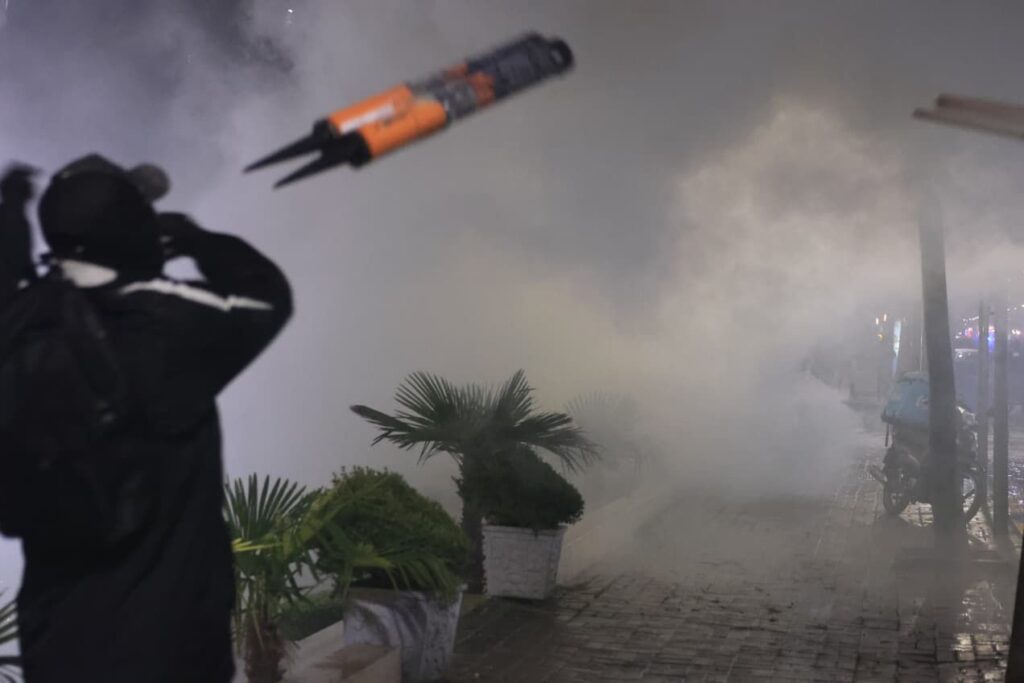
Video material shows two distinct categories of devices deployed during the unrest: Molotov cocktails and cylindrical smoke or gas canisters.
They serve different functions. Together, they alter the character of a protest.
The Molotov Cocktail: Not Symbol, but Weapon
The Molotov cocktail is not improvised theatre. It is an improvised incendiary weapon.
It consists of a glass container filled with flammable liquid and ignited upon impact. The mechanism is simple; the consequences are not. Upon shattering, the fuel disperses and ignites, spreading uncontrolled fire across whatever surface it contacts.
In Germany, such an act would fall under severe arson provisions (Brandstiftung), potentially aggravated if public safety is endangered. French and Greek criminal codes treat similar conduct as violent felony offenses. The legal classification across Europe is consistent: this is weaponized fire.
In Tirana, Molotov cocktails were thrown in a dense urban environment — where parked vehicles, shopfronts, and residential structures sit within meters of each other. The risk extends beyond immediate targets. Fire spreads. Secondary ignition is unpredictable.
The presence of Molotov cocktails alone would have marked a serious escalation.
But they were not alone.
The Second Device: Smoke as Tactical Tool
Alongside incendiary bottles, footage shows cylindrical orange canisters emitting dense white smoke. Their shape and stabilizing features suggest industrial pyrotechnic cartridges — possibly smoke or irritant devices.
Unlike Molotov cocktails, which burn locally, these devices saturate space.
Smoke moves into enclosed areas. It reduces visibility. It induces respiratory distress, particularly among vulnerable individuals. In narrow European city streets, it lingers.
Pyrotechnic smoke cartridges operate at high internal temperatures, often several hundred degrees Celsius. Direct contact can cause burns. If launcher-compatible, they can be propelled at high velocity, turning them into blunt-force projectiles.
International precedent demonstrates that misuse of such devices has led to serious injury and, in some cases, fatality.
Whether commercially sourced or improvised, their deployment in civilian protest settings introduces a second layer of hazard: environmental destabilization.
European Parallels
Berlin has seen Molotov cocktails during May Day clashes. Paris has witnessed incendiary attacks during protest waves. Athens carries the memory of demonstrations where fire crossed the line from confrontation to tragedy.
In each case, once incendiary weapons entered the scene, state response shifted accordingly — from crowd management to criminal investigation.
European democracies make a distinction between civil disobedience and violent escalation. The presence of weapons changes that classification.
Tirana now finds itself confronting the same boundary.
The Political and Legal Threshold
Under Albanian criminal law, the use of incendiary devices that endanger life or property can trigger severe penalties, including aggravated destruction and potential attempted homicide charges depending on circumstances.
Smoke or gas devices, if modified or deployed in a manner that endangers public safety, may fall under additional criminal provisions relating to explosives or public endangerment.
The legal implications are not theoretical. They are structural.
But beyond the courtroom lies a political question: how a democratic state responds when protest tactics begin to resemble tactical weapon deployment.
The combination of Molotov cocktails and smoke munitions is not random. One creates localized fire. The other expands disruption across space. Together, they increase unpredictability in an already volatile environment.
For European observers — especially in Berlin — the issue is not the legitimacy of dissent. It is the normalization of devices designed to burn or saturate urban space.
The images from Tirana do not yet signal collapse. But they do indicate escalation.
And escalation, in European political memory, has a trajectory.