by Klea Ukaj (Michigan, USA)
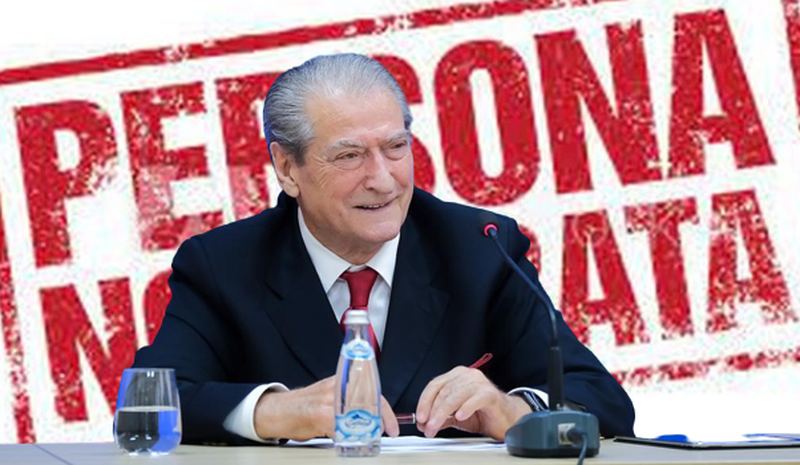
On May 19, 2021, the United States designated Sali Berisha persona non grata under Section 7031(c) of the State Department appropriations act. The charge: significant corruption, misappropriation of public funds, interference with public processes, a sustained pattern of self-protection at the expense of accountability. His wife, his son, and his daughter were designated alongside him. The statement was signed by Antony Blinken. It has never been reversed.
This week, at Harvard’s Institute of Politics, Blinken was asked about it directly. A PD-aligned candidate from Fier, positioned in the audience, framed the question as a provocation. Blinken did not adjust. He said he stands fully behind the sanctions, has no hesitation or doubt, and that the designation speaks to Berisha’s failures, not to any deficiency of the administration that issued it. What Blinken reaffirmed was not a decision. It was a file that remains unchanged.
Tedi Kopliku, who leads the party’s Brain Gain department, told Report TV that Blinken is not America and that the designation carries no legal weight in determining the Albanian opposition’s legitimacy. The party has held some version of this position for five years. It has never been coherent. It is less coherent now than it has ever been. An opposition whose central argument requires dismissing the United States government as an irrelevant actor is not making a political case. It is describing its own isolation.
The jurist Kreshnik Spahiu posed the operative question this week with surgical precision. If the Trump administration is the ally Berisha believed it to be, why has that administration not lifted his designation? In October 2025, Trump’s Treasury Department removed sanctions on Milorad Dodik, the Bosnian Serb leader convicted by his own courts for defying the Dayton accords. It granted visa waivers to figures with comparable or worse international standing. Berisha’s designation, after a six million dollar lobbying contract, after LaCivita and Manafort and Fabrizio were deployed to Tirana, after months of celebratory announcements from within his own party, remains publicly listed on the State Department’s website. The Trump administration’s silence on Berisha is not ambiguity. It is a verdict. A designation that survives two administrations, one of which spent four years dismantling every available Democratic-era precedent, is no longer a political decision. It is a classification.
The lobbying operation confirmed this with particular brutality. Continental Strategy was led by Carlos Trujillo, a Trump ally and former US Ambassador to the Organization of American States, working alongside Alberto Martinez, formerly Marco Rubio’s Senate chief of staff. Operators with direct access. Two hundred and fifty thousand dollars per month. The May 2025 elections came and went. PD dropped from 63 seats to 50, its weakest result in decades. The designation stayed. What the money proved is that influence cannot override institutional findings. It can only demonstrate, at considerable expense, that the findings are real.
The Dodik comparison collapses under examination. Dodik’s measures were Treasury sanctions, financial in nature, lifted after specific political conditions were met in Banja Luka. Berisha’s is a State Department designation covering travel ineligibility, financial restrictions, and political inadmissibility simultaneously. The instruments are not equivalent. More precisely: the designation Berisha carries was initiated under the first Trump administration’s State Department apparatus and formalized under Biden. It has now survived into the second Trump term intact. This is not a Democratic-era grievance awaiting Republican correction. It is a bipartisan American institutional judgment. Blinken this week reaffirmed the file. He did not write it.
The UK reached the same conclusion independently in 2022, citing links to organized crime as a risk to public safety. A court dismissed his appeal after nearly five hundred thousand euros in legal fees. Albania’s Special Anti-Corruption Prosecution charged him in September 2024. The consensus is cumulative, cross-jurisdictional, and has proven impervious to lobbying, litigation, and time.
The deeper question the designation raises is one Albanian political discourse has not yet been willing to confront. When the primary mechanism through which a democratic system disciplines its public officials is external rather than domestic, what remains of the system’s self-governance? The designation works precisely because Albanian institutions did not produce it. That is not an argument against the designation. It is a diagnosis of the condition that made it necessary. A party that cannot name this condition cannot reform around it.
What the designation is not is a diplomatic embarrassment. It is a ceiling. As long as Berisha leads, the party cannot govern. An opposition that cannot govern is not competing for power. It is managing dissent. The German flags at the March 22 rally, the Balluku framing, the street pressure: all of it operates beneath this ceiling. The party mobilizes. The ceiling holds.
Five years of theories, lobbyists, lawyers, and premature celebrations have produced nothing because the designation is not a misunderstanding to be corrected. It is a judgment to be reckoned with, or a structure to be built around. The Democratic Party of Albania has chosen neither. Until it does, the ceiling is not above it. It is what it is.
Klea Ukaj is an Albanian-American writer and civic commentator based in Michigan. Originally from Tirana, Albania, she holds a degree in Banking and is an active member of the Albanian-American community. She writes on Western Balkan and transatlantic affairs.