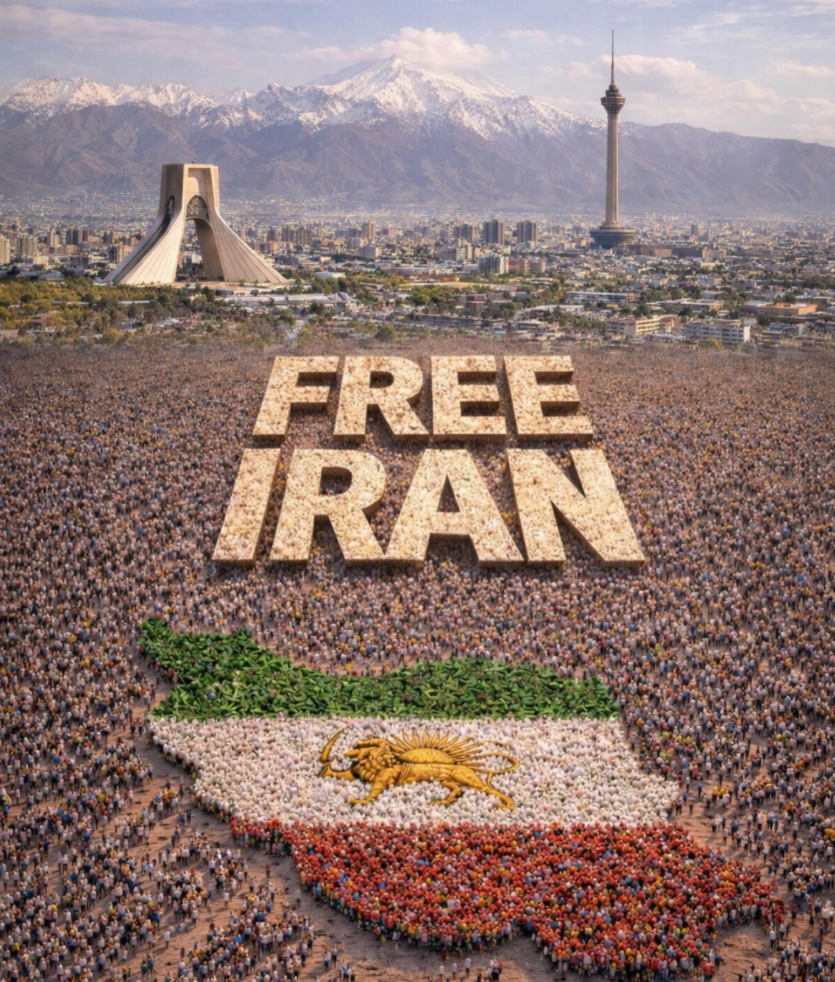
If Iran enters a political transition, two Balkan states have more at stake than most Europeans realize.
by Elmi Berisha (New York)
There is a quiet irony unfolding in global diplomacy.
If the Islamic Republic of Iran fractures—whether through internal succession crisis, institutional collapse, or negotiated transformation—the first structured proposal for stabilizing that transition may not come from Berlin, Paris, or even Washington. It may come from Tirana and Pristina.
That is not romanticism. It is geography, experience, and hard national interest.
Albania and Kosovo are not bystanders to the Iranian question. Both are founding members of the Board of Peace. Both have already confronted Tehran directly—Albania through a state-level cyberattack that led to the severing of diplomatic relations; Kosovo through explicit strategic alignment with the United States as tensions escalated. Neither country can afford to treat Iran as a distant Middle Eastern abstraction.
If Iran changes, Europe changes. And when Europe changes, the Balkans feel it first.
A Balkan Memory of State Collapse
The Western Balkans understand something many larger states prefer to forget: regimes do not fall neatly. They unravel. Institutions do not automatically regenerate. And the morning after political collapse is rarely governed by idealism—it is governed by whoever controls security, money, and narrative.
The Middle East offers recent case studies in what happens when transitions are unmanaged. Iraq after 2003. Libya after 2011. Syria after 2012. In each case, a power vacuum metastasized into factionalism, proxy war, and humanitarian fracture.
Iran is not Iraq. It is not Libya. It possesses a deep bureaucracy, a coherent national identity, a professional middle class, and a sophisticated state apparatus. But it is also a system built around a highly centralized clerical hierarchy and an entrenched Revolutionary Guard network. If that architecture cracks, it will not simply evaporate. It will fragment.
And fragmentation—especially in a nuclear-adjacent state with advanced cyber capabilities—is not a regional event. It is a global shock.
For Albania and Kosovo, that shock would not be theoretical.
Albania’s Iran File Is Not Symbolic
In 2022, Albania severed diplomatic relations with Iran after attributing a major cyberattack against its government infrastructure to Iranian state actors. That decision was not rhetorical; it was a declaration of doctrine. Sovereignty includes digital sovereignty. A small NATO country had publicly confronted a Middle Eastern regime and paid the diplomatic cost.
That episode established two realities:
- Albania is already in Tehran’s strategic field of view.
- Hybrid threats travel faster than geography.
If Iran’s internal structures splinter, cyber arsenals and proxy networks will not disappear. They will disperse. A transition that leaves these tools unmonitored could produce precisely the type of deniable aggression Albania has already experienced.
It is therefore not altruism for Tirana to advocate a structured Iranian transition. It is preventive security.
Kosovo’s Interest Is Precedent
Kosovo’s stake is different but equally sharp.
Kosovo exists in a world where international legitimacy determines survival. It has built its security architecture on alignment with the Atlantic alliance and on institutional recognition over geopolitical improvisation.
If Iran collapses into a negotiation between great powers alone, the message to smaller states will be clear: your fate is negotiable.
Kosovo’s interest is in building a template for transition that prioritizes legitimacy, process, and rules—because that template protects small states everywhere.
For Pristina, the Iranian transition question is ultimately about the structure of the international system itself.
The Board of Peace: A Tool Waiting for Scope
The Board of Peace was conceived as a stabilization instrument—designed to coordinate reconstruction and governance support without deploying combat forces. Its original theater may have been Gaza, but its architecture is broader than its first assignment.
This is where Albania and Kosovo can move from participants to agenda-setters.
The proposition is straightforward:
If Iran enters a political transition, the Board of Peace should offer a No-Boots Transition Compact—a structured, non-military framework to support Iranian sovereignty while preventing regional destabilization.
Not occupation.
Not trusteeship.
Not regime engineering.
Support.
What a Balkan Proposal Should Contain
Albania and Kosovo should jointly introduce five pillars inside the Board of Peace.
1. A No-Boots Transition Compact
Clear principles:
- No foreign combat forces on Iranian soil
- No external executive authority
- No imposed government
- Strict sunset provisions
- Iranian-led legitimacy as a precondition
This addresses the sovereignty question before critics weaponize it.
2. Cyber Containment Architecture
Albania should lead here.
A transition risks cyber fragmentation—state capabilities falling into semi-autonomous hands.
The Board should propose:
- A verified cyber de-escalation channel
- A joint threat-intelligence mechanism
- A protective infrastructure fund for exposed states
- Transparent attribution thresholds to avoid escalation by rumor
For Albania and Kosovo, this is direct self-protection.
3. Financial Forensics and Sanctions Sequencing
Transitions collapse when money disappears.
The Board should establish:
- A forensic finance task force tracking IRGC-linked networks
- A sequenced sanctions-relief framework tied to verifiable reforms
- An audited reconstruction escrow mechanism
This is Balkan realism applied to Middle Eastern volatility: follow the money before it follows you.
4. Nuclear and Strategic Site Security via Verification
Security without occupation.
- Immediate IAEA access guarantees
- International monitoring protocols
- Technical assistance for containment
Europe’s southeastern flank cannot afford nuclear ambiguity during transition.
5. Constitutional and Electoral Support
If Iran moves toward referendum or constituent assembly, the Board can offer:
- Election monitoring.
- Comparative constitutional expertise
- Minority and gender-inclusion benchmarks
Kosovo, as a post-conflict democracy, understands the difference between procedural legitimacy and imposed stability.
Why This Is National Interest—Not Moral Posturing
For Albania and Kosovo, the rationale is concrete:
- Alliance credibility: Founding membership must translate into agenda leadership.
- Deterrence through structure: Institutionalizing transition reduces retaliatory spillover.
- Regional insulation: Preventing Iranian fragmentation protects European stability.
- Small-state leverage: Building rules protects those who rely on them.
Iran may be 3,000 kilometers from Tirana, but cyber packets and energy shocks do not respect distance.
The Strategic Moment
If Iran stabilizes internally, this proposal will remain theoretical.
If Iran enters transition, the world will scramble. Great powers will calculate. Regional actors will hedge. Markets will convulse.
Small states that wait for instruction will be sidelined.
Small states that arrive with architecture will be heard.
Albania and Kosovo have already chosen their side in the larger geopolitical contest. The question now is whether they will choose to shape its institutional future.
The Balkans have known collapse. They have known occupation. They have known externally managed transitions.
They now have an opportunity to propose something better:
Peace as architecture.
Transition without invasion.
Stability without domination.
If the morning after comes in Tehran, Tirana and Pristina should not be watching. They should be presenting.
About the Author
Elmi Berisha is an Albanian-American community leader and businessman based in the New York area. He serves as President of the Pan-Albanian Federation of America “Vatra,” the oldest Albanian-American organization in the United States, founded in 1912. He holds a PhD in National Security Studies and writes on transatlantic security, Balkan geopolitics, and diaspora affairs.