FAZ journalist Michael Martens signals that Berlin sees little political space for rapid or “second-tier” EU integration — and that recognition of Kosovo remains central to Serbia’s path.
by Eris Zenelaj (Tirana)
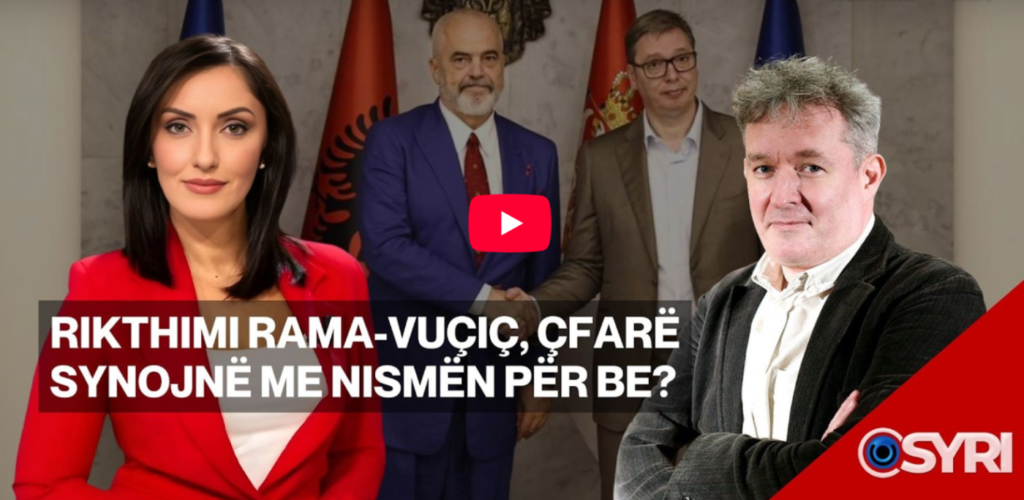
The debate sparked by the joint proposal of Edi Rama and Aleksandar Vučić for phased or “second-tier” integration into the European Union has now drawn a pointed reaction from one of Germany’s most seasoned Balkan observers.
In an interview on SYRI TV, Michael Martens dismissed expectations that Albania or Serbia could bypass enlargement fatigue by gaining early access to Schengen or the EU Single Market.
“The road to the EU is closed since there is no political majority willing to accept new members that would have veto rights,” Martens said.
His assessment directly challenges the political feasibility of the proposal advanced by Rama and Vučić in Frankfurter Allgemeine Zeitung, where they argued for deeper integration into the common market and Schengen area as an interim step.
Berlin’s Political Reality
As Southeast Europe correspondent for Frankfurter Allgemeine Zeitung, Martens writes for one of Germany’s most authoritative national newspapers — a paper closely followed by Berlin’s political class. Though independent from government, FAZ often mirrors the tenor of mainstream German foreign-policy thinking. His skepticism toward rapid or “second-tier” integration therefore carries analytical weight beyond a routine television appearance.
According to Martens, the obstacle is not only technical compliance but political will in core EU capitals.
“You cannot become part of Schengen or the Single Market without fulfilling key conditions such as independence of the judiciary and media freedom. The road to the Single Market is not that easy.”
He added that enlargement currently lacks a governing majority inside the EU, particularly in Germany and France. Even Montenegro, widely regarded as the most advanced Western Balkan candidate, faces limits:
“The only country that could be ready in 2–3 years for the European market is Montenegro. But Montenegro does not want this and seeks full membership.”
The underlying concern in Berlin, Martens suggested, is institutional: expanding the Union’s veto structure without prior internal reform is politically difficult to justify.
Serbia, Kosovo, and the Recognition Barrier
On Serbia’s EU trajectory, Martens was unequivocal:
“Full membership of Serbia in the EU is impossible if it does not recognize Kosovo.”
He was more cautious when asked whether Serbia could theoretically enter the Single Market without formal recognition, noting that the debate remains in its early stages. But he offered a strategic warning:
“By blocking Kosovo, Serbia will block itself.”
The implication aligns with long-standing EU positions: normalization between Belgrade and Pristina remains structurally tied to accession.
Mixed Signals in the Region
Martens also addressed political ambiguity in Tirana’s positioning. He recalled having once compared Rama — partly in jest — to Serbian statesman Nikola Pašić, referencing periods when Albania’s stance during Kosovo-Serbia tensions appeared less than unequivocal.
When asked how a Kosovar citizen might interpret Rama’s cooperation with Vučić on EU reform ideas, Martens replied:
“If I were a Kosovar citizen, I would feel confused because there are some mixed signals.”
At the same time, he acknowledged that differentiated integration is not a new invention of Rama and Vučić but an idea circulating in European policy circles for roughly a decade.
Enlargement Without Illusions
Martens’ intervention does not formally close the door on creative EU accession models. But it reflects a broader mood in Berlin: enlargement is politically constrained; rule-of-law benchmarks remain non-negotiable; and Serbia’s European ceiling remains tied to Kosovo.
For Albania and Serbia, the message is structural — rhetorical innovation cannot substitute institutional reform.
For Kosovo, the message is double-edged: enlargement fatigue affects everyone, but Serbia’s obstruction carries its own strategic cost.
In the current European climate, phased integration may be debated. But as seen from Berlin, the corridor remains narrow — and conditional.