A Serbian state-backed film turns contested allegations into lived experience — a case study in how memory competition is reshaping policymakers’ understanding of Kosovo’s past.
By Albatros Rexhaj (Tirana)
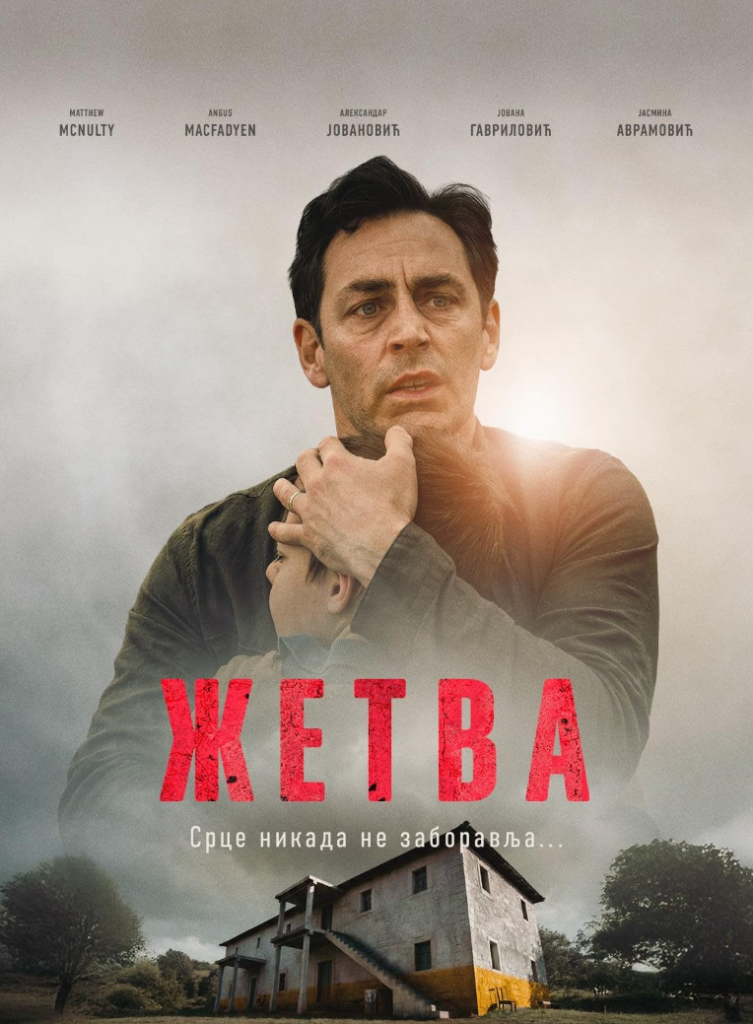
Serbia did not just premiere a film on March 17. It staged a message.
Arno Gujon promoted it personally. Ana Brnabić attended. A companion exhibition — Yellow House: Crime Without Judgment — opened in parallel. Harvest arrives as an American-Serbian-Italian co-production calibrated for international circulation.
Nothing here is accidental. Dates, venue, language, partners — aligned. This is not simply cinema. It is a coordinated narrative intervention.
States no longer compete only over territory or law. They compete over memory — over what is felt to have happened, not what can be proven. Narrative is not decoration. It is infrastructure.
To understand the operation, separate three elements Serbia collapses into one: allegation, investigation, proof.
The allegations are real. The Parliamentary Assembly of the Council of Europe adopted the report by Dick Marty in 2011, documenting claims that elements of the Kosovo Liberation Army operated detention sites in northern Albania after 1999. The “Yellow House” near Burrel entered international vocabulary through that report. Carla Del Ponte had raised similar concerns earlier.
They were serious enough to trigger a dedicated court: the Kosovo Specialist Chambers and its prosecutor.
That is the investigation.
For years, it has operated with full mandate. It has issued indictments. It has pursued high-profile cases, including Hashim Thaçi and others. It has charged murder, persecution, unlawful detention.
It has not charged systematic organ trafficking.
No indictment. No prosecution. No conviction.
That gap is the central fact Harvest removes.
It does not disprove the allegations. It does not resolve them. It locates them where they belong: unproven under sustained international scrutiny.
Harvest replaces that uncertainty with certainty.
In law, uncertainty is resolved.
In politics, it is eliminated.
The timing is not neutral.
Kosovo is navigating its European path. The Brussels dialogue remains unresolved on recognition and the north. The Specialist Chambers operate under constant pressure.
Into this environment, Serbia introduces a film designed for external audiences.
The Serbian Film Center funds it. Gujon’s office amplifies it. International co-production expands reach and credibility. The product is export-ready.
This is not cultural output. It is strategic communication.
Its effectiveness lies in method.
The film does not argue. It immerses.
A German baron receives a transplanted heart and begins experiencing the memories of a murdered Serbian donor. Evidence is bypassed. Distance collapses. The audience does not evaluate; it inhabits.
What is inhabited is no longer a claim. It becomes memory.
This follows a wider pattern. States increasingly use cultural production to stabilize contested narratives. Russia does it through historical cinema. China does it through curated film and television. The medium varies. The objective does not.
Control the story, and you narrow the range of acceptable conclusions.
Attention is limited. Primary documents go unread. Films travel.
The shift does not occur through argument. It occurs through atmosphere — through what feels established.
This is contemporary memory competition.
The humanitarian question remains. The fate of missing persons after 1999 — Serbs and others — is unresolved.
But Harvest is not an attempt to advance that question.
It is an attempt to conclude it.
Not in court. Not through evidence. Through narrative saturation.
The Yellow House is no longer an allegation. It is an event — fixed, visualized, internalized.
What cannot be proven can still be made to feel undeniable.
That is the objective.
And that is the distinction that matters: between a claim that requires proof, and a narrative that produces belief.
Albatros Rexhaj is an author, playwright, and national-security analyst with nearly three decades of experience in political and security affairs. He is a survivor of a Serbian execution squad in July 1998.