High above the Osum River, inside the stone walls of Berat Castle, centuries of faith and color converge in Albania’s most luminous museum.
by Rabiela Myteveli (Berat)
The climb to the Onufri Museum begins in stone.
Inside Kalaja e Beratit, narrow lanes thread between whitewashed houses and medieval walls. Laundry moves in the wind. Cats sleep on warm steps. From the ramparts, the Osum River bends through the valley below, and the mountains hold the horizon in a pale blue line.
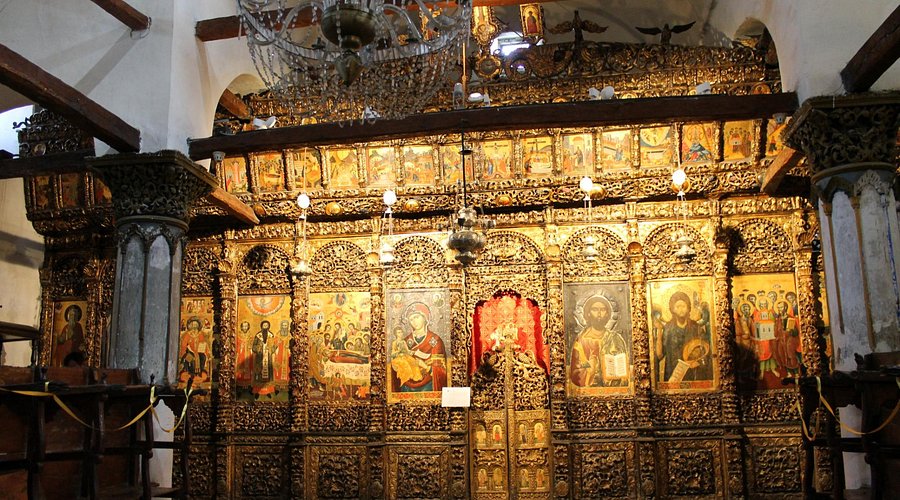
Near the top of the citadel stands a church built of rough-hewn stone — the former Cathedral of the Dormition. It doesn’t announce itself. You enter through a heavy wooden door and step into a room where the light drops and the air cools.
And then the color appears.
The Muzeu Kombëtar Ikonografik “Onufri” is named for Onufri, a master icon painter active in the 1500s, when Albania was part of the Ottoman Empire. His icons are known for a red so saturated it seems to generate its own light. Against gold backgrounds and darkened wood, the pigment burns — not bright like vermilion, but deep, almost earthen, as if pulled from the soil itself.
Stand close and you see more than color. You see faces that feel unexpectedly present. The saints’ eyes are steady. Their expressions are restrained but human. The folds of their robes carry weight. Onufri followed the strict visual language of Orthodox Christianity — the formal poses, the symbolic gestures — yet something in the modeling of the flesh, the shading around the eyes, suggests a painter attentive to lived reality.

He was working at a crossroads: Byzantine inheritance, Ottoman rule, faint echoes of Renaissance naturalism traveling across the Adriatic. In this room, those currents meet quietly.
The museum holds more than 170 works, selected from churches and monasteries across the region. Later masters — including the Zografi and Çetiri workshops of the 18th and 19th centuries — expand the visual vocabulary. Their compositions grow more intricate. Decorative elements flourish. But the core remains: gold leaf, stillness, the disciplined geometry of faith.
Outside, Berat moves at a different rhythm. The city is known as the “city of a thousand windows,” its Ottoman-era houses stacked along the hillside, their dark frames watching the river. It is a place layered with Illyrian, Byzantine, and Ottoman histories — none fully erased by the next.
The museum reflects that layering.
Some of these icons survived centuries of political upheaval and, more recently, decades of enforced atheism during Albania’s communist period, when churches were closed and religious practice was banned. Many were removed, stored, and eventually restored. Their survival is not accidental; it is the result of deliberate preservation.
What lingers after a visit is not a single masterpiece, but a sense of continuity. The red remains vivid. The wood still holds its carved patterns. The gold continues to catch what little light enters the room.
When you step back into the brightness of the castle courtyard, the valley seems sharper, the stone walls warmer in tone. The icons stay with you — not as relics of a distant past, but as evidence that culture here did not vanish. It adapted. It endured.
And in a quiet church above a river in central Albania, it still glows.