By Hajdi Xhixha (Tirana)
Democracy measurement has become one of the most consequential academic enterprises of our time. What began as a scholarly effort to track political change across countries has evolved into an infrastructure that shapes diplomatic positioning, conditions development assistance, and frames enlargement negotiations. When the Varieties of Democracy Institute publishes its annual Democracy Report, it is not merely contributing to academic debate. It is producing inputs that travel directly into policy environments where they acquire a weight the original methodology was never designed to carry.
This matters everywhere. It matters acutely in the Western Balkans.
V-Dem is a model designed to measure levels of democratic quality. It is now being used to classify regime types in transitional systems where direction matters as much as level — and often more. That mismatch is where the problem begins.
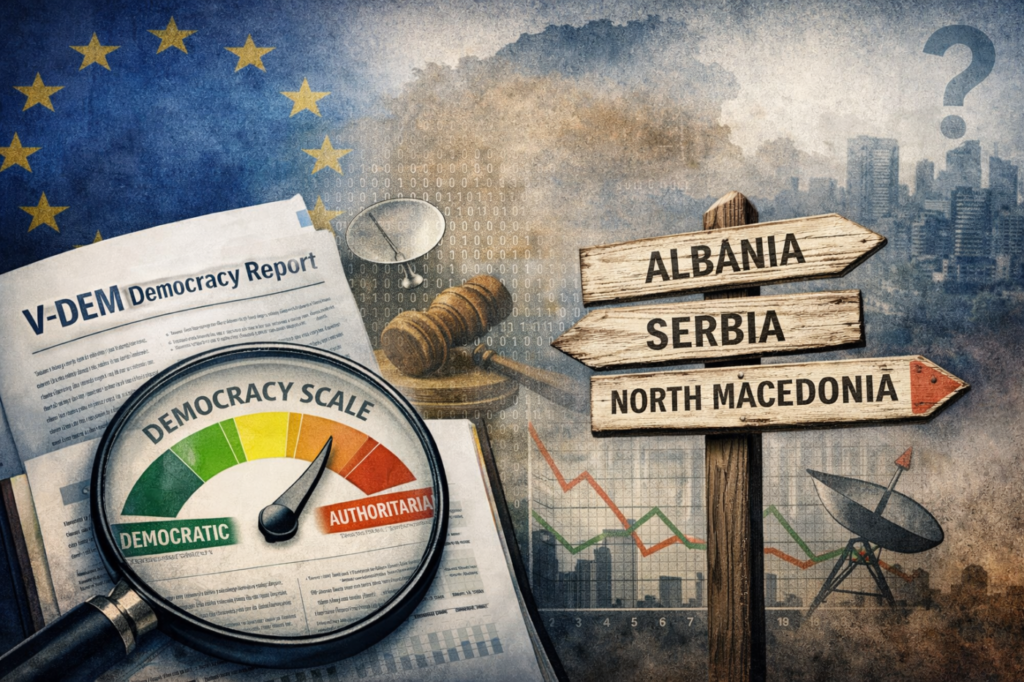
The V-Dem Democracy Report 2026 places Albania at the threshold of electoral autocracy. Bosnia-Herzegovina, North Macedonia, and Serbia sit in similar grey zones. Montenegro is classified as an electoral democracy but flagged for ongoing concerns. Kosovo holds electoral democracy status. The picture the report paints of the region is one of arrested democratization, hybrid governance, and proximity to authoritarian consolidation.
As a scholar of security studies and international relations working in this region, I do not dispute that the Western Balkans faces serious democratic deficits. It does. What I dispute is whether V-Dem’s methodology is equipped to classify these deficits accurately — and whether the classifications it produces, once they enter policy circulation, serve or distort the reform agenda the region urgently needs.
The measurement problem in transitional contexts
V-Dem’s Liberal Democracy Index aggregates five component scores: electoral quality, rule of law, judicial independence, checks and balances, and civil liberties. This maximalist conception of democracy is appropriate for tracking long-run variation across stable political systems. It is poorly suited to transitional contexts where institutional reform is actively underway, where the gap between legal framework and institutional practice is structural rather than deliberate, and where democratic deficits reflect capacity constraints as much as political will.
Institutional weakness and regime closure are not the same condition.
The Western Balkans sits precisely in this category. Every country in the region is engaged in formal EU accession processes that are themselves reform mechanisms — processes that identify institutional deficits, impose conditionality, and track progress against benchmarks developed specifically for transitional environments. The EU’s own assessment frameworks distinguish carefully between countries that are institutionally weak and countries that have deliberately closed their political systems. That distinction is analytically central to the enlargement methodology.
V-Dem’s composite scoring cannot make it. When judicial independence is weak because a vetting process is incomplete, and judicial independence is weak because an executive has captured the courts, the LDI registers both conditions in the same way. When civil liberties are poorly protected because institutional capacity is limited, and when they are suppressed because a government has chosen to suppress them, the score reflects a similar deficit. The instrument averages across fundamentally different political realities and produces a number that obscures the distinction that matters most.
The Western Balkans as a stress test
The region offers what social scientists would call a natural stress test for V-Dem’s methodology — a set of cases where the gap between institutional quality and regime openness is large, visible, and well-documented by multiple independent sources.
Take Albania. The country’s judicial sector is undergoing the most ambitious vetting process ever implemented in a European state, with international monitoring and direct EU and US engagement. The process has created institutional vacancies and reduced judicial capacity in the short term — conditions that V-Dem’s judicial independence indicators register as democratic deterioration. They are, in fact, the temporary costs of an irreversible reform. An instrument that cannot distinguish between a judiciary being dismantled and a judiciary being rebuilt is not measuring the right thing.
Take Serbia. V-Dem’s classification of Serbia as an electoral autocracy reflects real and serious problems — the erosion of media independence, the hollowing of electoral competition, and the concentration of executive power. These findings align broadly with independent assessments from Freedom House, the OSCE, and the European Commission. But Serbia also has a functioning opposition that campaigns, competes, and protests. Civil society organizations operate, publish, and challenge the government. The classification captures deterioration accurately. What it cannot capture is whether contestation remains structurally alive — a distinction that determines whether engagement or isolation is the appropriate policy response.
Take North Macedonia. A country that underwent a genuine democratic transition in 2017, implemented the Prespa Agreement under intense domestic and external pressure, and has sustained competitive elections with real turnover — yet remains classified in a grey zone between democracy and autocracy. The methodology captures its current institutional level but not its trajectory. A country that has moved significantly toward democratic consolidation but has not yet crossed a threshold reads as indistinguishable from one that has never moved at all.
What the classifications do once they travel
The methodological limitations would matter less if V-Dem’s outputs remained within academic discourse. They do not. The Democracy Report is cited in European Parliament resolutions, referenced in Commission progress reports, quoted in diplomatic communications, and used by civil society organizations to frame advocacy positions. Once a country is classified as an electoral autocracy, that label shapes the interpretive frame through which subsequent developments are read — making reform harder to recognize and regression easier to assert.
For the Western Balkans, this creates a specific policy risk. The region’s EU accession trajectory depends on sustained political will in both candidate countries and member states. That will is conditioned by how the region is perceived — whether it is seen as a space of genuine, if difficult, democratization, or as a zone of creeping authoritarianism where engagement yields diminishing returns. V-Dem’s classifications, stripped of their methodological qualifiers and uncertainty ranges, push systematically toward the second reading.
This is not an argument for softer standards. The Western Balkans should be held to rigorous democratic benchmarks, and external analytical pressure serves an important accountability function. But the standards must be applied with instruments capable of distinguishing between the problems they identify. An instrument that cannot separate institutional weakness from regime closure, or reform-induced disruption from deliberate dismantling, is not applying rigorous standards. It is applying blunt ones.
What the EU framework gets right that V-Dem misses
The European Commission’s annual progress reports on Western Balkans countries are imperfect documents. They reflect political considerations, vary in analytical depth, and are sometimes accused of excessive diplomatic softening. But they contain a methodological feature that V-Dem lacks: they assess trajectory, not just position. They distinguish between a country that has weak judicial independence because reform is incomplete and one that has weak judicial independence because the government has obstructed reform. They track whether civil society space is contracting or expanding. They assess whether electoral deficits are structural or manipulated.
This is the analytical capacity that regime classification requires — and that composite index scoring, by its nature, cannot provide. A single number derived from aggregated expert assessments across dozens of indicators cannot represent directionality, causation, or political meaning. It can represent level. In transitional contexts, level without direction is not just incomplete. It is misleading.
A proposal for policy users
I am not arguing that V-Dem’s data should be disregarded. The underlying indicators — on media freedom, civil liberties, electoral integrity, and judicial independence — contain genuine diagnostic value. The problem is not the data. It is the composite score that aggregates it, the regime classification that derives from it, and the policy weight that classification acquires once it exits the academic apparatus.
Policy users in Brussels, in Western capitals, and in the region itself should engage with V-Dem’s component-level data rather than its headline classifications. They should read the uncertainty ranges — the EA+ and ED- notations that signal how close a country sits to a threshold and in which direction the confidence intervals extend. They should triangulate with the EU’s own conditionality assessments, with OSCE electoral observation reports, and with the qualitative analysis produced by regional specialists who understand the specific political economies involved.
Most importantly, they should resist the translation of probabilistic, model-dependent classifications into categorical policy verdicts. A grey zone classification is an invitation to look more carefully. It is not a finding.
The stakes
The Western Balkans is at a geopolitical inflection point. Russian influence is active. Chinese economic presence is expanding. The credibility of the EU enlargement process — already strained by years of process without progress — is under pressure. In this environment, how the region’s democratic trajectory is characterized matters enormously. A narrative of regional autocratization serves those who benefit from Western disengagement. A narrative that accurately distinguishes flawed democracy from regime closure serves those who want the region to succeed.
V-Dem’s methodology, as currently applied, cannot support the second narrative — not because its data is wrong, but because its instrument was not designed for the discrimination the policy context demands.
Democratic measurement should illuminate political reality. When it systematically obscures the distinctions that matter most, the instrument must be read with discipline — not abandoned, but not trusted beyond what it was built to do.
In the Western Balkans, it is being trusted well beyond that point. That is not a marginal methodological issue. It is a structural misreading of a region whose political trajectory depends on getting that distinction right.
Hajdi Xhixha is Assistant Professor and Dean of the Faculty of Political Science and Security Studies at the University for Business and Technology. Her research focuses on garrison state theory, grey-zone conflict, and democratic resilience under conditions of strategic competition. She writes on security architecture, authoritarian adaptation, and the geopolitics of the Western Balkans for academic and policy audiences. She is a regular contributor to the Tirana Examiner.