No vote. No block. No nine countries. Just a claim the process itself does not support.
Ardit Rada | Tirana Examiner
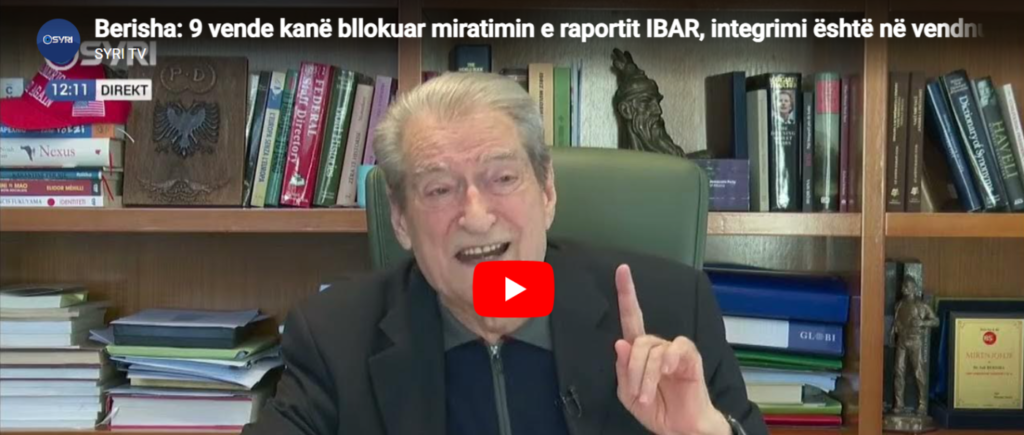
On April 4, Sali Berisha described a decision that was never taken. Nine European Union member states, he told the press, had blocked Albania’s IBAR report in Brussels. Integration was frozen. Penalties loomed. By afternoon, the claim was running across Albanian media as established fact. It was not a fact. It was not close to one.
The IBAR, Albania’s Interim Benchmark Assessment Report on rule of law and fundamentals, does not move through a single council session where member states cast blocking votes. It advances through sequential readings inside national institutions, each proceeding on its own timeline, subject to the internal consultation procedures of each government. A country that says it needs more time, or that the document is still working through relevant bodies at home, is describing a procedural reality, not announcing opposition. The difference between a country reading a report carefully and a country blocking it is not semantic. It is the entire substance of Berisha’s claim.
The picture from Brussels directly contradicts him. At a working-level meeting of COELA, the Working Party on Enlargement and Countries Negotiating Accession, held in late March and attended by member state representatives and the European Commission, every delegation that took the floor expressed positive appreciation of Albania’s progress on interim benchmarks and solid support for its European path. Not most. Not the majority. Every one.
The record of that meeting is specific. Slovenia raised questions on the ministerial suspension initiative and anti-corruption frameworks. Poland asked about implementation challenges. Austria commended Albania’s progress, declared its support for membership, and flagged organized crime, vetting, and the business climate as areas of ongoing interest. Germany expressed support for Albania’s EU path, commended progress, noted interest in political communication and anti-corruption, and said it was following the IBAR with attention, adding that the document naturally requires time as it works through relevant domestic institutions. Belgium focused on media ownership and defamation decriminalization and recommended stronger cooperation with the EU on security and defense. Italy made a very positive intervention and ensured its full support for Albania’s integration. Greece offered positive remarks, recognized concrete progress on minority rights, property rights, and digitalization, and noted close bilateral technical cooperation. The Netherlands asked about defamation decriminalization in practice and IPARD implementation progress.
That is eight named delegations. Every one engaged constructively. None announced opposition. None coordinated a blocking position. The number itself collapses under scrutiny: the ninth country central to Berisha’s claim does not appear in any account of the meeting. He has not named it. He has not identified the forum or the procedure through which it allegedly acted. He has not offered a source. What he described as a coordinated block was, by all available evidence, the opposite: a room in which Albania’s trajectory drew uniform endorsement across delegations with different priorities, different emphases, and different questions, none of which add up to obstruction.
Germany’s comment is worth isolating because it is the statement most susceptible to the misreading Berisha appears to be exploiting. Saying that the IBAR requires time as it moves through domestic institutions is not a hostile position. It is a description of how the process works in every member state. Scrutiny and timeline are not synonyms for blockage. A coalition requires a joint position, coordinated opposition, a shared intention to prevent an outcome. There is no evidence of any of that.
Berisha also tied the IBAR alarm to the Balluku immunity case and the AKSHI dossier, presenting Rama’s handling of both as the mechanism by which Brussels would deliver severe penalties. That is a separate argument requiring separate evidence. None was offered. Linking a domestic political dispute to a specific consequence in an EU accession process without establishing the chain of causation is assertion dressed as analysis.
What turns this from an opposition claim into a media failure is what happened next. The nine-country figure traveled across Albanian outlets without a single one asking the necessary question: blocking what, in which forum, through which procedure? The IBAR process is not obscure. The working structure of COELA discussions has been on the public record for years. Repeating a procedural claim without checking whether the described procedure exists is not cautious reporting. It is procedural illiteracy on a file with direct consequences for the country’s strategic future.
Albania’s integration process has real friction. The IBAR has not been formally concluded. Questions from member states on outstanding benchmarks are genuine and ongoing. None of that is a secret, and none of it is what Berisha described. The honest version of where things stand is more complicated than either his catastrophism or the government’s periodic triumphalism allows. But the floor for honest coverage is a refusal to transmit an account of events that the basic mechanics of the process already rule out, and that the available record from Brussels directly contradicts.
Eight delegations. All constructive. Zero blocking positions. The number itself collapses under scrutiny: the ninth country central to Berisha’s claim does not appear in any account of the meeting. The record does not support ambiguity. It supports a single conclusion. The event described on April 4 did not occur.