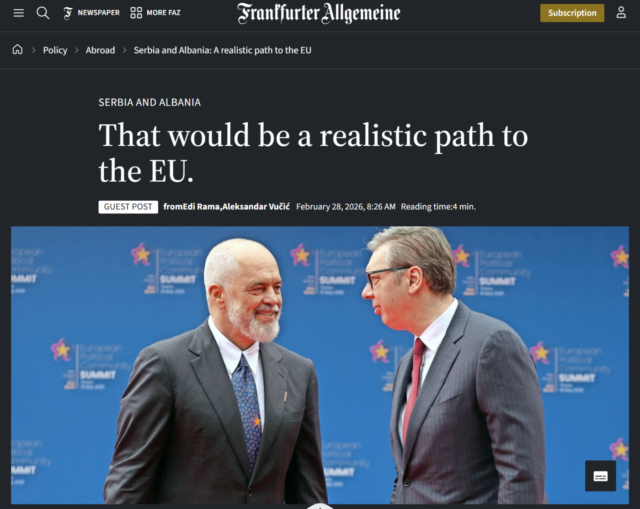
A senior opposition official accuses Prime Minister Edi Rama of attempting to redefine Albania’s EU trajectory through a controversial proposal with Serbian President Aleksandar Vučić.
by Besa Ruka (Tirana)
A new debate has erupted in Albania’s political arena after comments suggesting a potential re-framing of the country’s path toward the European Union. The controversy follows statements and interpretations surrounding a joint proposal associated with Prime Minister Edi Rama and Serbian President Aleksandar Vučić concerning deeper economic integration with the EU without full membership.
Opposition figures argue that the proposal represents a significant shift in Albania’s traditional EU accession strategy.
Speaking during an appearance on Syri TV, Ilda Zhulali, head of the Democratic Party’s Department for Foreign Relations, sharply criticized the idea, describing it as a strategic retreat from Albania’s long-standing goal of full EU membership.
According to Zhulali, the proposal effectively seeks to secure economic benefits from the European Union — particularly access to the single market and participation in the Schengen area — while relinquishing the institutional rights that come with full membership, including representation in EU institutions.
Claims of a Strategic Retreat
Zhulali framed the initiative as a potential departure from one of the central commitments of Rama’s current government.
“In a move that fundamentally changes the course of foreign policy,” she argued, “Prime Minister Edi Rama has signaled that Albania may no longer seek full membership in the European Union.”
She contrasted this with Rama’s earlier electoral pledge that Albania would become an EU member by 2027, a promise that formed a key pillar of the government’s political mandate.
Less than six months after the formation of the current government, she said, the newly discussed concept — reportedly articulated alongside Serbian President Aleksandar Vučić — would involve Albania seeking participation in the Schengen area and the European single market, while abandoning other elements of full membership such as:
- voting rights within EU institutions
- the right to appoint a European Commissioner
- representation in the European Parliament
For Zhulali, the implications of such an approach would be profound.
“A Joint Resignation from EU Membership”
During the interview, Zhulali described the proposal as more than a technical policy adjustment.
She argued that it should instead be interpreted as:
“a joint resignation from the process of European Union membership.”
According to her analysis, the initiative may be politically motivated.
Zhulali suggested that both leaders face significant domestic pressures and are attempting to redirect public attention.
“Each of these leaders is facing a deep internal crisis,” she said. “Citizens both in Albania and in Serbia are expecting their resignations. Instead, what we are seeing is a resignation from the EU accession process itself.”
She argued that such initiatives serve primarily as political gestures rather than concrete policy shifts.
“This is a tactical move to keep their alliance alive and to throw each other a lifeline, as they have done many times before.”
Revival of “Open Balkan” Under a New Label?
Another line of criticism presented by the opposition concerns the broader regional implications.
Zhulali suggested that the initiative resembles earlier regional cooperation schemes such as the “Open Balkan” initiative, which was promoted by Albania, Serbia and North Macedonia but remained controversial across the region.
According to critics, the current proposal may represent a rebranding of similar concepts.
Some commentators, she noted, have already begun referring to the idea as “Euro-Yugoslavia.”
The core of the criticism is that the model seeks to obtain economic advantages from European integration while avoiding the political obligations associated with EU membership.
As Zhulali explained:
“They are seeking access to the market and economic connections, while removing every other political obligation that comes with membership.”
Those obligations, she emphasized, include:
rule of law reforms
democratic standards
protection of human rights
anti-corruption measures
the fight against organized crime and drug trafficking
Questions About Timing
A central question raised by the opposition concerns the timing of the initiative.
Zhulali asked why such a proposal would emerge precisely at a moment when Albania’s EU perspective appears relatively stable.
“Why is this happening now? In whose name is he making this move?” she asked.
She stressed that decisions affecting EU integration represent commitments made on behalf of the Albanian state and its citizens.
“These are political commitments made in the name of Albania and the Albanian people.”
For critics, any proposal that could redefine the country’s European trajectory requires broader public debate.
Albania’s Current Geopolitical Position
Zhulali also placed the discussion within the broader geopolitical context.
She argued that Albania is currently firmly anchored within the Euro-Atlantic framework, particularly through NATO membership and the EU accession process.
According to her assessment, the European perspective itself is not currently under question.
“The European perspective of Albania has not been questioned by anyone,” she said.
Instead, the debate within the EU concerns the pace of enlargement rather than the principle of membership.
In this context, she pointed to Montenegro as the current frontrunner in accession negotiations, followed by Albania as one of the next potential candidates for membership.
She warned that any move to redefine the process could undermine Albania’s geopolitical positioning — particularly at a time of shifting global alliances and growing instability in Europe and the Middle East.
Regional Implications
Finally, Zhulali suggested that closer political alignment between Albania and Serbia on such proposals raises additional strategic concerns.
According to her, the interests of the two countries in the region often diverge significantly.
“How is it possible,” she asked, “that at precisely these moments he always finds a way to merge the interests of Albania and those of Serbia, when those interests often move in completely opposite directions?”
She argued that such questions deserve careful examination by policymakers and the public alike.
A Debate That Is Likely to Continue
For now, the proposal remains part of a growing political debate rather than an official change in Albania’s EU accession strategy.
However, the controversy illustrates the sensitivity surrounding the country’s European trajectory — a strategic objective that has defined Albanian foreign policy for decades.
As the discussion unfolds, the central question remains whether the idea represents a genuine policy shift or simply another episode in Albania’s increasingly polarized domestic political landscape.