When the opposition truly has the support of the people, it can bring down even a mafia-state like Hungary had become
by Carlo Bollino (Tirana)
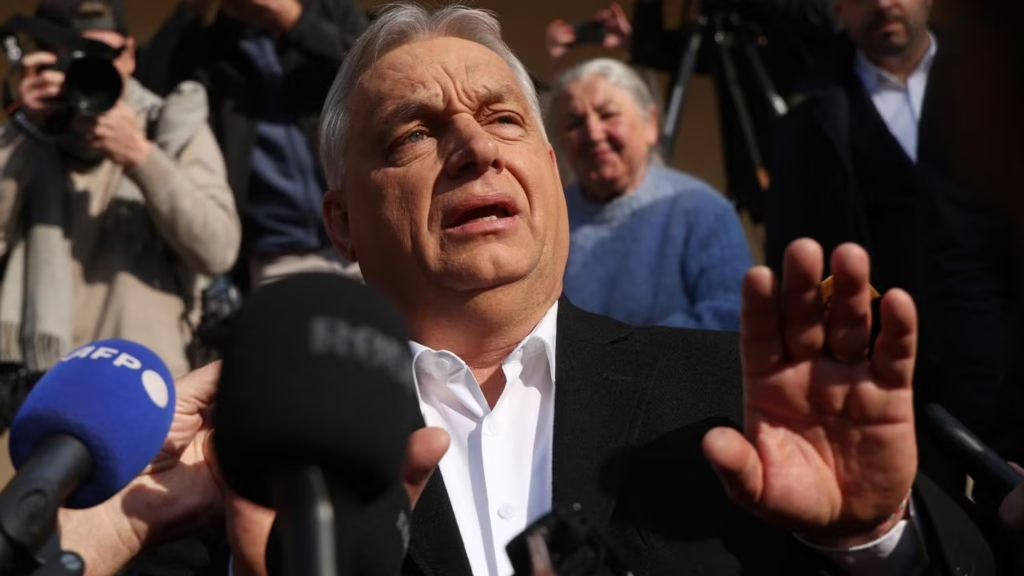
The defeat of Viktor Orbán in Hungary marks a moment that reaches far beyond the borders of Budapest. For years, the system built by the Hungarian leader was described by the Hungarian opposition as a “mafia-state”: an intertwining of political power, economic interests, and institutional control that appeared impenetrable to any alternative. A model that, for many observers, represented the most complete example of illiberal democracy in Europe.
And yet that system was brought down. Despite control over the media, despite the levers of power consolidated over time, despite even open international support, such as the visit by American Vice President JD Vance, far more significant and influential than the paid La Civita engagement arranged by Sali Berisha, the opposition managed to win. Not through miracle, not through foreign intervention, but for a simple and decisive reason: because a considerable portion of the Hungarian people genuinely wanted change.
That is the essence of it. When change becomes a real demand of society, no machinery of power is unbreakable. Neither propaganda, nor institutional control, nor networks of interests can long resist a genuine, widespread, and resolute popular will. European political history has demonstrated this many times. Hungary confirms it once more.
And this fact, inevitably, speaks to Albania as well.
For years, Sali Berisha has led an opposition that describes the government as a closed, corrupt, and impenetrable system. The language used is not very different from what the Hungarian opposition directed at Orbán. But there is a fundamental difference: in Hungary, in the end, popular support rewarded the alternative. In Albania, it has not. And it is precisely here that all the excuses collapse.
Because if a system is truly perceived as unacceptable by the majority of citizens, that majority expresses itself at the ballot box. If that does not happen, the explanation cannot be found only in the strength of the opponent. It must be sought also, and above all, in the weakness of the alternative.
An opposition that loses repeatedly cannot continue to shelter behind the narrative of an impenetrable system. It must reflect on its own capacity to represent a credible hope, to channel social discontent, to turn protest into support.
Hungary shows that even the most consolidated systems can be brought down. But it also shows that this happens only when change is not a slogan but a collective will.
In Albania, that will, at least until today, has not emerged with the same force. And this is not a detail. It is a political verdict.
To ignore it means remaining imprisoned in one’s own justifications. To accept it, on the contrary, is the first step toward building a genuine alternative.
Because the truth is only one: power does not fall when the opposition denounces it. It falls when the people decide to change it.
first published in Shqiptarja.com