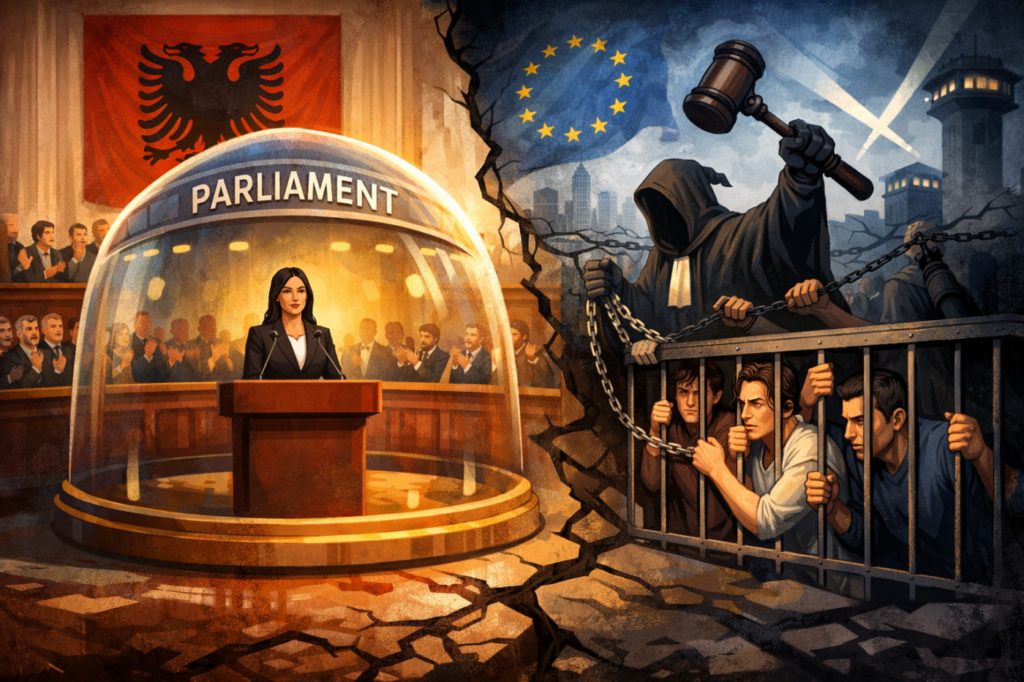
Parliament protected one of its own. Now it must protect everyone else.
By Ylli Manjani (Tirana)
The vote to block SPAK’s arrest request against Belinda Balluku should be a beginning, not an end. Albania’s parliament has been handed an opportunity — and so far, it has chosen to squander it.
Let me be clear about what I mean. The immunity vote was the right call. I have argued for years, and I will keep arguing, that pretrial detention in Albania has reached the apex of its abuse. Arrest without proven guilt has become a default instrument — wielded not as a last resort of criminal justice, but as a first instinct of political theatre, calibrated to satisfy crowds rather than courts. That is not a justice system. That is a mob with robes.
But if parliament stops at Balluku, it will have committed the greatest injustice of all: protecting one of its own while leaving everyone else to the same broken machine.
Parliament does not exist to legislate for its members. It exists to legislate for the country. If deputies can summon the courage to defend a colleague from prosecutorial overreach, they can summon the same courage to defend every Albanian citizen from the same overreach. The standard cannot be one thing inside this chamber and another thing everywhere else.
There is a charge I have heard repeated in recent days, and it deserves a direct answer. The theory goes: reform the criminal procedure code, restrict pretrial detention, and the EU will punish us for it. Negotiations will stall. Membership will be delayed. We must keep arresting people freely if we want to join Europe.
I reject this entirely — and not only because it is cynical. I reject it because it is factually wrong.
Look at what happened in Prague just twelve days ago. On March 5th, the Czech lower house voted 104 to 81 to shield Prime Minister Andrej Babiš from criminal prosecution. The charges are not trivial: a €2 million EU subsidy fraud tied to his Stork’s Nest farm, a case that has dragged through courts for over a decade. The parliament voted to protect him — and he will not face trial until 2029 at the earliest. This is not a fringe EU candidate state. This is a full member of the European Union.
Did the European Commission issue an ultimatum? Did ambassadors in Prague hold a joint press conference expressing “serious concern”? Did anyone suggest that Czech EU membership was now conditional on lifting Babiš’s immunity?
Not a word. Not a syllable.
I am not citing the Czech case to defend parliamentary immunity as an absolute principle, or to suggest that Babiš is innocent. I cite it because it demolishes the argument that the EU demands Albania maintain its particular brand of mass pretrial incarceration as a condition of accession. That argument has no basis in law, no basis in practice, and no basis in the actual conduct of EU member states. It is a ghost story told to frighten reformers into silence.
The real EU standard — one that Albania consistently falls short of — is the presumption of innocence. It is the right to be judged by a court that is genuinely independent of the prosecution. It is the guarantee that pretrial detention is exceptional, not routine; a measure of last resort, not a substitute for a verdict. Nowhere in democratic Europe does remand custody function as a pre-emptive punishment. Nowhere — except here.
No democratic standard on earth permits pretrial detention to function as a preliminary sentence. That is not law. That is coercion dressed in legal language, and parliament has the power and the obligation to end it.
Albania’s Criminal Procedure Code needs structural reform. The courts that rule on detention requests must be genuinely independent of the prosecutorial apparatus that submits them. Procedural guarantees must be strengthened — not to protect the guilty, but to protect the system from itself. A conviction secured through a broken process is not justice. It is a performance of justice, and it poisons the entire institution it claims to serve.
Parliament has the votes to act. It has the constitutional mandate. It has the European precedent on its side, if anyone cares to look. What it has lacked, until now, is the political will to treat criminal procedure reform as something that concerns all Albanians, not just the ones with seats in that chamber.
The Balluku vote was a beginning. Albania has seen many beginnings that went nowhere. This one cannot afford to be another.
About the author
Ylli Manjani is an Albanian lawyer and former Minister of Justice (2015–2017). Since his dismissal from government — after which he publicly accused the Rama administration of protecting corruption — he has returned to legal practice and become one of Albania’s most persistent critics of prosecutorial overreach and judicial dysfunction.