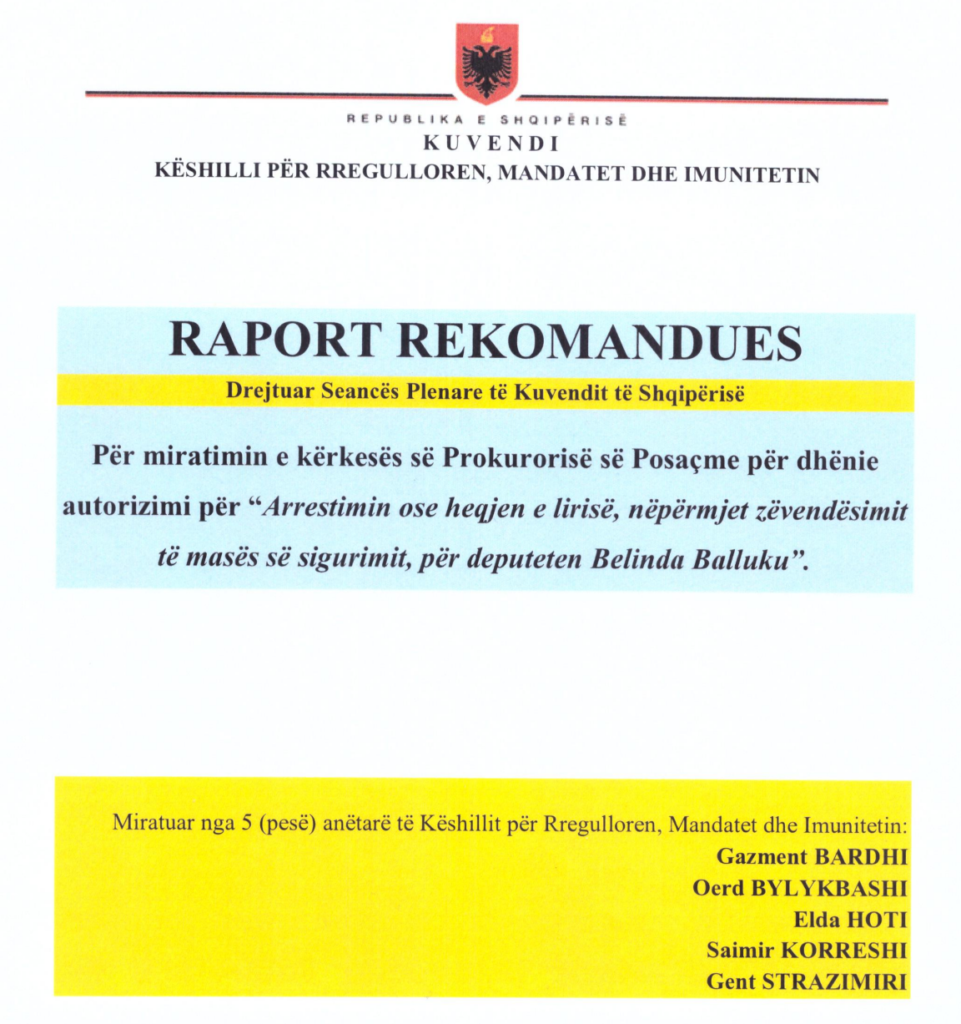
Having reviewed the Democratic Party’s parliamentary report on the Balluku case, Tirana Examiner assesses its constitutional thesis and the proportionality arguments it advances against European rule-of-law standards.
By The Tirana Examiner Legal Desk
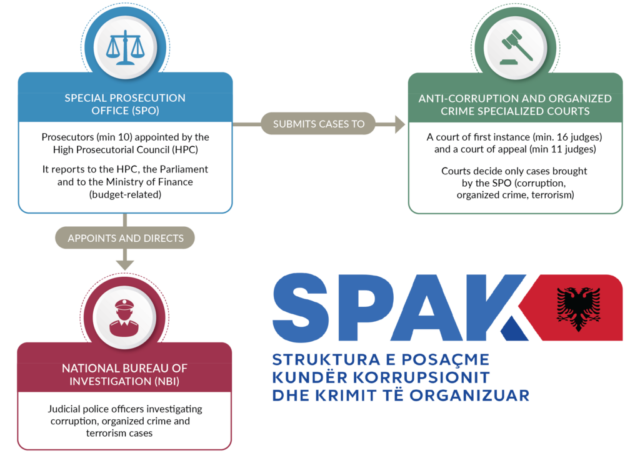
Albania’s Democratic Party (PD) has released a parliamentary recommendation urging the Plenary to authorize SPAK’s request for a stricter precautionary measure against MP and former minister Belinda Balluku.
The document is not a judicial ruling. It is a political-parliamentary brief. But it makes a serious constitutional argument that deserves careful scrutiny — particularly in light of Albania’s EU accession trajectory and ongoing rule-of-law monitoring.
At stake is not only an individual case, but the functioning of three institutions: Parliament, the prosecution, and the courts.
I. The Immunity Question: Functional Safeguard or Political Shield?
PD’s central thesis is institutional:
Parliamentary immunity exists to prevent politically motivated prosecution — not to insulate executive conduct from judicial review.
This aligns with Venice Commission doctrine and broader European constitutional practice. Immunity is functional, not personal. It protects legislative deliberation, not administrative decisions.
The report therefore narrows Parliament’s role to two questions:
- Is there a legally regular criminal proceeding?
- Is there credible evidence that the prosecution is politically motivated?
If the answer to the second is “no,” PD argues that Parliament must authorize the judiciary to proceed.
From a Brussels perspective, this framing is orthodox. In EU member states, legislatures generally avoid substituting themselves for courts in evidentiary evaluation. Immunity procedures are meant to filter abuse, not to block ordinary criminal accountability.
The strength of PD’s position lies here: it situates Parliament as a constitutional gatekeeper, not an alternative tribunal.
II. The Political Motivation Standard
PD places weight on the absence of an articulated claim of political persecution in the parliamentary hearing record it cites.
This is a meaningful point — but not a conclusive one.
In European practice, the political-motivation test is rarely proven by rhetorical assertion alone. It is assessed through objective indicators:
- timing relative to political events,
- prosecutorial irregularities,
- selective enforcement,
- procedural anomalies.
The PD report does not present evidence of such indicators. Instead, it argues that none have been demonstrated.
That distinction matters.
In EU rule-of-law discourse, absence of proof of political motive is not automatically proof of neutrality. It simply means the burden has not shifted decisively in either direction.
III. The Proportionality Question: Escalation of Precautionary Measures
The more delicate issue is not immunity, but proportionality.
SPAK has sought stricter precautionary measures. PD’s report supports this escalation on the basis of three “risk pillars”:
- alleged witness intimidation,
- potential influence through institutional networks,
- documentary delays in procurement files.
From a European criminal-procedure perspective, precautionary measures must meet three conditions:
- Legality
- Necessity
- Proportionality
Risk-based reasoning is legitimate in principle. Courts are not required to wait for evidence to be destroyed before acting. However, European human-rights jurisprudence requires that risk be:
- specific,
- individualized,
- and attributable.
This is where the analytical pressure point lies.
The PD report accepts the prosecution’s presentation that risk exists. It does not independently demonstrate attribution or explain why less intrusive measures would be insufficient.
For Brussels observers, the key question will be whether any escalation is tightly reasoned and demonstrably necessary — not merely justified by generalized reference to influence.
IV. The “Network Influence” Theory
The report reflects a modern understanding of corruption investigations: influence may operate indirectly, through hierarchies and institutional proximity.
This is credible in structural terms.
However, European standards require more than structural plausibility. They require concrete linkage. Former authority alone does not automatically translate into present interference risk.
If courts escalate precautionary measures, they will need to articulate clearly:
- how influence is operational,
- why it cannot be mitigated through narrower conditions (e.g., contact prohibitions),
- and how proportionality is maintained.
This is where judicial reasoning — not parliamentary recommendation — becomes decisive.
V. Procurement Scope and Aggregate Seriousness
PD emphasizes that the investigation now covers multiple procurement procedures beyond the initial episodes.
Expanded scope can increase legal seriousness and potentially justify stricter measures. But seriousness must be evidence-driven.
In EU monitoring frameworks, expansion of investigative scope is viewed neutrally unless accompanied by irregular procedural acceleration or selective targeting.
There is no evidence in the PD report of procedural irregularity. But neither does the report provide independent verification of evidentiary strength.
It functions as a threshold endorsement, not a merits assessment.
VI. The Institutional Test for Albania
From a Brussels-calibrated perspective, this case is not primarily about the opposition or the government. It is about institutional boundaries.
Three principles are being tested simultaneously:
- Parliament must not transform immunity into impunity.
- The prosecution must avoid politicization.
- Courts must rigorously justify any restriction of liberty.
If Parliament blocks authorization without demonstrable political motive, it risks weakening anti-corruption credibility.
If precautionary measures escalate without individualized, well-reasoned necessity, Albania risks criticism under proportionality standards.
The equilibrium lies in institutional restraint on all sides.
Conclusion
The PD report is strongest where it invokes constitutional doctrine: immunity is functional and should not obstruct judicial accountability absent political motive.
It is weaker where it assumes that risk, once alleged, necessarily justifies escalation without publicly demonstrating proportional calibration.
Ultimately, Parliament’s vote will answer the political question.
The courts must answer the proportionality question.
For Albania’s EU path, the credibility of those answers — and the clarity of their reasoning — will matter more than the outcome itself.