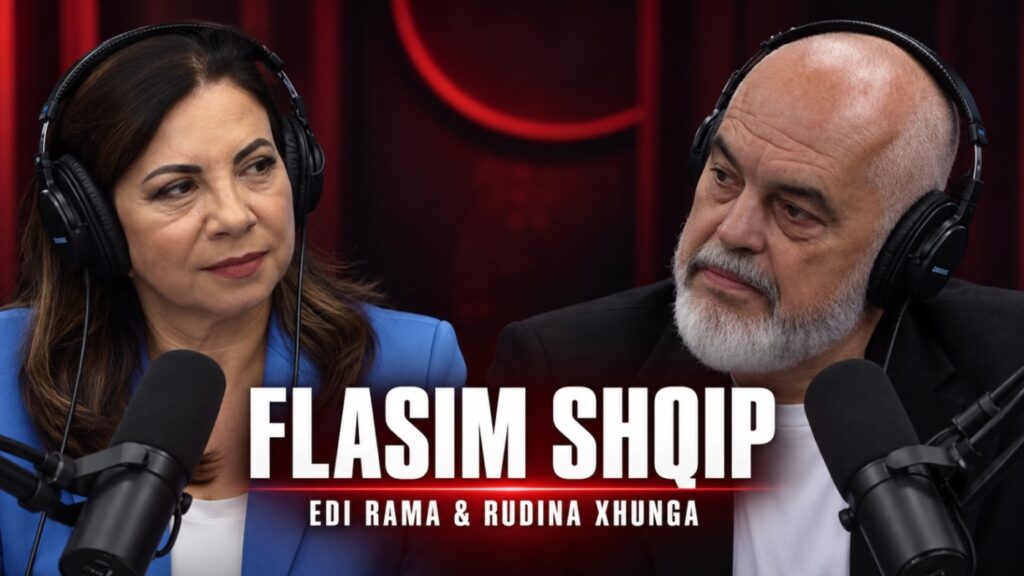
Prime Minister Edi Rama used a joint edition of his podcast, Flasim, and Rudina Xhunga’s programme on Dritare Television, recorded as a single four-hour interview, to address the widest range of questions he has taken in public since the Flamingo protests began: the terms of the Sazan negotiations and the status of the Zvërnec project, the foreign bot campaign he says is close to formal attribution, the effect of the protests on investor sentiment, the Besa and Prania Besnike initiatives and the plan to put the Pasqyra platform into law, the suspension of Belinda Balluku, the detention of Erion Veliaj and Ilir Meta, the succession inside the Socialist Party, and Albania’s relations with the United States, Israel, Turkey, the Gulf states, France, Italy and Kosovo. Below is an edited transcript of the Prime Minister’s answers. The interviewer’s questions are given in abbreviated form; repetitions, false starts and interruptions have been removed, and some passages have been condensed.
Editor’s note: This transcript was prepared from an automated transcription of the broadcast, which in places garbled names and individual words. Where Dritare has since published its own cleaned excerpts, we have checked our text against them and corrected it. The corrections include the names of the three intelligence service directors, which our first version omitted because the recording rendered them unreliably; the words “with me” in Rama’s statement that the EU door is crossed “with me, the Socialist Party and this majority,” which the automated text dropped; the statement that the government refused the “first” Zvërnec project, which the recording rendered unclearly; and the wording of the passage on Arben Ahmetaj. Any remaining errors are ours. Readers should treat Dritare’s published excerpts as the authoritative Albanian text.
On the format and the state of political interviewing
Journalists and critics of the arts are not generally inclined to think about likes and followers, and they are always inclined toward extended conversation with the possibility of going deeper. Political journalists are more and more under the pressure of audiences, more and more aligned, more and more not intermediaries with the public but protagonists who come at you almost as if you had an election with them next Sunday. Still, I believe this format gives us the chance for an extended conversation. It is not true that I do many interviews. I have done few for some time, precisely because it is always harder to have a conversation from which people can inform themselves or judge calmly.
What I feel more and more as a limitation in interviews or in certain media spaces is the impossibility of developing a thought from beginning to end, and an ever greater lack of patience and an ever greater spirit of aggression that characterises our whole public life, not just Albania’s but, it seems to me, the world’s.
Which trait of the adolescent Edi Rama defined the leader?
I have great admiration for Kissinger, and I accepted the publisher’s invitation to write the preface with great pleasure, but I never thought about it in that respect. If I went back to find a trait that could foreshadow the nature of the leader I later became, I would say it was the refusal to accept limits. From very small I did not accept limits as imposition or as fate. I always tried to step over them, to push them, to do the thing the limit said not to do. The refusal of limits and the pushing of limits have motivated me my whole life, whether in how I lived at a certain period or in the Academy of Arts.
I remember one episode. Five of us in the studio, arranged in a half-arc in front of the model, agreed that we would each paint the background in a different colour, and when the professor came we would insist that was what we saw. The background was an anonymous whitewashed wall, dirty. One made it yellow, one blue, one green, one red. The professor was scandalised. What is this? And we all played the fool: that’s how I see it. For that time that was a great heresy.
A desire for control?
The desire for control is a stereotyped reading, a way of defining my public profile fed by various motives. Fortunately in some respects and unfortunately in others, one of my weaknesses is that I am not a person driven to control. I have witnesses: I have worked with three directors of the Albanian intelligence service: Visho Ajazi, Helidon Bendo who replaced him, and now Vlora Hyseni, and all three can testify that I delegated the process of reporting and conversation with the service almost entirely to the director of the cabinet, and took only very reserved and very special information concerning our allies and alliances. For the rest I have been extraordinarily negligent, because I do not have that trait. I believe strongly in people.
I grew up with the spirit injected in me first by my grandmother, a practising Catholic even when religion was banned, with that famous saying: you touched and believed, but blessed is he who believed without touching. Trust is very pronounced in me; control is generally a weakness. I have known very suspicious people. I had in particular a fellow traveller for a certain stretch of road, who is still a person but no longer a fellow traveller, who suffered deeply from suspicion toward everything and everyone. I have always believed that to suspect others, to live with suspicions, is a very great cost for you. But sometimes I say it is necessary, especially in positions where you have responsibility toward others, because excessive trust becomes a cost that others may pay too.
On the claim that he was bullied as a child
Those who say it come from a political community that has a muscular relationship with society and politics, the community of the old Democratic Party, where the club had the last word when things needed settling. The truth is that in childhood I was extraordinarily rebellious. I did not accept limits. But bullied, never. I have two beatings in my history, where I did not beat but was beaten. One in the showers of the Partizani sports palace after a tense match against Apollonia of Fier; as a player I was sometimes a provocateur, and I paid for the tension on the court with four or five boys about my height, treacherously fast, and I ended up on the floor. The other is the beating known to the world, in January 1997, when they ambushed me on the road to the entrance of my house and left me thinking I was already gone. That was also the opinion of the doctor who saw me here and the doctor in France, who said independently of each other that my height had saved me, because blows are less effective when you are taller than the one attacking you.
On the version that it was a crime of passion and that I was with a man: that story is fully clarified, like many stories from that unbridled mouth that I do not want to deal with today. Not only was there no crime of passion and not only was I not with a man, but I was with a girl I lived with and with a friend who lived in our apartment because he was from Shkodra. It was a crime mandated by that mouth, and one of the two executors is a person fully known to me, whose repentance I accepted by pretending not to understand, and who died some time ago from an illness. He never confessed the crime to me and I never asked him. He repented in another way, by showing friendship.
How did the Flamingo Boulevard challenge him?
Tony Blair says something in his new book on leadership that I find very true. When a leader takes office he listens avidly, because he has the great weight of not knowing and must learn as much as possible as quickly as possible. Then he gains experience and starts to think he knows, and becomes ever more impatient to listen. And there is a third phase, if you reach it, when you return to listening in a different way, with humility, because experience teaches you that you do not know everything. The Flamingo Boulevard, as I baptised it, was exactly such an experience. A very challenging mirror was placed in front of me without warning. In the intermediate phase I would have quarrelled with the mirror. In fact the mirror became more and more interesting to me as a way of understanding what was really happening. That is the real test for a leader: between the pride of being right, which nobody escapes, especially in that middle phase, and the courage to accept that the one who challenges you may be right, and to understand where you stand.
Why did he mention resignation?
I take as reference an episode with a mayor, one of the mayors who is genuinely results-oriented. A community of residents in a peripheral neighbourhood had risen against him and he was very irritated. “I have never seen such an ungrateful people. They had no road, now they have a road; I put in lights, I put in benches, and they are ungrateful.” It is not ingratitude. It is a change of stage that Tocqueville calls the paradox of success. As long as the bad seems inevitable, seems fate, seems something that can get worse, it becomes bearable; it becomes unbearable the moment you begin to imagine you can escape it. The more the country moves, the more things change, the less the citizen is inclined to look at what was done. There was a time in Albania when votes were won with gravel: trucks of gravel dumped in a neighbourhood, and people gave their vote and considered it a gift. That time has long gone. Then I lived through the time when a road, a rebuilt school, a lighting system were met with celebration. That is no more either. The old theory of when we took office, “it could be worse, thank God,” has given way to the theory “it could be better. Full stop. Don’t tell me what you did; you’ve been here so many years, tell me why this hasn’t been done.” In that sense it is a question of expectations.
I did not expect it. I did not understand it immediately. I had to start following the signs and analysing, and there were moments that helped me understand it fully, and I accompanied that with reading. It is a very good thing, because it is a change of season for Albania, officially stamped by the people. But it is very challenging, because impatience is great. A city that lived with two hours of water a day, when it starts getting eighteen, is no longer satisfied; it needs twenty-four, and then it is no longer the hours but the quality. A country that ten years ago was entirely indifferent to the mass killing of animals and the mass cutting of forests is today in a battle where biodiversity and the protection of animal life are at stake. That is a very big leap.
Was the protest manufactured?
It is not a matter of the secret services. What happened here is what the English call a perfect storm: many components came together at one point, and that gave the whole thing a kind of grandeur. I spoke about the algorithm because it was true, and not only true but very shocking to see from my angle. We had heard how interference is done in elections in other countries, how interference is used to incite revolts, how the whole French digital communication system was interfered with to provoke the burnings in Paris. It is one thing to hear about it and another to see how it happens: thousands and thousands of soldiers produced in technology laboratories, with Albanian faces and names, attacking the country’s digital space and creating, or more precisely raising, that great tension.
I said repeatedly that I am not accusing those who came out onto the boulevard of being agents of Iran. This is the world of mirrors we live in. It influences our perception of the physical world more and more, and it creates new contexts: we see thirty seconds of something that may be true in itself but taken out of context creates a new context. I do not think the algorithm created the problem, but I think the algorithm took the problem outside any equilibrium in relation to the facts.
Those soldiers were not at the protest. They do not exist. They are created in a laboratory and they give voice to different narratives. What connection did this whole development, in which some people were rightly worried about the flamingos and biodiversity, have with relations with Israel? Where did Israel come in? The idea that the Israelis are coming to take Sazan was a lie, a narrative created and pushed by this army of unreal soldiers raised in technology laboratories, which even Facebook and Instagram find very hard to identify, because they grow, they take on images, they take on life and form. Behind them are operators, forces that throw them into war.
We have in Albania an extraordinary cyber-defence capacity, valued worldwide, not by chance. We built it out of necessity, because we found ourselves under a very savage attack by Iran that aimed to flatten the entire infrastructure of digital services. They did not succeed, but we saw we had to raise a wall, as all countries do, because it is a daily war in the invisible part of those mirrors. We have a file. But I am not an analyst who determines the location of an account. We have learned that before we come out and say “it is this one,” what is called attribution, we do it by securing the truth of our findings through cooperation with other actors. We are completing that, in cooperation with the other known actors, and I believe we will have the final result of the attribution. We have no doubt at all.
Just as we have no doubt that the narrative of religious division and the narrative of ethnic division, setting Muslims against Jews through some very dark figures of the world of the Albanian Muslim community, which is on the contrary spiritually rich, and the anti-Israeli narrative, projecting as Israeli an investment that has nothing to do with the State of Israel or with any agreement between Albania and Israel, in which the first-rank actors are two Syrian Muslim brothers who are citizens of Qatar, and in which Qatar, a country with no relations with Israel, is an integral part of the investment. Can anyone imagine Qatar investing funds in a project that aims to turn Zvërnec into an enclave of Israel, or to take the Palestinians from there and bring them here? That can be imagined only in absolutely diabolical fantasies that know very well it is not true but want to incite hatred.
They want to incite hatred, to incite division, not toward me. In this case I am simply a dam that must be demolished. Hatred among Albanians and against Israelis is a terrible thing, because it is spitting on the graves of all those Albanians, Muslims first and then Christians, who made Albania the country that came out of the Second World War with honour when everyone else came out with their heads bowed in relation to the Jews. You can be completely against the politics in Israel, but politics in Israel comes and goes. The relationship of Albanians and Albania with Israel is as important as the relationship with the Arab countries, with which we have symmetrically fraternal relations, built with much effort and a very clear strategic vision, and with Turkey.
There was another component, not malign interference but political interference, if it can be called that. The shadow of the President of the United States drew a lot of attention. If the names of Kushner and Trump were not on this project, I am sure it would not have taken the international dimensions it took. The whole anti-Trump part of international politics found in the boulevard a battlefield on which to call Donald Trump to a duel and defeat him with Albanians. Those were the extra aspects, but they were not what created the protest. Let us be very clear. If the false claims are knocked down one by one with documents, the question marks people have about property, transparency, environmental impact, public access, whether the beach will be public or closed, and the relationship of this development to the public interest, are all legitimate questions. We have a duty to fight the lie, but not to declare every question mark an enemy.
The essence of the first week
The essence of the first week is a distinction between fact and experience. We had the facts. I had the facts, and at first it seemed to me a very great injustice that all those people were terrified by a lie. But people had the experience. I think the revolution of expectations Tocqueville describes, the moment of passage into a new season of society, had come. The video was found, that terrible video. If the video had not happened, another cause would have been found, because the time had come. We looked at the procedure; they experienced the threat to property, and the experience of the threat to property atomises into hundreds of thousands of individual experiences about their own property, their own permit, their own right. We had the map; they looked at the sea and thought this piece of sea would be taken from us. We had a development project, and one that for me is extraordinary; they did not have the project but had the fence, and that fence was like a fence of hell separating them from something they felt was theirs and was being taken. Into that gap between our facts and people’s experience came the algorithm, the videos, all the other horrors.
One of the things that helped me see clearly was an episode a friend told me about his eighty-year-old mother, who ended up at the protest. She had nothing to do with Sazan or Zvërnec, but she could no longer bear the stress and the humiliation she felt when on a certain day of the month she had to go to the polyclinic and queue with her contemporaries as in the days of the milk queues, because the doctor always came late and stayed very little.
Does Edi Rama know everyday Albania?
I have a claim here that I know it better than anyone. One of the boys in my security detail told me the car had done 500,000 kilometres, and I thought that was a lot, until he told me that was not the total. The total of this journey of mine is 1.6 million kilometres across Albania. To do 1.6 million kilometres across Albania as leader of the opposition and as head of government means having a fairly deep knowledge of Albania. On knowing the reality of people, what people feel and how they experience things, I leave first place to no one.
I am very proud of those images and of this protest, because on that boulevard I have been a protester, and on that boulevard I lived through lives taken from the windows of this building with rifles. I know very well what protest has meant in Albania. I have never seen a protest or a gathering of people as a democratic threat, and I have never spoken of the genuine protesters as people who threaten. That is the difference between a dictatorship and a democracy. In a dictatorship protesters are treated as a threat, as hooligans. We have heard all of that here. Because of what I know in office, I had to inform people about some of the heads of the protest, who at best should be taken with reserve because they come with other agendas and sponsors behind them. But the protesters as a whole I have never seen as a threat.
I never used the word agent for any part. I spoke about specific concrete people, based on things I stand by. I did not make accusations in the air.
“Failures and the resentful”
They are a component of this protest, a group of people very easily identifiable. Some of them I have known in my career; they had the chance to make a career with us, and I know what they are worth. Others are long-standing and permanent failures who pose as consultants, as civil society. It is a group united by only one thing: hatred for me. I am a dam between them and Albania, or more precisely between them and the road Albania must follow: either this road with all its challenges and defects, or the old road on which these people had all their contributions and all their glorious failures. It is not at all the idea that because these people had a career they must feel bad or be anathematised. Changing your mind is a virtue, not a sin. It is the anger, the rancour. A characteristic figure of this crowd wrote a necrology for Vlora, how Vlora had lost its smile, the whisper of the waves and the song of the seagulls. My grandmother used to say: rancour is the black of its owner.
I have had many direct personal communications with protesters. They call me or I call them. Someone sent me the posts of a man, posts of extraordinary rancour, “let’s take them out, hang them, thirty-five years is enough,” and said this one works in such-and-such a place. I called the director of that institution, who said he is a serious employee, and gave me the number. I called him. At first he did not believe it was me. I said, I want to know what I have done to you, what this government has done to you, what you are living through in this Albania that makes you go on social networks and demand these terrible endings. He started: I am an admirer of Edi Rama, of the strength of the word, but things should not be taken as a template. I said, I have the impression you don’t understand me. I am not calling to pressure you or to hold you to account. Why do you go to the protest? I want to know, because I do not understand, and help me understand. At one point he said, let me go, please, I am covered in sweat, I feel like an idiot; for Edi Rama to call me for twenty minutes to ask my reason means I did not know you, you are not the one I know. I said, calm down, help me understand; and as for your job, you are safer now than ever. Then he said: if you want to know, take my CV and take the CV of my department head and look at who should be whose boss.
Each one wants something. All together they are a mosaic. Everyone has the right to want something; not everyone is right in what they want. But it is a very complex mosaic that speaks precisely to what I say: people are no longer satisfied just because they have a job. We do a survey of the public administration, and this year we had the largest number of participants, over 4,000. It is now clearly a phenomenon. Naturally when you ask about pay, I do not believe there is a person in Albania who says my pay is enough. But very close to insufficient pay is another concern: the failure to punish poor performance. We are all the same, whether you worked or not, and that connects directly to the perception of merit.
What will this produce on the government’s side?
This is a whole process. It is not a story that ever ends; it has not ended for any country. We need to make our reflections and improvements. Above all, this is not a matter of communication. Communication is one element; this is a matter of substance.
The Socialist Party was in a moment of stupor, of bewilderment, on the part of many who had taken this job lightly and had not understood what I told them after we won: these 83 mandates are our blessing but also our curse, and this will be an extraordinarily difficult mandate, because expectations are very high. The Flamingo Boulevard has shown us that by taking care of the organisation in every territory as an electoral machine, we guaranteed great power across the whole map, but we are missing precisely at one point, which is the individual’s trouble. That is why this is not a matter of communication. That reflection is based on two strategic documents, Besa and Prania Besnike as its annex.
Besa is a word chosen for its solemn meaning, chosen with the conviction that it would create debate, but it speaks to Albanians immediately, and the fact is that everyone mentions it now. It is also an acronym: trust, empathy, service, engagement. And it is not “I ask for trust without giving account.” It is “check me.” That is Besa. Prania Besnike is the obligation to be where the citizen faces the problem. We are creating a system, of which Pasqyra is part, that turns every complaint, every request, every idea into a verifiable trace that does not get lost, like a package you send with DHL and track at every stage. We are also working on another component, Shkalla e Meritës, which uses technology for entry into the administration, promotion, competitions, standardised exams and evaluations.
It is a whole system that will take time to build but will be built step by step, and by creating traceability it will create responsibility, and by creating identifiable responsibility it will create much more concrete accountability. If you made a request or a complaint and got no answer, it will not be a case of “send a message to Edi Rama to get an answer.” On that big screen of problems, artificial intelligence will notify the person or institution responsible for the non-answer, and the one directly responsible will give account directly. That is why we will make Pasqyra law. We have a law on co-governance; co-governance worked for what it had, but now that we have the capacity of artificial intelligence we can raise it to a completely different level. You can have an app, a phone number, platforms, millions of messages. The question is what happens to the message. It is not the creation of a new channel into which troubles will be poured; it is the idea that the trouble cannot get lost on the way. That is why Besa does not say “trust me” but “check me.”
Who will solve the problem, Rama or Diella? Together. No person individually can solve the things a system solves. It is not true that entry into the administration is predetermined; if it were, we would not have a third of competitions ending without a winner. The idea is to use artificial intelligence and create a single mirror, so that people do not have to wander around to find where to go, a single mirror that is the result of studying many good world experiences, where you go in and not only complain but see where the road that connects your village to the next one stands, everything you are interested in. Our ambition is that the part on individual troubles enters into operation faster, with the services; the rest will take a little time, but we will have it within this mandate.
What philosophy of tourism is Sazan and Zvërnec?
We have a great strategic challenge: what Albania do we want in the next ten years, and connected to that, what tourism do we want in the next ten years, because that tourism will determine much for afterwards. It is called elite tourism; I call it value-added tourism, tourism that creates value in relation to tourism that creates numbers. We have today a tourism that creates numbers, very big numbers. But we need value tourism. A superyacht is not a rich man who comes to the sea; it is a crew, a marina, supplies, repairs, transport, specialised services, and in total a much higher expenditure per night. Ten thousand low-budget visitors create volume but create great pressure on service systems, traffic, water, waste collection. A hundred yachts bring far more revenue for the country than ten thousand visitors and create a much bigger value cycle. These are facts known worldwide.
Value tourism is not a fence that separates the rich from the rest of society. One billion invested within the perimeter of a resort is not a development in there; it is a source of income for what happens outside. It is a fact that for every dollar invested in this category of tourism, 1.6 to 2 dollars are generated outside the perimeter: agriculture, fishing, transport, services, vocational education, entrepreneurship. Mass tourism does not give that.
One project or two?
Two different projects, the same investors, two different properties. Sazan is state property; Zvërnec is private property. They are connected by the fact of the same investors, but they are not connected by bridges or tunnels or anything. In Zvërnec, the company that was working there had, under the law and on the basis of a preliminary authorisation to carry out the environmental monitoring and the necessary geological, hydrological and environmental studies, the right to erect fencing and do some preliminary works.
On Sazan, again, they are two different things. The area of the property is not the area of construction, let us be very clear. Negotiations have begun. The island is 560 hectares and we are discussing only 8 percent, because we have set restrictions related to natural heritage, cultural heritage, the bunkers and so on. The buildable area is 8 percent, about 45 hectares. That does not mean the 45 hectares will all be filled; there is a certain intensity that comes out of the negotiations. A property map is not a construction map.
In Zvërnec we have a different story, a story of several years, and today we are waiting for a project, since we refused the first project. For Sazan, the negotiations are not finished. Completely different phases, because Zvërnec is private, Sazan is state land and will remain state land. Sazan will not be sold.
The figure of 10,000 rooms is one I have never seen anywhere. To say 10,000 rooms you need the whole construction plan in front of you. There is no construction plan; there is no approved project; and the new project we are waiting for will come with lower intensity and with other restrictions that we set in the protocol of the relevant meeting.
I do not think the public learned more from the Ivanka Trump podcast than from us. Ivanka Trump was in Vlora some months ago with a very large group of engineers and architects; there was a lot of positivity. Then that phrase in the podcast took off and became a sensation, and there was another enormous speculation involving big international media, in which it was impossible to place the truth as part of it. I did not blame anyone. The fact is that these are unheard-of lies that have been repeated so much that one says: is there no interest here in the truth at all?
“Sazan was sold”
A sale has a document of sale, and here there is no sale document, because there can be no sale. Sazan has been in negotiations for years. We negotiate with the other party on how cooperation on Sazan will be built. They have never asked to buy it; there has been no request for purchase. We have also set another limit: we will be partners. The Republic of Albania will not give the land there and say build and do what you want with one euro, which it could have done and would have been entirely legal. We have insisted on being partners, on building a joint-stock company in which the Republic of Albania will be a shareholder, will make the property available and will take shares in the enterprise. What is sold here? There is no contract today. Today there are only negotiations.
Sazan is not a treasure that has an accounting. It is a very beautiful territory but also very problematic. Sazan is a mined zone; demining must be done. There is no water on Sazan and no electricity, and that does not make Sazan an indisputable asset, because that too is an investment that must be made. Both my predecessor and my predecessor’s predecessor, the late Fatos, wanted to bring investors to Sazan and tried to turn it into a tourist destination. I have had an approach on Sazan on two other occasions that did not materialise, in one case because it was an unacceptable request with big volumes that changed its nature, and in the other because we could not materialise it with an extraordinarily prestigious investor.
If we realise this project, Albania gains a new international position, unimaginable until it happens, as a tourist destination but also in terms of horizons. The moment we raise Albania’s level in this category of interested people, you need only imagine how many others will be interested in coming, investing, building. The requests we have had since Jared Kushner launched Sazan are unimaginable: for technology hubs, artificial intelligence, pharmaceuticals. It is a spillover effect of proportions we cannot conceive today.
They will make an experience destination. There will be much more than villas, though there will be villas. There will be hotels of the highest level in the world, which do not come to Albania today. Cheval Blanc is a firm that does not come to Albania as things stand. Atlantis, the famous hotel in Dubai, would be the first Atlantis to enter Europe. There will also be things connected to health, and together with the partners we are working on an important health project in the Vlora area, a hospital of the highest level in that territory, not a hospital inside a fence. That zone will not be a fenced zone with a gate. There will be parts you cannot go into, as there are anywhere, but there will be plenty of other parts, including the beach, that are public. It will not be a closed community. We are also working on the Vlora hospital, to turn it into another reference point. Together we will build housing for those who will work there.
If you want to work there, you will work there. First preference for locals is beyond discussion. But this is not a development to exploit cheap labour. This kind of development, unique in Europe, is based on excellence in service, on qualified employees, and for that reason they are preparing an agreement with the tourism schools in Albania so that those in the schools today are potential employees of that destination.
One of the new things we will do as part of Pasqyra, accessible very soon, is Pasqyra e Flamingos, the Flamingo Mirror. We will put it in English too, so others can see, since this became an international story. Its first public test will be exactly Sazan and Zvërnec, and there you will see everything, not my words: commitments, documents, answers, deadlines, standards, limits, conditions, property, beneficiaries except those protected by the personal data law, environmental guarantees, changes to the project. All facts. We will publish them very soon, and it will be enriched when the project comes in. We will do it for every sensitive project or project of particular size.
Has there been a freeze in investor interest?
I was in Rome during the flamingo period at the Future Investment Initiative conference, and at the dinner of that very prestigious conference there were eighty people of the world of business in Europe, the Middle East and Italy, and without exaggeration about fifty of them came and asked me: will it happen, or how is it possible? Another big investment of these dimensions, for which we had an expression of interest and an advance of things as a project idea from Dubai, came to me to ask whether they should continue, whether there was any chance that things here would go in the direction they had started, toward serious investment in value tourism. There were many components here, and an important component in inciting and inflating the flamingos was the competition component. Those who wanted to sabotage Albania at this point, and invested a lot of money in social networks to do it, have won a position at this moment, because they have frightened everyone. Cancelling the project would bring fear and departure; there is no discussion. We would lose ten years to reach this category. Investments would continue, but to reach this category, at least ten years. Not if it were stopped because it turned out harmful to nature; that would be another thing, and we will see what the impact assessment says. But if it were stopped because people came out into the street, ten years.
Have I ever spoken with President Trump about this project? Never. Zero.
The project failed in Belgrade. I know that they lost a great chance and I know that they made themselves a suspicious place for investments of this nature coming from the West. That is what I know.
I have not personally been involved in the selection of architects, consultants and companies. Albania today is a country where architects of the highest world level work at the same time inside the same perimeter, as in no other country. In this respect Tirana and Albania are somewhat like Berlin after the Wall or the New York of the thirties. But in this case I did not influence, because they make their own choices.
Water and electricity for Sazan
Water and electricity are the Achilles heel of the negotiations, because from the very beginning our position has been very clear: we cannot invest in the water supply and the electricity line for Sazan, to take them from the shore to the island. Nobody would understand, and I would not understand, how in a country where there are still villages and inhabited peripheral territories needing investment in water supply and grid reinforcement, state money would be invested in this. I understand very well that in a state with other powers this would be normal, and I understand that we have this obligation toward strategic investors, but it is not an obligation that can be applied when it comes to an island in the middle of the sea. This is a point of the negotiation we have not conceded for a single moment and which they have a problem with, because it costs. And they are not buying the island, they are not even taking ownership of it. The island will be property of the Republic of Albania, the Republic is a partner, and the Republic says no, this investment we do not make. That is me. I am not the seller of Albania.
Protected areas
Sazan is not a protected area. Zvërnec is protected landscape, category five, and under European protection standards a protected landscape can also be an inhabited area. We are not violating anything. On the contrary, there are many reasons to understand that the investment is good for the lagoon too. The lagoon today is one of the most polluted points in Albania. On a clear day when you cross the bridge you see all that sludge under the water, and that sludge is sewage, accumulations from the water not circulating. The project will completely clean the water of the lagoon.
It is not I who say some areas are less protected; the categorisations and the standards of good practice say so. In 2017 or 2018, when we made the protected areas law, we increased Albania’s protected territory. We did not reduce it and we continue to add. But we did not do the categorisation of the zones; we created protection in bulk. Theth is a protected area, but there is life in Theth, people who built their houses there in these years and could not get title because it is a protected area. How can that be? Bulk protection at the highest level is unjustified; graduated protection is the right thing.
The 2024 change was not a coincidence with the Kushner request, because nothing changed for them. There is another speculation here: they talk about the Vjosa-Narta zone. It is not Vjosa-Narta; it is Pishë Poro-Narta, on this side. Pishë Poro was always protected landscape; it never had the same status as Vjosa-Narta, which has the status of inviolability. In Pishë Poro-Narta, construction permits for apartment blocks were granted in the previous era. They were not built because we blocked them afterwards.
It does not work like that with the government I lead, and I do not work like that. From the first day I entered office it has been very clear: whoever you are in front of me, I give you respect, you give me respect, and that is it. Jared Kushner, when this process started, told me: everything by the book. So on this point I am very clear. Whoever you are, I am the prime minister of Albanians, and as prime minister of Albanians I accept that you look me in the eye. You cannot look at me from above, not because I am tall but because Albania is small; America may be very big, but when it comes to what we represent, you have your country and I have mine.
The National Territorial Council in September 2024 did not approve the first proposal for Zvërnec. It refused the master plan, asked for a reduction in construction intensity, a review of the footprint and the whole organisation, and clearly set markers for more protection for the lagoon, the habitats, the ecological corridors, stronger measures for sensitive zones. The Kushner proposal did not come as a holy book we would simply chant; it was returned, it was changed, and as we speak it will come again re-changed, with intensity lower still than the initial proposal.
On ownership there is nothing to finish. Ownership is based on registers, and as long as a court has not given another decision, the title of ownership is binding on everyone. And we cannot suspend the process while we wait for the environmental impact assessment. When the assessment comes, together with the new proposal, we will have the chance to make all our evaluations.
The Zvërnec land and SPAK
Zvërnec is a completely private relationship. They told me they wanted to do a development on the mainland too, and that is private property; I have no business with private parties. A check on the man selling the land is not done anywhere. We check when the file with the owners comes. Claims come in 30 or 40 percent of cases: it’s mine, we have the martyrs here, my grandfather worked here. Claims are not connected to the processes of property rights. Processes are based on titles of ownership that derive from the cadastre.
SPAK is a prosecuting body, not a final court. Here we are in a situation where the property was bought in good faith by the investors, so today the owners there are the investors. SPAK tells me nothing. SPAK is in its own work, the government in its own, the owners in theirs. SPAK has not questioned the transaction, because it cannot; the transaction is completed; the registered owners in the cadastre today are the investors. SPAK has done something else: it created a frozen account, so that the money for the suspected subject does not go to the suspected subject until the case is fully cleared in court. The money will stay there.
I heard the name of Artur Shehu as I heard everyone else’s. In the Zvërnec story there is no criminal money if we speak of the investors; if we speak of the person in question or other persons, that is a matter for the justice bodies, not the government. SPAK acted very intelligently. It did not prevent the transaction, which it could have. It accepted the transaction because it is a sale in good faith and the person has not been judged a forger; he is suspected. SPAK said: this money stays here. If our suspicions do not materialise, he takes it. If the court finds him a forger, the Albanian state takes it. And there are two sets of claimant owners there fighting each other, those who say it belonged to our forebears, and those of the cooperative. The court may decide it belongs to X or Y or the cooperative, or that it never was private property. In Albania more property has been recognised than the territory of Albania; we have more than 28,000 square kilometres of recognised property.
The figure of 1.4 billion is the investors’ projection for financing. The investors bring all the necessary capital. That people build and sell in pre-sale is a fact known everywhere, in America, in England. It is combined. Durrës Marina takes instalments from apartment buyers, but it does not take instalments for the big beach it is creating there or the infrastructure. And yes, Durrës Marina continues.
I do not do due diligence on the funds. I know the investors are the ones I told you, and as for the Gulf countries, they are buying half of London, a quarter of Paris, a quarter of Vienna, so there is nothing special here. The funds then pass through the due diligence of the banks and of the agency we have for tracking funds.
We are about to sign an agreement with the Philippines for workers, and we are not signing it yet because we are thirty-seventh in the queue, behind the countries of the European Union. Young people in the countries of Europe prefer less and less to be waiters. But in this kind of investment wages will be very high, as in Porto Montenegro, where the Montenegrin boys I met earn very high wages, and where they still have to take foreigners because not all the boys and girls of Montenegro want to work in the private sector.
The Zvërnec resident who says he gains nothing is wrong. The image created is of a fence, a piece of Albania cut off from the rest, people arriving by ship with their own bread. Everything that happens in there is tied to the economy outside, because they will want the country’s products. These developments are tied to identity, authenticity, experience, territory. Those people will go out, buy, climb up to Kaninë, see the cultural heritage. The value of his property will rise enormously; property values across the whole Bay of Vlora will jump, and by jumping become far more collateralisable for bank credit. The barbed wire will accompany no one; it was a very ugly, aggressive display by the company here that the investors had engaged for the preliminary works, and they removed it too. How will people come to spend four billion here in order to put up barbed wire?
The EU dimension
Nobody in the EU said stop; the European Parliament said so, and the European Parliament has no coercive power over any country. It has its resolutions, very respectable, but it cannot impose on anyone. We are running the last kilometres, God willing, toward EU membership, and let us not destroy this process with our own hands, because the others are not in our hands. How can anyone imagine we would do a project here that contradicts European Union environmental standards? The European Union is in this case another guarantee for people that this will pass the proper filters.
When I spoke of resignation I meant something else. I said I am not here to sit and enjoy power, to consume power. I have tested myself in everything I could want to test in the challenge of power. I am here to lead, not to follow others from behind, to bring Albania into the European Union and to do things that until yesterday seemed impossible and written as fate.
When I said this project does not stop, I said Albania cannot be frightened away from a great dream by a cloud of disinformation, by street pressure, even if 500,000 people do not want the project, when there are three and a half million others who may want it, because I count the whole Albanian people. I did not say I would not stop if the law stops me or if science stops me. Here we have the law, which requires the environmental impact assessment to be passed. If there are problems of that nature, they will be corrected and the project adapted. If it is said that it is impossible here, then of course it will be suspended.
I have never seen a challenge of mine as a personal battle, still less a moment of challenge by the people. People came out massively, and more massively, I think, for the chemical weapons. I withdrew, because I did not have the conviction and the passion I have in this case, and because people convinced me they were right. The students’ protest came, another very big protest. I did not withdraw, but I did not tell them they had no right; they too brought out things we had taken for granted. It would be a loss to kill the project out of fear, and the project cannot be built out of pride if the evidence says it should not be. Fear of dreaming and aiming high, and arrogance that says I will go up even if I fall, are two sides of the same coin.
What has Trump to do with it? He is president for another two years. The investment is at least four billion; together with Sazan, which is 1.4 on its own, more. Four billion coming to Albania, a country whose whole gross product is 27 billion. We have almost tripled it, but it is very little. Meanwhile we want higher wages, better health, better education; where will this money come from? The whole world is racing for foreign investment, and the Greeks say it aloud: the Albanians took this investment from us, it will be a problem, and I speak of the tourism industry, not the government. When I started this, we did not know whether Trump would go to the White House or to prison. I am not here to become king or to stay forever. I am here only because I see the door of the European Union open. The moment, God and Albanians willing, I cross the threshold of that door, you will be rid of me.
Who is selling Albania? Albania was for sale, in the sense that it was a country nobody looked at. I experienced it myself at my beginnings, like going to a bank for a loan and being told, politely, you are not eligible. That was Albania. We barely reached two million tourists, counting the prime minister every time he crossed the border. Today we are in another situation.
On rebels, hypocrites, leadership and succession
I remember when we were at the Academy of Arts and the interior minister of the time came and said, speak openly, I am alone, no one is taking notes, don’t even say your name. I started talking and raised the temperature a great deal, and at one point he let slip: Zapata. Emiliano Zapata. Remember the film, when the rebel became the man of power and someone else challenged him. Anyone who knows me knows I like challenges. The only thing I cannot stomach are violent challenges, screaming, blockades, what the old opposition taught us. Challenges of this nature energise and motivate me. Genuine rebels I value even when their ideas seem foolish to me. Hypocrites who rebel disgust me: a great hypocrite who plays the rebel, puts the phone in front and screams in parliament while he is sunk up to here. The hypocrite in the holy books is the worst of all, worse than the murderer.
In every parliamentary democracy today the leader becomes the identifying face of a majority. Do you remember any minister of Obama or of Macron? What is seen is one thing; how the majority functions inside is completely different. The coach makes the formation with the players available. He does not negotiate whether you play. As long as they have chosen me as coach, I determine the formation.
Term limits are not a rule of parliamentary democracies. The prime minister is an expression of the majority, not a person elected directly by the people. Those are fairy tales, theories of people who belong among the failures and the resentful.
I have had communication with about twenty protesters. No failures and no resentful, because those are hypocrites. Someone sent me heavy insults; I called him, he picked up, and then: how is it possible, is this you, why do you seem different on television? That is my problem; this is how I am. I do not call institutions; I call ministers, and not to intervene. Two reasons: to push a task that was left, or when a person complains to me and they do not answer in time, because I consider the most terrible thing to leave a person hanging. Say no and finish. I am not the man of control, and that is a big defect. It has the great good that you do not live as a man suffering from suspicion, and the great bad that you find yourself in situations that surprise you.
Saying people gave us 83 mandates because they had no one else is insulting to people. There were many people at the big protest who were our voters, and I have spoken with protesters who not only supported me but told me they would support me again. Of course the weakness of the opposition is part of the political reality. Our oppositions are impossible: the old big one, and the new ones which are just as old in mentality. At the protest there is a conglomerate of extremes, of frustrated people, and a genuine part too.
The one who challenges you and becomes successor must kill you. He is not someone you choose. When I first met Angela Merkel in 2014, it was the only meeting before which I did not sleep, because I did not understand that person; on television she gave the impression of a school headmistress. She asked about my opposition and about the other one, whether he had gone. I said he is no longer at the head but he is still there. She said: I am always grateful to Helmut Kohl because he produced me, but when I became party chair he continued to sit there and people went to him. One day I told him this does not work; now it is me. He laughed and said you will see. And she said: every democratic party in which the next one is conceived as successor finds it very hard, if not impossible, to function. So I personally do not intend to choose a successor. Let the successor emerge, whoever, and take over the Socialist Party. I have told them, when the conversation arose: do not think about whose turn it is, because the race is not open. Serve your career and your figure by doing your duties. Then, when the moment of passing the baton comes, the baton is passed by leaving and leaving the other person free, as I intend to. I will never leave the Socialist Party. Never. I will be a member of the Surrel organisation of the Socialist Party, not chair, a member, and I do not intend to get under the feet of whoever comes after me.
Do I not want to do other things? I can hardly wait to have time to do other things. But I cannot leave the job without finishing this contract, and I asked for this contract because I see the EU door open. And that door we will cross. Only this way: with me, the Socialist Party and this majority that exists now. Otherwise nobody crosses that door for a long time. Those who talk about change, rotation, resignation, departure do not know what they are talking about in relation to what I am saying. This is a race against the clock. Every week we report there on the tasks. The moment we stop running, the clock stops, and to restart the clock: North Macedonia was very close, look where it is today; Serbia was far ahead, look where it is today.
On the administration
I hear the word arrogance repeated a lot: the arrogance of the administration. Is the administration arrogant here, or is arrogance the main trait of our behaviour as a society, the main example the parliament of Albania gives, the oppositions give, the main type of communication in messages between people themselves, between strangers in the street? Social networks have escalated the tension. Having said all that, the Albanian administration today is better than it has ever been, but absolutely not where it should be. I had great reservations about the administration; I said we will open negotiations and then become the laughing stock of the world with these people. We were spectacular. I speak of 1,000 people involved in the screening process with the European Union; Albania was a spectacle, which shows we have many people of value in the administration. The other problem is that people in the administration think poor performance is not punished. That is what we want to address with Shkalla e Meritës.
Cadastre and legalisations are one of the hottest points. We inherited a country with 21,000 legalisations; today we have done 270,000, and from January to July this year alone 21,000. The mass of things done is considerable, but the part of things that do not go is such that it creates this inflammation. An administration is not built like a building or a road or a railway; it takes a lot of time. This does not mean that the moment I leave the administration has become German. It means that those who take the baton will continue to improve it. The cadastre is the mirror; the problem is never the mirror, the problem is property, the overlaps, the lawsuits, the histories. Digitalisation will help a lot.
The patronage system is not our invention and is absolutely not a story of surveillance. It is what modern, large, territorially organised parties do: canvassing, door to door. The Democratic Party does it too, in a very vulgar and very ineffective way. We did it seriously and took it to the level of a strong electoral machine. It is a great injustice to mention criminal groups in the last elections, because in the last elections, as never before, we had a system of patronage in quotation marks by SPAK. I was against it at first, but the fact is that SPAK did an extraordinary job and was present across the whole territory. Altin Dumani was at the head of SPAK and of that operation, and I have full trust in that man, in his integrity and in the fact that he is uncompromising with criminal groups. With a personality like that at the head, and criminal groups supposedly having a field day, that is nonsense.
On SPAK, Veliaj, Balluku and Meta
Unfortunately it is true. Tirana is an absurd example. I tried to find similar cases. There are only two, somewhat similar, not this brutal: one in Hungary with a head of an administrative unit, one in Turkey, and what unites them is that Strasbourg struck both down as violations of human rights. That the elected mayor of the capital is shut in pre-trial detention and on the other hand you have no possibility of replacement, because the Constitutional Court said he is in office, is an absurdity, and the capital is suffering the lack of leadership. I see it in relations with the municipality. Tirana’s MPs are all frustrated to the limit. I do not agree with Erjon Braçe, because you are in the governing majority, but the problems he raises are municipal problems, and nobody can solve them because the municipality has no head. It is a social, political and economic experiment, a capital run without a head.
I have no regret for being godfather of SPAK. I think it is one of the best things that has happened to Albania in these 35 years. The justice reform did not give us immunity from corruption or abuse; it removed from corruption and abuse their immunity from justice. SPAK is a new institution; it will make its mistakes, and it is very painful because these are mistakes that affect people and lives. But there is no other way. The Albanian government has had life since 1912; SPAK has six or seven years. When I said we want a justice that does not look left and right but strikes left and right, I was not doing propaganda. I knew very well what was coming. You cannot imagine there is no corruption when the arm of justice was missing for thirty years, and of course SPAK would strike inside us. But the fact is that the cases struck, in their largest percentage, belong to the first mandate and to some extent the second. The rest is very different, because it had its effect. History will judge this very positively as a very courageous state-building reform.
The informal spokespeople SPAK uses to leak, who use the media, break the law there. That is one of the worst things SPAK has done, using the media to smear those it will charge. That is not done. Otherwise no: I had no prior information on the charges. For all those who see only conspiracy or trickery, it is impossible to believe SPAK is independent, and those who see only trickery either did trickery when they had something in hand or would do it. That is how I see all those who raise accusations against me without evidence. We have no communication of any such nature. It is another power, in its own work, and I have done everything so that that power is not undermined, because we could have undermined it and turned it into a rag.
A hand in the state budget is a subject that must be proven in court, and so far I have not seen any hand in the state budget proven in court. Accusations yes. There are some very visible elements of abuse, for me and for us, in the file SPAK brought on the incinerators, but in the state budget I have not yet seen anything significant. The whole story of 450 million turned out to be a very big bluff. From everything I have followed we are dealing not with 450, not with 150, not with 50, but with some tens of millions which so far appear to be concealment, evasion, whatever, but do not appear to be budget money taken without the work being done. Today Tirana has no more problems with smoke and rubbish thrown in the river; Durrës takes it there; Elbasan, with all the problems there, no longer has that. What the Albanian state paid was the service part. There were abuses there, no discussion; those are matters for the prosecution. But we are not in the situation of the urban joke that 450 million were handed over and they left. We continued to pay a contract, and that was absolute according to all the legal opinions we took, and SPAK itself found it in order; otherwise SPAK would have come and blocked it. Today it is in the administration of the agency, and we are discussing with Suez, one of the largest companies in the world for waste and water. Where was Suez to approach Albania in the years when we did these discussions? Where were Kushner, Qatar, Dubai, Abu Dhabi to approach Albania when nobody came here?
If I started from accusations and used them as an argument for not putting someone in office or dismissing him outright, I would have to sack myself from morning to night, so much am I accused. And that has made me believe that others too are accused unjustly, as I am. But in the case that is mentioned, I had invested in a carnival mask, not in a public asset to be trusted. Because if it then turns out that the human resource you invested in is tainted, and the person you saw was a carnival mask, then it is painful, but it is a fact. In relation to the justice reform I have only one political responsibility: that the reform does not go backwards, that the new institutions consolidate, and that the pledge that there is no left and right, if you are identified as a subject of investigation you will be investigated and if as a subject of punishment you will be punished, is not broken. If I have done that, my political responsibility is discharged. If I had tolerated deliberately, or deliberately closed my eyes, then the political responsibility would be significant. But I cannot take that responsibility, because I have not seen things that way.
In the case of Belinda Balluku something else was badly confused, something with no connection to Belinda Balluku. An absurd measure, unheard of in the history of the world, was used: the suspension of a minister from office. The prosecutor and the judge got together in a room and decided to make the prime minister, to make parliament, to make the president. I was not challenged; the Constitution of the Republic of Albania was challenged, and an independent power was challenged. We are not independent of the law; we must apply the law. They are there, independent of us, to check the application of the law. But they are not independent to the point of deciding for us. They are independent to decide criminal sanctions for us if we break the law in taking decisions. The red line between powers was crossed. I could have taken the short route if I were cynical about tomorrow, because if that road were opened it would become an unheard-of sport: do this job for me or I suspend you. It had nothing to do with the person. Any minister, if suspended, I would have taken the same position.
In the case of the mayor, I did not personally agree, but I had no possibility or reason to say no, this cannot happen because you are crossing a line. What line? They have the right to do that. “Veliaj was let go”: what does that mean, that we should hold a demonstration? That is the perception of people who see the thing perversely and who would do these things if they were in my place. I always think of the decision today and the precedent I create for tomorrow. This is a revolutionary situation, a phase of concentrated blows against corruption and abuse, a transitional phase after which the whole state structure with its three powers will recompose into new balances. Then it can be discussed whether resignation is automatic. In Europe there is no standard. Germany may have it automatic; Italy does not; France does not. In France the justice minister had a formal accusation from the prosecutor and said, never in this world will I resign, and the President of the Republic took the same position. Every country has its custom. And once the suspension process concluded, with a four-four result in the Constitutional Court where even those against did not dispute that a minister cannot be suspended, only whether it should be done by law, it was normal to move to another phase.
The current minister of energy and infrastructure is ideal for that job, and Belinda Balluku did not bring him to that ministry; she found him there. He did exemplary work at OSHEE and I am very satisfied with his work. That she controls the government from the shadows, and that I control everything: these are the jokes of Tirana’s so-called intellectuals. The truth is simple: Belinda Balluku has a case with the justice system, on which I have said nothing. The same standard. I have never spoken on the merits of any case, not Ilir Beqja’s either, for whom I am waiting to see where the corruption is. I have spoken only about principle and standard.
What would I take revenge on Ilir Meta for? I am not a vengeful person. Not because I am good; I grew up with a grandmother who said stay away from rancour and never think of settling scores with anyone. And I have never known anyone who could lower me to spending the life God gave me on revenge by entering another’s life. I leave everything to others and to God. For Ilir Meta I honestly feel regret, because he was a great political talent who could not bear the weight of power. Power is a monstrous beast; it is hard to bear; it has eaten and swallowed many men. He could not bear it and ended up, in his career, as a ridiculous character, and I am sorry. As for pre-trial detention, it is public that I have very serious reservations about the practice of pre-trial detention in Albania. We are a country with a black record on it, and, excluding organised crime cases, where they do well, I do not see any long pre-trial detention justified for taking away another’s freedom. Freedom is a very great thing.
On the media
When I became minister of culture I read everything my comrades-in-arms in the trench of the free press wrote, and I got irritated and called them and fought. I forgot that for them I was no longer the tall one who came for coffee and made jokes, but a man of power putting pressure on them. So I stopped reading the papers; I told my driver to drop the bundles in the Lana every night. In 2009, the day after the result was certified and we had not won, I removed the Albanian news channels from the house. No more debates, no more news. With the portals I closed it too. I do not know who died yesterday and who rose today. I know only that the story about the deceased woman is an ugly, fabricated, scandalous story, a disgrace.
That I gave construction permits to television owners: it would mean I was so incapable and such a donkey that I did that, and meanwhile the ratio in traditional and online media between my party and government and the opposition is 60 percent against me, 35 percent neutral, and only 5 percent for. I control nothing. I have never given anyone a construction permit to get something back. Nobody has yet been born here with the capacity to put me in a relationship of exchange.
Oligarchs, polarisation, Lubonja, drug money
These perceptions are part of the world of mirrors, with the algorithm behind them stimulating fear, hatred, scandal, taking things out of context. Oligarchy means a force of an individual or individuals who write the law, appoint the minister, buy the government’s decision. If that is the oligarch, there is no oligarch here. To meet me you have to wait a long time. I meet entrepreneurs; it is part of my job; I listen, I try to understand how they see the economy. But I have no relations with anyone in which roles are confused. I represent far more than any wealth in this Albania in terms of the interests I defend. Nobody proposes ministers to me, and if there were such people, every media prediction about ministerial changes would not always come out wrong.
Is there a possible development without polarisation? I have not found a case. Even in China, where capitalism is politically controlled, there are moments when the party has to intervene to rearrange the blocks of development, which is impossible in a democracy.
Ahmetaj’s claim about organised crime in my office is again an accusation without evidence, from a man who sought political asylum to escape justice. That kind of subject does not merit my reply. Fatos Lubonja has shown with his living example what happens to people and what literature has treated as a phenomenon: the persecuted becomes the persecutor and uses the same method, driven by hatred. To raise such an accusation, being a man who suffered heavily from unjust, arbitrary, political accusations, and to do it because someone is your opponent: I am not his opponent; I have no account with him. It is an intellectual misfortune. An intellectual should not allow himself to become an amplifier of an accusation he has not seen proven.
That Albania is a narco-state is one of those things only Albanians can do to Albanians. It is impossible to find in another country an internal force so wicked toward its own country that, purely for power, takes the position: if I do not have power, this country can go to the devil. Real estate is a classic sector for money laundering in every economy, especially in fast-growing ones; laundering in real estate is a fight in America, in Britain, in Spain, in Italy. To say the risk does not exist is illogical. But to say the towers were built on drug money is a catastrophe. How many towers have been built in Albania, five, six? And transactions for the sale of these homes are transparent today, in part because of SPAK’s work. Banks run continuous tests; we cross-check with the estate agencies; the Bank of Albania monitors. There is so far no symptom of a bubble. The fairy tale of 84,000 unsold apartments is complete nonsense.
The economy and Social Albania
Those who shout about the everyday economy are all with the latest smartphones. This shows in consumption and in the general rise in revenue: we collect more revenue without raising taxes; part is formalisation, but another part is economy. On the other hand I cannot show the statistics and tell any citizen or family who says I do not feel it that they are wrong. It means more is needed. We have on average a rise in purchasing power, but not universally; there are families who do not feel it because prices, rents, expenses rise. It is a daily battle. What we must do is increase housing opportunities with a new policy, which we promised, and increase access to services by raising the capacity and quality of health and education. For all this we are formulating an initiative we call Shqipëria Sociale, Social Albania, under the influence of the reflection on the Flamingo Boulevard, and in November we will have a big national conference on it.
Small business has been supported in this country as in no other. Small business will naturally have checks, because as long as we do not tax it we ask nothing else except that it respect what we require: pay social and health contributions, because we ask for more effective health care, and how can we finance it when we have the lowest health contribution in the region? We do not want to raise contributions or taxes, but we want to raise the awareness that what falls to you is done.
We have the lowest inflation in the region, according to the Bank of Albania and European-level statistics, so we have the lowest price growth relative to wages in the region. We have territories of prices that rise abusively, and we will fight that. That is why we are preparing the price mirror: no government can impose prices in capitalism, but a mirror of price transparency will help citizens and put businesses in a more reasonable balance. We have a plan for the supermarkets with a methodology we will make known to them, and a plan to build a supermarket in public partnership; we are studying it. We cannot demand higher pensions if we do not pay social contributions. We cannot say administration, administration, and be the first to pay a bribe every time and never once say stop. Let them take an example from the flamingos and raise the cry: two rascals came to my shop asking for a bribe. I would be the first to go there. We plan to bring all inspectors into the intelligent camera system: every representative of the state whose duty takes him to the door of a business will carry an intelligent camera, and his whole working day will be transparent. He cannot go to the café, use the state car for private business, or speak to people rudely.
Services take the largest part of our economy. Tourism is Albania’s competitive advantage; construction brings investment and transformation; but they cannot be the horizon. We have a boom in startups; we have today nearly 20,000 people in technology in Albania, and the latest startup application was a big surprise. We are pushing the Albanian Development Bank, which will start with its first products soon, and the programme Double Your Enterprise, so that medium and small businesses can grow into specialised industries, energy, professional services for the European market, exports with more quality and knowledge. According to the OECD and SIGMA we have the most advanced public administration in the region; in public procurement we are first. We need a little more context and to step outside the perimeter of the mirror where one says Aruba, another says crime, another says there is nothing.
Gjergj Luca is a brand, and what he does is revitalise ruins with no chance of revival, creating employment, agro-processing, fish processing and export; he exports tuna to Japan, one of the most demanding exports in quality. He took ruins for one euro, former factories and military units, but invested his own money, not the state’s. Agro-processing and export is number one for us. Agro-tourism has multiplied from a handful to more than 100 thanks to our support policy, and the mountain package is another instrument to spread the Mrizi i Zanave model. The mountain package is not for building resorts on someone else’s land; it is to develop grandfather’s land, and you must have ten years of connection to that territory. Do you know any oligarch who has lived in the mountains for ten years?
To my knowledge there is only one country from which people do not emigrate, the United States. Emigration is an unstoppable phenomenon that all countries have gone through, and free movement is as much a problem for the loss of human resources in this phase as it is an asset, because experience gained abroad returns to the country’s benefit. In this period we have over 100,000 Albanians returned, not necessarily of pension age; many of the protagonists in agro-tourism and business are returned emigrants. Berat is a municipality where the trend has reversed.
We have made a great transformation of health infrastructure and we have very good doctors. But we have a very big problem with hospital management, and we are doing the hospital autonomy reform. The medicines problem is more disturbing than a shortage: the money is given, the orders are made, but management is very bad, and bad management includes not only theft but incompetence. We are building companies with state participation: in defence, in digital services, after the whole story of those digitalisation companies that circled the state budget, and the same for medicines and hospital materials: a state joint-stock company that will then form partnerships for a completely different scheme of supply. I believe we will solve this within this mandate. Sterilisation as a public-private partnership changed the life of hospitals; that is a fact. The idea of these partnerships is that at a certain moment they turn into knowledge and a base from which the state continues.
Pre-university education is more or less stabilised at the regional level; our problem is the university. Internationalisation has begun to bring results, but my ambition is to bring foreign universities in parallel with hospitals of excellence, and we are negotiating with a large group to bring several foreign universities to Albania. We are very close.
The blocking of agricultural funds has happened to all countries; Greece today is in a far heavier situation with the same EU structure, OLAF. It did not happen to “corrupt Albania”; it happened, I believe, because of a sector we found completely shattered and hugely informal. We are close to unblocking and financing will resume. Farmers complain, rightly, because they want more, because they see that more is possible.
Diella, Agasi, the architects
Diella does not take decisions; Diella runs processes. Diella takes part in cabinet meetings, accumulates knowledge and, unlike all of us, remembers everything. Diella will very soon be able to give opinions on questions she is asked, and very soon be able to give television interviews. We are working on a new version to bring to parliament, and on an artificial-intelligence procurement system, a big and very complex innovation. We have brought AI into several work processes with quite encouraging results, and soon another novelty, Diella’s children in the Assembly, who will be assistants to MPs.
Closeness to me is not a public function: not the photograph, not personal relations, not the claim that “I have it with him, I speak on his behalf.” I have never authorised anyone to speak in my name or to do the state’s business in my name. Of course I am sorry when someone with whom I had a human relationship is exposed as a person with problems with the law. But I am entirely relieved, beyond regret, also for myself in a way, because each of them there faces the law with themselves and their lawyers. People who know me know nobody speaks in my name. Everyone should know that in my name I speak myself.
The architects speak in their own name; they use my name to speak about me. There are 170 or 180, not 60; 60 are in the book that was sentenced to death. Leaving Albanian architects out is a very big fairy tale, because none of these foreign architects works alone; every one works with Albanian architects and Albanian studios. To do a one-month internship in one of their studios you would compete with a thousand others, and even then the chance of working directly with them is one in a hundred thousand. Meanwhile our local studios sit at the table with Steven Holl. Albania is today the biggest open-air university of architecture in the world, for post-graduate studies, and in five to eight years it will produce architects of ours who will be like these. The same happened in China. That I am the chief architect who must design the towers is another madness; there is not yet the knowledge in Albania to build towers at a level that merits the money people pay for those apartments. I would be very honoured to be chief architect in the sense of the person who leads this process, not the one who builds buildings. Every project goes through a process before it reaches the Territorial Council, and I give my opinions there, of course. For Blendi Kajsiu to say what architecture should be is folkloric authoritarianism. Tirana has far more greenery today than before I became mayor: 95 percent of the trees that shade Tirana’s streets today were planted by me. If we had had the Ark Army back then, many things would have been done differently; that is why we have many ugly buildings, also deformed on the way by bad execution. If a tower is built in Shëngjin, why not; if in Vlora, why not. Albania will become a preferred destination for many who want to live here, not only Albanians. Imagine if the Italians said Italy for the Italians and the Greeks said Greece for the Greeks.
Foreign policy
As prime minister of this small country that suffered for a very long time because it never had friends, I must make this country as many friends as possible. Whether they will know how to keep these friends, I do not know, but that is my duty. Albania can take a position only when it faces a direct enemy, as it did with Iran. Albania cannot take positions among friends, or defy one friend because of another. Whoever does not understand that Albania must be very close to Israel, to the Gulf countries and to Turkey has understood nothing about what Albania needs. All at once: not easy, but necessary, and I have managed it.
We are not divided from Kosovo. On Kosovo we have always had the same position. We have done many joint programmes and agreements, but Kosovo cannot impose our position on us, just as we have no reason to impose ours on Kosovo in some things. When it comes to security and defence we are with Kosovo to the death, but when it comes to the approach to the process we have a different approach. We do not have different goals. I see the objective the same; I see reaching it differently.
The story that Soros made the justice reform is an extraordinary fairy tale. How do you impose a justice reform by paying 500,000 euros, which was the sum made available, for the special commission, awareness activities, experts? George Soros was here personally, I spoke about the justice reform, and he told me: I will have to speak to the head of the opposition too, meaning Lulzim Basha, to get his approval that we may contribute, and Basha said yes. The Open Society Foundation supports NGOs for programmes; if its people were not at the protest it would mean the foundation had failed. That shows the foundation has success and that I am not a Soros puppet. Trump I have met only in group settings, never one to one.
With Macron the relationship is very close, and for the first time we have France with us as Albania, in the European Council and in Brussels; five years ago that seemed unimaginable. As long as I am here, I will guarantee Albania the necessary friendships with all those who have value on the chessboard for our country; afterwards others must try to continue this work. Relationships are structured with economy, not love letters, and these friendly countries must all have their share of interest here. We must be very careful when we defy those who come here in good will, because Albania is not the only place left for them. I know what my skin has endured in front of people telling me you are not ready, Albania is not ready. With Italy it is not only the frigate: energy, the interconnection that makes us players at another level, a very large agreement to take from Italy a series of top-level equipment for the army. These are strategic relationships cultivated through interests and well-being, not pride based on history and fairy tales. We took a country with less than 10 billion euros of GDP; we have it at 27; we must take it to 35, 40, 50. Otherwise we eat each other, take from this one, give to that one, until we are all the same as we once were.
Power tires those who do not have it, Andreotti said. I may have made many more mistakes than I think, but I have not yet done that balance sheet. Albania today is indisputably far better than it was; otherwise we would not be talking about biodiversity and the flamingos and the water quality of the lagoon. It is a very good Albania compared with what it was, but absolutely not as good as it should be, and that will accompany you for a long time, even when I am no longer around.