the Newsroom (Tirana)
Prime Minister Edi Rama used an extensive visit to Durrës on Thursday to deliver a layered political message spanning EU accession strategy, opposition criticism, construction sector governance, and affordable housing reform, addressing Socialist Party structures, entrepreneurs, and a party assembly in the course of a single day.
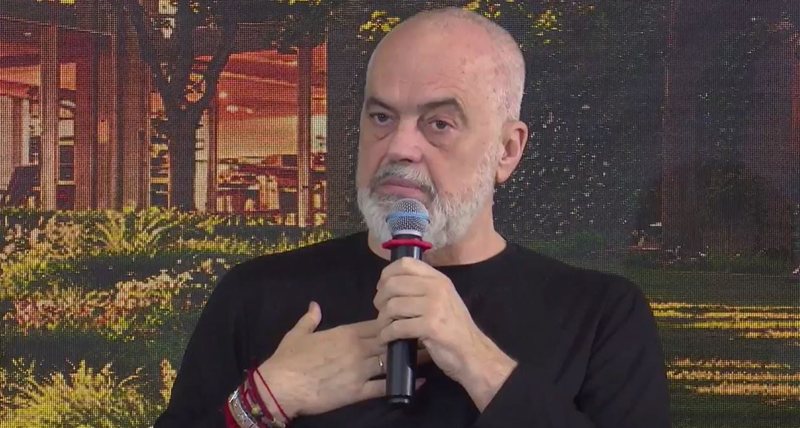
Speaking at a PS assembly, Rama argued that Albania faces a narrow and historically contingent window for EU membership, one that requires the party to consolidate power at the local level to sustain accession momentum. Blendi Klosi, the PS political director for Durrës, was present at the meeting. “We must do everything not to let that door close without entering,” Rama told the gathering, casting next year’s local elections as “more political than local” and urging unconditional support for the party on those grounds.
Rama invoked the language of historical inevitability, describing EU membership as a stone that fate had caused to fall on the Socialist Party’s back to carry up the final stretch and plant at the summit. The formulation collapsed the distinction between party interest and national interest in terms his critics are likely to contest, but it served his immediate purpose of elevating a municipal election cycle into a civilisational referendum.
He also addressed the Democratic Party’s claims that accession negotiations have stalled, rejecting them as fabrications. In a sardonic sequence reconstructing the full arc of the PD’s shifting foreign policy alignments, Rama recounted how the opposition had questioned his invitation to the Washington Peace Board summit, then claimed he was barred from attending a subsequent Swiss event, when in fact he had simply been with his daughter. When he did attend, both he and his interlocutors were accused of corruption. America, in the opposition’s narrative, then gave way to Germany as the new reference point. Rama promised to raise the German flag in Durrës’s Shijak neighbourhood in May, in the Lugina quarter specifically, daring the opposition to produce a veto against negotiations that he insisted does not exist anywhere in the process.
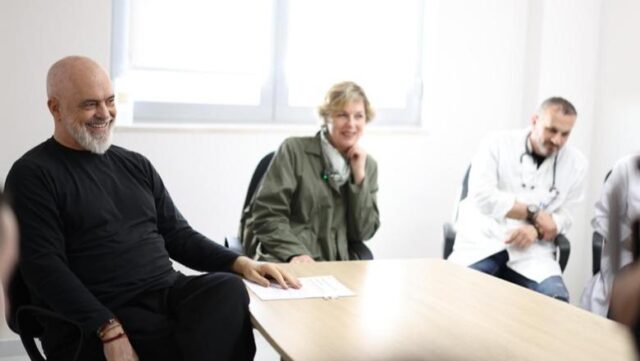
Earlier in the day Rama met with construction sector entrepreneurs, pushing back against parliamentary accusations that the industry serves as a conduit for criminal money laundering. He acknowledged that informality exists within the sector, and that problems in Albania are in some instances sharper than elsewhere, but rejected what he called the wholesale criminalisation of an industry that drives urban transformation and economic output. As a concrete rebuttal to the laundering narrative, he cited a single development project in which 350 apartments had been purchased exclusively by diaspora buyers, all paid through bank transfers rather than cash, representing one quarter of the total units in the complex. Tirana municipality had collected fourteen million euros in taxes from that project alone, a portion of which feeds into a three percent levy earmarked for social housing. The same project will deliver a nursery and kindergarten to the surrounding community, and the developer has committed to building a school on the condition that the municipality provides the land.
Addressing the entrepreneurs more broadly, Rama urged the industry to hold two considerations in balance: project quality and construction cost. He noted that building tall carries engineering and financial consequences that compound in distinct steps. What proceeds straightforwardly up to twenty floors enters a different category of structural complexity beyond that threshold, and crossing thirty floors introduces additional components absent from lower buildings entirely. The industry, he said, bears responsibility for managing those thresholds rather than simply chasing height.
At the PS assembly later in the day, Rama announced that the three percent construction tax levy currently collected and retained by individual municipalities will be consolidated into a single national housing fund. He cited Himara as the rationale for the change: the municipality generates substantial permit revenues given the volume of coastal development but has no significant local housing need, making municipal retention of the levy incoherent as social policy. The consolidated fund will finance affordable housing schemes targeting younger workers, teachers, police officers, and military personnel, extending a zero-interest credit programme the government has already launched for those categories.
The Durrës visit forms part of a broader mobilisation effort by the Socialist Party as it moves to lock in institutional and electoral momentum ahead of what Rama has positioned as the most consequential political cycle of his tenure.