Prime Minister Edi Rama used a Socialist Party assembly in Lezhë on Tuesday to reiterate the government’s EU accession timeline, announce a healthcare pay upgrade, and outline plans to redesign hospital management along a public-private hybrid model.
by the Newsroom (Tirana)
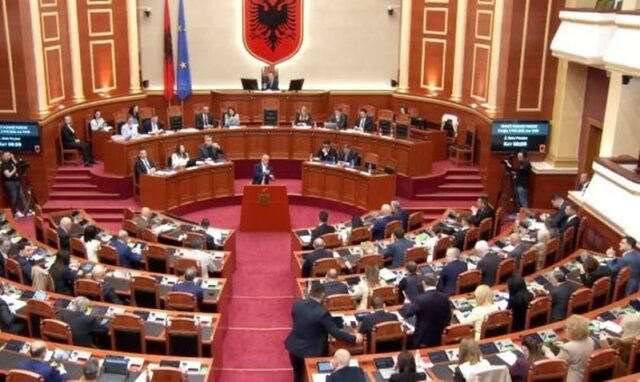
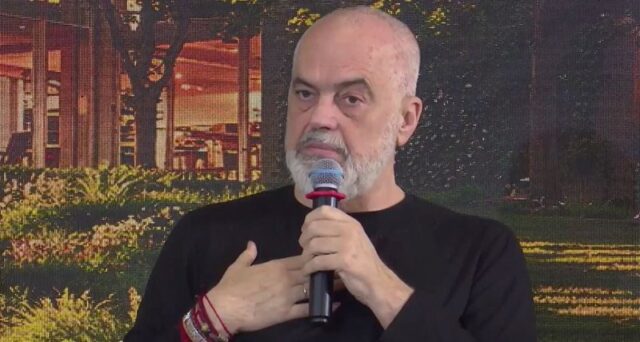
Prime Minister Edi Rama addressed the Socialist Party assembly in Lezhë on Tuesday in what amounted to a wide-ranging policy and political statement, covering Albania’s EU integration calendar, emergency physician pay, hospital management reform, and a financing initiative for small and medium enterprises.
The EU timeline
Rama used the assembly to defend his repeated assertion that Albania will become an EU member by 2030, a claim that has drawn sustained skepticism from the opposition. The prime minister insisted the projection is not a political promise but a function of a working calendar agreed with the European Commission, under which Albania is expected to complete its negotiating chapters by 2027. The subsequent two years would then be required for ratification across all 27 member state parliaments, bringing the timeline to 2030.
“When I said we would integrate into the EU by 2030, everyone said it was a lie,” Rama told the assembly. “In fact, it was an agreement with the European Commission to execute a work calendar.”
He acknowledged that unanimity among member states remains the decisive constraint, noting that a single veto from any EU capital would halt accession regardless of what Tirana delivers on its side. The prime minister described all negotiating chapters as having been opened in record time, crediting both his government’s work and what he characterised as political will from the EU side.
Corruption and the opposition
Rama responded to opposition characterisations of his government as corrupt with a flat rejection, though he stopped short of claiming corruption has been eliminated. His framing was comparative: no Albanian government has fought corruption more aggressively, he argued, and current levels are lower than at any previous point. He drew a contrast with conditions under Democratic Party governance, when citizens queued to pay electricity bills or obtain basic documents, presenting administrative modernisation as evidence of governance improvement.
The argument that wage and pension increases are incompatible with rising corruption also featured in his remarks, on the grounds that real income growth requires a healthier fiscal base, which he linked to reduced leakage.
Rama closed the political section of his remarks with a formulation that doubled as a warning to his own party: if Albania fails to enter the EU while the current opportunity is open, history will not forgive the Socialist Party.
Emergency physicians
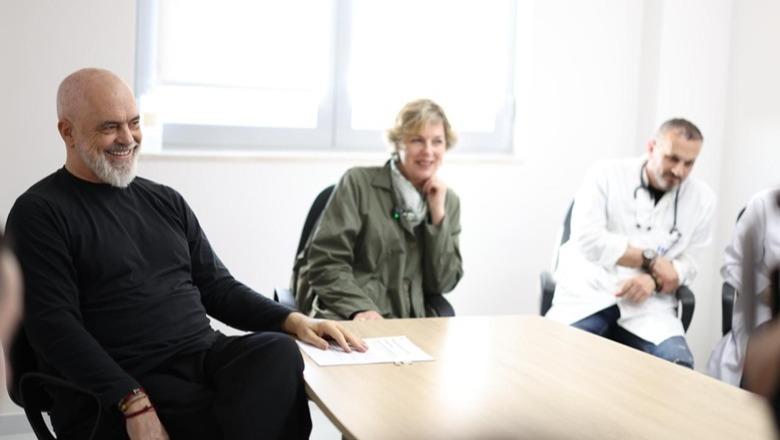
Earlier in the day, following an inspection at the new Regional Hospital in Lezhë, Rama announced that emergency medicine physicians will be reclassified as specialists for pay purposes starting in June, aligning their salaries with those of other specialist doctors. The move comes in response to what the prime minister described as a shortage of applicants for emergency positions, which he attributed to the pay differential between emergency and specialist tracks. The announcement was framed as a mid-year budget adjustment, consistent with the government’s practice of biannual salary revisions.
Public hospital, private unit
The more structurally ambitious announcement from the Lezhë hospital visit concerned hospital management. Rama said the government is examining a model in which a private clinical unit would be embedded within public hospitals, operating as part of the hospital’s internal structure rather than as an external concession. He cited consultations with two major international hospital management groups — both of which had been engaged in discussions specifically concerning Mother Teresa University Hospital — noting that each independently recommended the same approach. He referenced Poland’s reform experience as a reference point.
The logic behind the model, as Rama described it, is to give hospital physicians a co-ownership stake in clinical outcomes and an income stream linked to performance, as a mechanism to retain staff and improve service quality. He also signalled that fee differentiation for foreign tourists using public hospital services is under consideration.
Rama welcomed the decentralisation of oncology services, specifically the planned establishment of chemotherapy units at regional hospitals, as a measure that would reduce the burden on central facilities and bring treatment closer to patients outside Tirana.
SME financing
In Durrës earlier on Tuesday, accompanying Mayor Emirjana Sako and Economy and Innovation Minister Delina Ibrahimaj during an inspection of an industrial complex engaged in electronics recycling and precious metals extraction, Rama announced a new financing instrument targeting small and medium enterprises. The initiative, operating under the “Double Your Enterprise” platform, will make available credit facilities of up to two million euros to businesses that commit to growth plans and investment in labour conditions. The programme is intended to be simpler and more accessible than existing credit mechanisms.