This editorial examines a statement issued by the European Federation of Journalists that has circulated internationally as evidence of a press-freedom violation in Albania, in light of the full video record of the exchange now publicly available.
the Editorial Board (Tirana)
The international criticism directed today at Edi Rama, Prime Minister of Albania, originates from a report published by Syri TV. Before any verdict is accepted, the source deserves to be examined carefully — because the source itself explains almost everything about what followed.
This is how the article described the press-conference exchange:
“Prime Minister Edi Rama lost control when a Syri TV journalist asked him a question about prisoners lacking electricity and water, and about the strong defense the Socialist Party gave to Belinda Balluku even though SPAK had requested her arrest.”
The article continues:
“Trying to twist his answer, Rama hoped he could hide the truth that has already come to light and did not hesitate to accuse the Syri TV journalist and the outlet she represents of lies and abnormal insinuations that sounded like statements from a prosecutor.”
The report then adds:
“Meanwhile, it is reported that Rama told the Syri TV journalist that she is permanently excluded from the Prime Minister’s press conferences.”
And finally the article concludes with an explicit political judgment:
“This is an unprecedented event in our country. Fear of free media shows that the kleptocratic regime is nearing its end.”
Those are the words of the report itself.
No transcript of the exchange.
No video presented at the time of publication.
No independent verification.
Instead, a politically saturated narrative published by a television channel with a well-documented editorial hostility toward the Albanian government — describing a press conference it had not yet shown to its own audience.
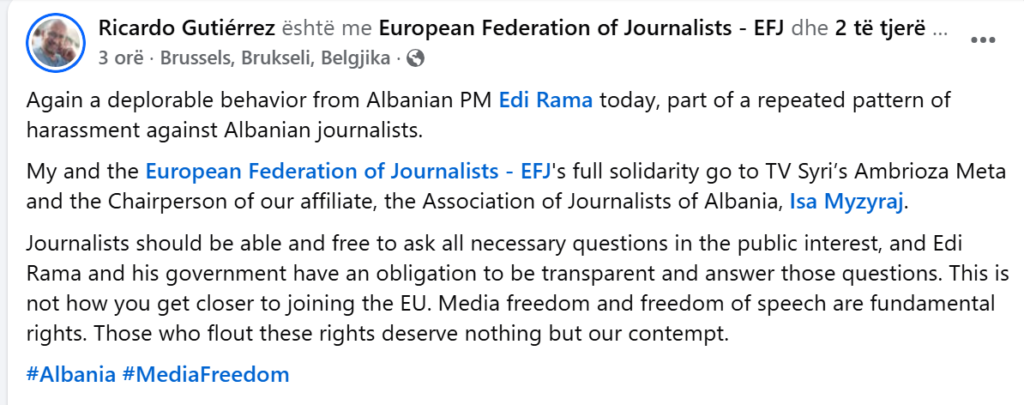
From this text — and apparently from nothing else — Ricardo Gutiérrez, Secretary General of the European Federation of Journalists, issued the following international condemnation:
“Again a deplorable behavior from Albanian PM Edi Rama today, part of a repeated pattern of harassment against Albanian journalists.”
He then went further:
“Those who flout these rights deserve nothing but our contempt.”
That is a remarkable statement for the head of Europe’s largest journalists’ federation to make about the elected leader of a democratic country.
It is also a statement that appears to have been issued before examining the most basic piece of evidence available.
Because there is now a full video of the exchange.
The footage runs for approximately thirteen minutes and shows the entire interaction between the Prime Minister and the Syri TV journalist.
What it shows is not a journalist being silenced.
It shows a prolonged exchange in which the journalist repeatedly interrupts the Prime Minister while he is attempting to respond. The interruptions are not momentary. They continue throughout the exchange — across thirteen minutes, on camera, in a room full of other journalists.
Watch it. Then read Gutiérrez’s statement again.
“Again”
The statement opens with the word again — a word that presupposes a prior established violation. It is not an assertion to be proven. It is presented as settled history, inserted before a single fact has been established.
For a reader unfamiliar with Albania, again performs the work of an entire evidentiary record that does not exist in the statement.
It is the rhetorical equivalent of beginning a criminal indictment with the words as usual.
“Deplorable behavior”
“Deplorable” is a word of strong moral condemnation. It belongs to a register used for serious ethical breaches — not for heated press conferences.
More importantly, the statement does not specify what the behavior was. There is no description of the exchange, no account of what was said, and no indication that Gutiérrez had reviewed a primary record of the interaction before publishing.
The condemnation arrives before the facts.
That is not advocacy. It is a verdict without a trial.
“Full solidarity”
Solidarity is a legitimate expression of support. But solidarity issued before the facts are established is not neutrality — it is partisanship.
When the EFJ declares solidarity with a journalist from a politically aligned outlet while making no attempt to verify the account that triggered the controversy, it ceases to function as a neutral monitor of press freedom.
It becomes an actor in a domestic political dispute.
“Harassment”
In press-freedom discourse, harassment has a specific meaning: sustained, targeted conduct designed to intimidate or silence journalists — legal threats, surveillance, physical intimidation, or systematic exclusion from professional access.
Applying the term to a combative press-conference exchange — one in which the journalist herself interrupts continuously for thirteen minutes — is not proportionate.
It dilutes the meaning of genuine harassment cases.
“Part of a repeated pattern”
This is the most consequential phrase in the statement.
In European institutional language — in Commission rule-of-law monitoring and accession reports — pattern signals documented, recurring behavior that rises above the level of an isolated incident.
Gutiérrez knows this. Yet his statement cites no previous incident, no documentation, and no timeline.
“Repeated pattern” is presented as an established fact when it is, in reality, an unsupported assertion.
“This is not how you get closer to joining the EU”
This is the most politically calculated line in the statement.
It is not a description of events. It is leverage.
In Brussels advocacy circles this technique is familiar: link an incident involving a candidate country to its EU accession path and the statement immediately acquires geopolitical weight it would not carry if directed at an EU member state.
A comparable press-conference confrontation involving a French or German minister would not generate a warning about that country’s relationship with the European Union.
“Those who flout these rights deserve nothing but our contempt”
This sentence should follow Ricardo Gutiérrez into every Brussels meeting room where the credibility of the European Federation of Journalists is discussed.
“Contempt” is not diplomatic language. It is the language of moral disqualification — language that places its target beyond the reach of reasoned engagement.
Directed at the elected leader of any EU member state over a combative press-conference exchange, it would almost certainly have generated immediate demands for retraction.
Instead it was directed at the Prime Minister of Albania — a democratic country with a pluralistic and aggressively adversarial media landscape — on the basis of a partisan article and without verification.
That is the entire statement. Six sentences. Every one of them a choice.
Taken together, those choices describe not a press-freedom intervention but a political act — one that borrows the language of journalism’s highest values to deliver a result those values explicitly forbid: condemnation before evidence.
Press freedom guarantees the right of journalists to ask questions and publish their reporting. It does not oblige political leaders to absorb continuous interruption without response, nor does it require them to answer every question to a journalist’s satisfaction.
Refusing to answer is not censorship.
A heated exchange is not harassment.
Press conferences are moderated events, not unlimited forums. Governments routinely regulate speaking time and intervene when exchanges become disruptive, particularly when multiple journalists are present. Ending or limiting an exchange may be controversial, but it is not in itself evidence of censorship or harassment.
What transforms a press confrontation into a press-freedom violation is something categorically different: censorship, intimidation, legal persecution, or violence against journalists.
None of those elements appear anywhere in the material that triggered this controversy.
This matters beyond Albania.
Ricardo Gutiérrez leads an organization whose authority depends entirely on credibility — on the assumption that when the European Federation of Journalists speaks, it has done the work.
When that credibility is spent on a condemnation issued from a partisan source without verification, without evidence of a pattern, and without watching the thirteen-minute video that was available before the statement was published, something institutional is damaged.
And it is not Albania’s reputation.
The video is public.
The source text is quoted above in full.
Both were available before Ricardo Gutiérrez issued his statement from Brussels.
The standards he claims to defend required him to examine both first.
He did not.