By The Fact Check Desk (Tirana)
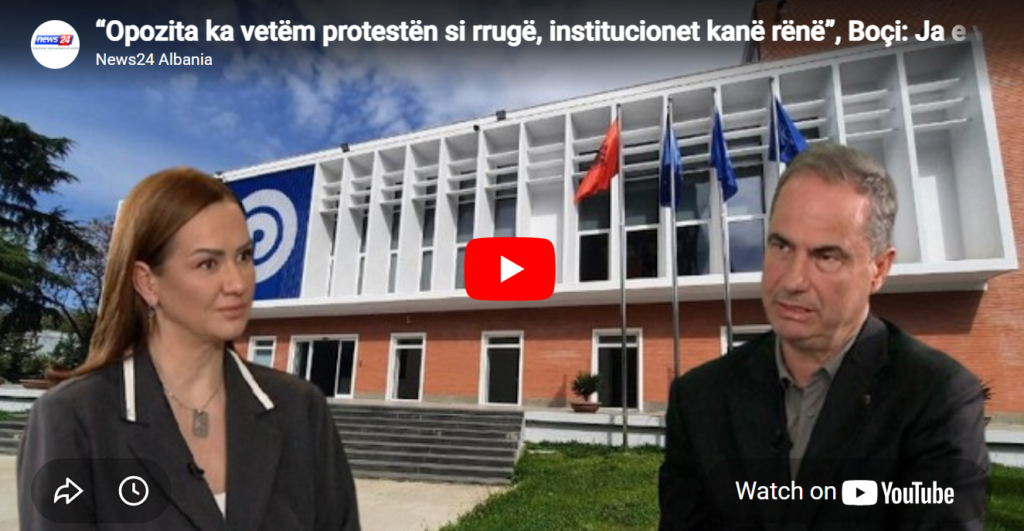
Luçiano Boçi appeared on News 24 on March 26 and said, with considerable confidence, that Albanian institutions have collapsed, that the opposition bears no blame for political violence, and that Germany’s Embassy effectively endorsed the Democratic Party’s conduct. The record says otherwise on all three counts. What follows is the record.
Claim 1
“The three pillars of the state, Parliament, justice, and institutions, have collapsed, leaving protest as the only path.”
This is a political slogan dressed as a constitutional diagnosis. The claim that institutions have “fallen” is not a finding; it is a rhetorical posture, and it requires evidence that Boçi does not supply. What he means, stripped of the drama, is that institutions are not doing what he wants them to do. Those are different propositions.
The strongest refutation comes from the opposition’s own preferred example. SPAK is operational, independent, and producing results that generate genuine political earthquakes. It investigated a sitting minister. It applied a security measure against the Deputy Prime Minister. It produced a case file that forced a parliamentary confrontation and drew sharp reactions from the EU and Western embassies. An institution that has “fallen” does not do any of that. The opposition cannot simultaneously argue that institutions have collapsed and that SPAK is soft-pedalling its most important cases. One of those arguments has to give, and the public record decides which.
Parliament, the second pillar named, continues to convene, legislate, and seat an opposition that uses its floor. That floor is precisely the platform from which Boçi and his colleagues reach the public. The parliamentary system’s shortcomings are real and worth debating on their specific terms. But shortcoming and collapse are not synonyms. Boçi’s conflation of the two is not a description of Albanian institutions. It is a description of his party’s political needs.
Claim 2
“The government is corrupt and linked to organized crime.”
This assertion is the oldest item in the Albanian opposition’s inventory, and its age has not made it more precise. Boçi offers no specific allegation, no name, no transaction, no institution implicated. Delivered without evidence at a television appearance, it is not a contribution to accountability. It is a substitute for one.
The distinction matters. Serious reporting and judicial records do document connections between political networks and criminal structures in Albania, and those connections deserve sustained investigative attention. But that work requires specificity: a named official, a documented transaction, a traceable chain. A blanket accusation trains audiences to treat serious claims as the routine background noise of political life, which is precisely the condition under which genuine corruption thrives. Boçi’s claim does not threaten the government. It insulates it, by making every future specific accusation sound like more of the same.
If the Democratic Party has evidence, the place for it is a SPAK referral or a documented parliamentary filing. What Boçi offered instead was a posture. Those are not the same thing, and the difference is not procedural. It is the difference between accountability and its performance.
Claim 3
“The opposition bears no responsibility for violence at the protest. The State Police escalated the situation.”
The denial deserves scrutiny it did not receive in the broadcast. The protest of March 22 produced documented scenes of confrontation. Reporting by Timoni and Shqiptarja documented six injured officers on that night alone. Boçi’s blanket exculpation of the opposition does not dispute that figure. It ignores it entirely, which is precisely what Sali Berisha did four hours after the German Embassy’s statement landed, when he declared that “not a single police officer has been injured.” The leader’s denial and the deputy chairman’s denial are the same denial, issued four days apart. A party that cannot keep its fabrications consistent across a single week has not earned the benefit of the doubt on a question of fact.
Legitimate questions about police conduct, including the use of force against Berisha and other figures, are worth investigating seriously and on the full record. This newspaper has pressed those questions and will continue to. But the serious investigation of police excess and the serious investigation of opposition conduct are not mutually exclusive. Boçi frames them as if they are because acknowledging both would require the Democratic Party to answer for its own.
An opposition that demands institutional accountability cannot apply situational standards to accountability itself. The argument that police must answer for their conduct while the opposition operates without equivalent scrutiny is not a democratic position. It is a shield dressed as a principle, and the six injured officers are what it is designed to cover.
Claim 4
“Germany’s reaction vindicated the opposition’s conduct. It was a diplomatic statement that maintained balance and condemned violence against individuals.”
Boçi is summarizing a diplomatic statement he did not write and attributing to it a meaning that serves his political purpose. That is worth naming plainly, because the Embassy’s actual language does the opposite of what he claims.
The German Embassy statement was not a balanced communiqué weighing both sides of the confrontation. It used one word as its operative demand: unequivocally. “We call on representatives of responsible political parties to distance themselves unequivocally from violence.” There is no interpretive latitude in that construction. The Embassy was not maintaining balance. It was issuing a directional demand addressed to the Democratic Party by name.
What the Embassy received in response, four hours later, was a statement from Berisha that erased the six injured officers from the picture, preserved the doctrine that “in the conditions of a coup all means are legitimate,” and offered nonviolence as the more productive path for now rather than as an unconditional moral commitment. Boçi on March 26 was still defending that response, recasting Germany’s demand as diplomatic vindication. The Embassy asked for one thing. It did not receive it. Presenting the exchange as endorsement is not a misreading of the diplomatic record. It is an inversion of it, and Boçi knows the difference.
Claim 5
“The blocking of investigative committees and restrictions on parliamentary debate have forced the opposition to choose protest.”
There are documented cases of investigative committee formations being obstructed or their scope constrained by the majority. That part of the claim rests on a factual foundation and deserves to be stated plainly. Albania’s parliamentary oversight mechanisms have, at specific documented moments, been weakened by majority action.
But Boçi presents this as the exhaustion of all institutional options, and that conclusion does not follow. Parliamentary minorities possess tools beyond committee chairmanships: floor debate, formal motions, public records requests, referrals to independent institutions, and the sustained use of the legislative record as a documentary foundation for political argument. The opposition has used some of these tools intermittently and abandoned others without explanation. Protest is not what remains after everything else has failed. It is what the Democratic Party has chosen while other options remain unused.
Claim 6
“Investigations into senior officials, including Belinda Balluku, are not being properly handled. There are indications of corruption and misuse of funds that justice is not pursuing.”
This is the most internally contradictory claim Boçi made, and it passed without challenge in the broadcast.
The Balluku investigation is real, active, and consequential. SPAK applied a security measure against the Deputy Prime Minister. That measure was contested before GJKKO, generating a documented legal dispute that is part of the public record. The case produced a political crisis severe enough to draw EU and Western embassy reactions, to restructure dynamics within the majority, and to force a sequence of parliamentary maneuvers whose effects are still unfolding. By any reasonable standard, this is a prosecution being handled actively and publicly by the very institution Boçi is accusing of inaction.
He may be dissatisfied with specific procedural decisions SPAK has made. That is an arguable position and one this newspaper takes seriously. But characterizing the Balluku case as evidence that justice is failing to pursue corruption requires ignoring the bulk of what has actually occurred in the case. Boçi chose as his proof of institutional failure the single case that most visibly disproves it. That is not a political argument. It is a political error, and it is the kind that only happens when you assume no one will check.
Claim 7
“The justice system applies double standards and fails to act on significant cases.”
The double standards accusation is the broadest claim in the set and the one most in need of specificity. Which cases. Which standards. Compared to what benchmark. Applied by which body within a justice system that now includes SPAK, GJKKO, the High Court, and the Constitutional Court as distinct institutions that do not always move in alignment. Boçi supplies none of these answers because the claim was never designed to be tested. It was designed to be felt.
The Albanian justice system has documented inconsistencies worth serious examination. The vetting process produced outcomes that serious observers have questioned on methodological grounds. The relationship between the ordinary court hierarchy and the specialized anti-corruption track raises legitimate procedural questions this newspaper has examined in detail. But Boçi is not making those arguments. He is standing near them, borrowing their credibility, and contributing nothing to the analytical work they require. The double standards accusation deployed as atmosphere rather than finding is not accountability politics. It is the performance of grievance by a party that has confused the two for long enough that the distinction may no longer be visible to it.
The pattern across all seven. Each claim follows the same structure: a real underlying concern, extended beyond what the evidence supports, stripped of the specificity that would make it falsifiable, and delivered with a confidence that assumes the audience will not check. That is not political opposition. It is political theater, and the distinction matters because the problems Boçi gestures toward are real. Albania’s institutional record is genuinely imperfect and genuinely worth challenging. But imprecise accusations against imperfect institutions do not strengthen accountability. They dilute it, claim by claim, appearance by appearance, until the accusation itself becomes the noise it was meant to cut through. At that point, the opposition is no longer holding power to account. It is providing power with cover.