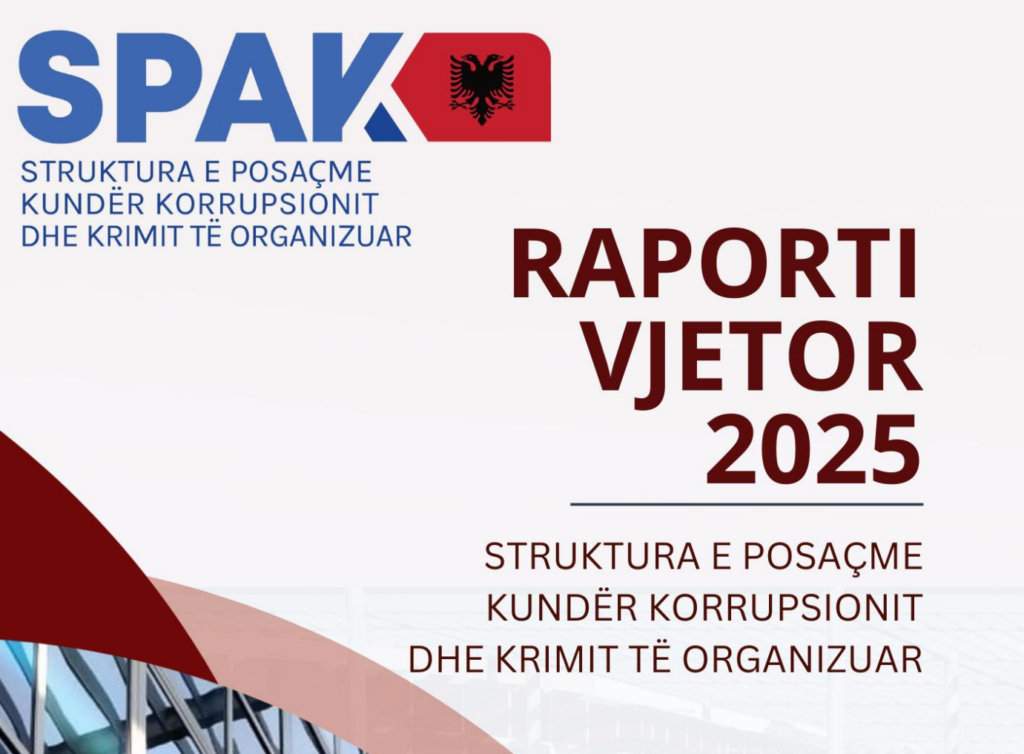
Three sentences on page 11 of SPAK’s 2025 statutory report raise a question that Albania’s institutional architecture has not yet had to answer: where does prosecutorial independence end and institutional insulation begin?
by Albatros Rexhaj (Tirana)
SPAK’s 2025 Annual Report was submitted to parliament in early 2026 under constitutional obligation. Most of it does what such documents are designed to do: account for caseload, effectiveness, budget, and institutional development. The European Commission’s own assessments are cited approvingly throughout. On most metrics, the picture is one of consolidation.
One passage, on page 11, does something different.
“Political and media rhetoric can influence public perception and institutional authority, and can serve as a driver for increasing the level of threats from organized crime. SPAK would consider particularly alarming those initiatives or measures of a legal or institutional character that would aim at limiting its procedural tools and its independence. Such interventions would constitute a serious risk to SPAK’s constitutional function and to the rule of law itself.”
The rest of the report accounts for what SPAK has done. This passage addresses what others should not do. That is a different kind of document.
The Institutional Tension
The concern underlying the passage is legitimate and well-established. Prosecutorial independence is a structural requirement for anti-corruption enforcement. Venice Commission standards, Council of Europe recommendations, and the EU’s own rule-of-law framework all recognize that prosecutors must be shielded from political pressure — and Albania’s justice reform was designed precisely around that principle.
The issue here is not the concern. It is the instrument chosen to express it.
SPAK’s annual report is an accountability document addressed to parliament — the institution constitutionally empowered to oversee SPAK and, where it judges necessary, to amend the laws under which SPAK operates. Using that document to warn parliament that legislative initiatives affecting the institution would endanger the rule of law itself inverts the logic of the accountability relationship. The report is designed to address parliament. This passage reads as a pre-emptive response to it.
That distinction — between independence and insulation — is one that Albania’s justice reform was designed to balance carefully. The passage on page 11 does not observe that balance.
Two Details the Report Does Not Explain
The passage would be easier to read as routine institutional caution were it not for two further elements in the same document.
The first is a data table on page 41, tracking investigations initiated by referral source over five years. Referrals from political subjects fell from 57 in 2021 to 10 in 2025 — nearly halved in a single year, and down 82 percent from the peak. The report records this in a single sentence and offers no explanation. No analysis, no contextualisation, no follow-up. For a document that runs to 120 pages and accounts for most institutional metrics in considerable detail, the absence of comment on an 82 percent five-year decline in a named category is notable.
The second is on page 83, in the media and communications section. The report lists all significant interviews given by SPAK prosecutors during 2025. Entry seven, dated 20 December — two days before the outgoing chief prosecutor handed over to his successor — reproduces the following headline verbatim, as institutional record:
“Altin Dumani, the prosecutor who dared and doesn’t back down. The final interview before handing over his duties — the head of SPAK tells all.”
The report cites this without comment. A departing chief prosecutor’s exit framed in those terms, preserved in a statutory document, is the closest the report comes to naming a pressure it otherwise only implies.
Neither detail, taken alone, is conclusive. Together, and alongside the passage on page 11, they suggest that what reads as abstract institutional caution may be something more specific: a signal embedded in a document of record, addressed to an audience that will know how to read it.
Why the Framing Is Problematic
The passage conflates two categories that democratic systems treat as distinct. One is political interference with specific prosecutions — a genuine threat to the rule of law, well documented in the region, and appropriately resisted. The other is democratic scrutiny of prosecutorial institutions: parliamentary debate, media investigation, civil society evaluation, legislative reform.
Placing both within the same threat register — and linking both to organized crime pressure — is a significant rhetorical move for a formal accountability document. It implies that criticism of the institution and interference with the institution are variations of the same problem. They are not.
The rule-of-law formulation in the final sentence compounds this. The rule of law is not coextensive with any single institution. It includes prosecutorial independence, but it equally includes parliamentary sovereignty, judicial review, and institutional accountability. When a prosecution body characterises legislative constraints on its powers as a risk to the rule of law itself, it has made a claim that goes beyond defending its mandate. It has positioned its operational autonomy as a systemic principle that other democratic actors may not disturb.
That is an argument worth having in Albania. It is not an argument that belongs in an annual accountability report.
Albania’s justice reform created SPAK on a clear premise: that effective anti-corruption enforcement requires institutional independence from political control. Ten years on, that premise remains sound. SPAK’s record — reflected in its own report — shows an institution that has delivered results, withstood pressure, and built credibility with international partners.
That record is precisely why the passage on page 11 warrants attention rather than dismissal. Strong institutions do not typically need to pre-empt scrutiny in accountability documents. When they do, it is worth asking what they are anticipating — and whether the instrument they have chosen to signal it is the right one.
Independence and accountability are not in tension in a well-functioning system. They are the same commitment, expressed in different directions. SPAK’s 2025 report should have demonstrated both. On page 11, it demonstrates only one.
Source: SPAK Annual Report 2025. “Problematikat dhe Sfidat” (Challenges to be Addressed), p. 11. Referral data table, p. 41. Media and communications section, p. 83.
About the author
Albatros Rexhaj is a well known author, playwright, and analyst whose work weaves literary prose, philosophy, and lived experience into thoughtful cultural and political insight. He trained in dramaturgy and screenwriting, holds advanced training in national-security studies, and has spent nearly three decades in political and security affairs before focusing on independent writing and research.