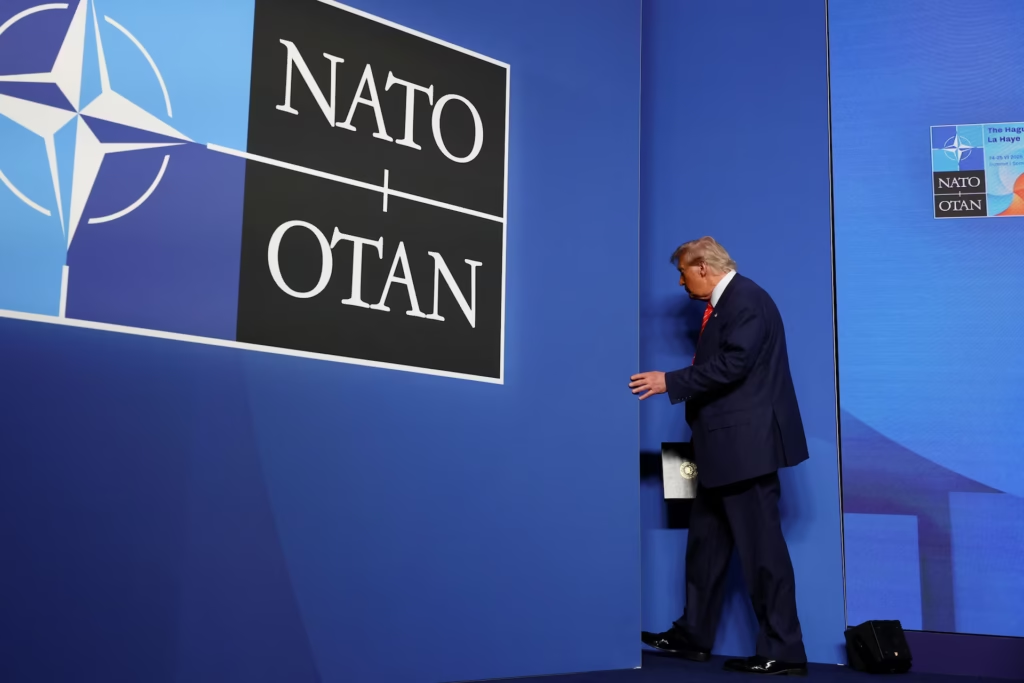
The Iran war has torn away the last polite fiction sustaining NATO. For Albania and Kosovo, two states whose entire post-war trajectories were built on the assumption of Western permanence, the consequences are not abstract.
by Klea Ukaj (Michigan, USA)
There is a sentence that does not appear in any official communiqué but that European governments have spent the past three months absorbing in silence. It was delivered by Secretary of State Marco Rubio with the flat affect of a man stating a self-evident truth: if the United States has reached a point where the NATO alliance means it cannot use member-state bases to defend American interests, then NATO becomes a one-way street.
Read that sentence carefully. It does not threaten withdrawal. It does something more corrosive. It reframes the entire postwar security architecture as a transactional arrangement subject to ongoing cost-benefit review, one that Washington will reassess once the guns in the Middle East go quiet. For seventy-five years, NATO has rested on a different premise entirely: that collective defense is indivisible, that an attack on one is an attack on all, and that the alliance’s value cannot be denominated in terms of access rights or basing availability. Rubio’s formulation did not merely challenge that premise. It suggested that Washington had already moved past it.
The immediate trigger was the Iran war. Spain closed its airspace to American jets. Italy refused permission for US military aircraft to land at a base in Sicily. Poland declined a request to redeploy Patriot air defense systems to the Middle East. These were not acts of hostility. They were acts of legal and political self-preservation by governments that had not been consulted on a war they did not support and that their own legal frameworks did not permit them to join. What European leaders mean when they call this war legally groundless is specific: the United Nations did not authorize it, it was not a war of self-defense against an imminent Iranian threat, and NATO allies were not consulted before the first strike was ordered.
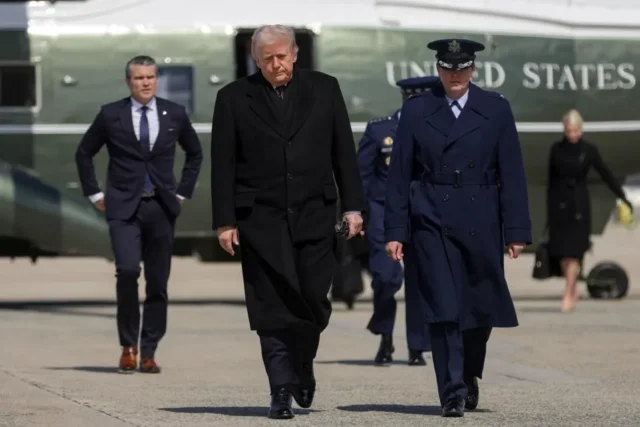
Trump’s response was to threaten. He warned France that “the U.S.A. will REMEMBER.” He mocked allies running short on jet fuel. And he did something no American president had done in the postwar era: he described the alliance that invoked Article 5 for the first and only time in history after September 11, 2001, on behalf of the United States, as a “paper tiger.” He then said, in the same week, that leaving NATO was “beyond consideration.” The contradiction is not confusion. It is a negotiating posture that has become a strategic doctrine, and the difference between the two has ceased to matter for the governments that must plan around it.
What has crystallized over these past months is not a crisis but a clarification. The 2026 US National Defense Strategy, published in January, made explicit what had been implicit since Trump’s return to office. Europe is no longer a priority theater for American conventional power. Washington will remain in NATO, retain its nuclear deterrent role, and provide what the strategy calls high-end enablers. It will no longer underwrite European conventional defense by default. European allies are described in the document as rich, capable, and therefore responsible for managing the Russian threat themselves. Influence within the alliance will henceforth be measured by deliverable military output rather than political alignment. States that spend, produce, and deploy gain access and leverage. States that do not lose both, without being formally excluded.
This is the world that small states in the Western Balkans now inhabit. And of all the countries in that region, none faces the combination of exposure and opportunity in starker terms than Albania and Kosovo: two entities whose modern political existence was constructed, almost entirely, on the assumption that American commitment to the region was a permanent feature of the international order rather than a policy choice subject to revision.
Albania’s strategic value to NATO has always rested on two pillars: geography and reliability. Its ports at Durrës and Vlorë are critical logistical nodes for Mediterranean operations. Its position at the junction of the Adriatic and the Ionian, bordering Greece and Montenegro while facing Italy across a narrow sea, makes it among the most consequential pieces of real estate the alliance holds in southeastern Europe. NATO inaugurated its first airbase in the Western Balkans at Kuçovë in March 2024. Negotiations are underway for a naval facility at Porto Romano. When alliance planners think about projecting stability into a region where neighboring states face more volatile internal conditions, they think about Albanian territory.
But leverage built on being useful to a patron assumes the patron remains engaged on terms that do not change without notice. Rubio’s one-way-street framing is not merely a complaint about basing rights in the Middle East. It is the operating logic of an administration that evaluates every alliance relationship by what it extracts, and that will apply the same logic to southeastern Europe the moment attention turns in that direction. Albania’s geographic indispensability does not insulate it from that assessment. It merely raises its profile in it.
Albania has read the signals with characteristic realism. When the Iran war began and the Western alliance fractured along a fault line between American demands and European refusals, Albania did not hesitate. It expressed unwavering support for US and Israeli military action, breaking publicly with several larger European partners. The calculation was deliberate: whatever Europe decides, Tirana will not appear in the column of those who told Washington no. For a country that spent the Cold War in ideological isolation, that lived through the collapse of its state in 1997, and that has staked its entire post-communist trajectory on Euro-Atlantic integration, the instinct to remain visibly aligned with American power is not merely strategic. It is existential memory.
That instinct is not wrong. But it is incomplete. Supporting the United States in a war that most of Europe opposed costs Tirana nothing in the short term and earns goodwill in Washington. The problem arrives when the question is no longer which side you stand on in a Middle Eastern conflict, but what happens when American commitment to European security is itself the variable under negotiation. On that question, vocal alignment defers the exposure rather than resolving it. A country that has organized its security architecture entirely around one patron’s good will is not secure. It is dependent, and the distinction matters precisely when the patron begins repricing its commitments.
The deeper issue is institutional. Albania is preparing to host the 2027 NATO Summit, the first time in its modern history that Tirana will serve as the seat of the alliance’s highest gathering. Prime Minister Rama has described the moment as unimaginable a generation ago: a country that once designated NATO as its primary enemy now welcoming every NATO head of state and government to its capital. The symbolism is genuine. But summits are snapshots. What matters is the architecture that outlasts them, and that architecture is under reconstruction in real time on terms that Tirana did not set and cannot control alone.
Kosovo is not a NATO member. That single fact, more than any other, explains why the transatlantic fracture lands with disproportionate weight in Pristina.
Albania chose Euro-Atlantic integration. Kosovo was born inside it. NATO’s 1999 intervention was not a diplomatic option that Kosovo’s leadership weighed against alternatives. It was the act of liberation that brought the country into existence as a political entity, ending a campaign of ethnic cleansing and replacing Serbian administrative control with international governance. The United States did not merely support Kosovo’s emergence. It authored it. Camp Bondsteel, the American military base near Ferizaj built in 1999 and now one of the largest US installations in Europe, is not simply a logistical asset. It is the physical embodiment of the guarantee that made Kosovo’s independence conceivable, the hardened steel expression of a commitment that no treaty obligated Washington to make and that no treaty can now be relied upon to sustain indefinitely.
The United States currently contributes roughly 600 troops to KFOR, the NATO peacekeeping mission, and leads Regional Command East from Camp Bondsteel, providing the intelligence, logistics, and command capacity on which the mission’s operational credibility depends. Reports of a potential American drawdown have circulated for months. Official denials have been issued. Bipartisan groups of US lawmakers wrote to Rubio warning against premature reduction. But the fact that official denial was necessary is itself the signal. Deterrence is a function of belief, and belief is a function of perceived political will. When allies publicly debate whether a guarantee will hold, the guarantee has already been partially degraded, regardless of what the troop numbers say on any given morning.
Beyond the military question, the US has suspended its strategic dialogue with Kosovo, citing the Kurti government’s actions as having increased tensions and instability. That suspension matters more than the troop question in the medium term. Washington’s direct bilateral engagement with Pristina has historically been the mechanism through which Kosovo navigates friction with Brussels, manages pressure from Belgrade, and maintains the political confidence that a small, partially recognized state requires to function. The EU is not structured to provide the same kind of direct political backing, and the Belgrade-Pristina normalization dialogue has produced no meaningful progress since the 2023 agreements whose implementation remains contested.
Into this situation, Kosovo’s constitutional crisis arrived with the precision of a stress test administered at the worst possible moment. The sequence is familiar: parliamentary elections in December, a prolonged recount, a new Kurti-led government formed in February, and then, within weeks, the failure to elect a president before the constitutional deadline, opposition parties boycotting the session, Osmani dissolving parliament on March 6, the Constitutional Court overturning the dissolution on March 25, and the assembly now under a 34-day deadline to elect a president or face a third election in barely more than a year. Kosovo’s constitutional architecture did not foresee this combination of pressures. No constitution does.
What the crisis reveals is structural. Kosovo’s political class is engaged in a competition for institutional control at precisely the moment when the external environment demands institutional coherence. The legal arguments on all sides are real. The Constitutional Court’s ruling reflects substantive constitutional interpretation, not merely political convenience. But the consequence, regardless of legal merit, is a country that has been functionally headless at the presidential level for weeks, whose democratic legitimacy is being contested through mechanisms that outside observers do not have the patience to follow in detail, and whose ability to project credible statehood to the partners whose support it most needs is being eroded in real time.
Serbia has registered all of this with precision. On March 30, Vučić called Putin. The topics discussed included strategic partnership, energy cooperation, and preparations for a bilateral meeting. The call was made at the initiative of the Serbian side, at the precise moment when European capitals were still absorbing the implications of the transatlantic fracture over Iran. Timing in this region is never accidental. Vučić has spent years constructing a political persona built on strategic ambiguity: maintaining formal EU candidacy while deepening ties with Russia and Hungary, pressing territorial claims on Kosovo while protesting that Serbia seeks only peace, acquiring advanced weapons systems including the CM-400 ballistic missile while accusing neighboring states of militarization. That strategy depends on a particular structural condition: that the Western alliance remains divided enough to be manipulated but coherent enough to keep demanding Serbian alignment as the price of EU accession. A NATO in which the American commitment to southeastern Europe is openly questioned does not hand Vučić what he wants. It hands him something more valuable: room to operate without consequence.
The regional response has been to build redundancy. In January 2026, defense officials from Croatia, Albania, and Kosovo met in Zagreb to deepen cooperation in military capacities, joint exercises, and defense industry coordination. A follow-up meeting of chiefs of general staff took place in Shkodër in February. The trilateral arrangement is a hedge against the scenario that should concern all three parties equally: that KFOR becomes less capable, that American attention migrates elsewhere, and that deterrence in southeastern Europe depends increasingly on what aligned states can generate among themselves.
The hedge is sensible. It is also a measure of last resort dressed as proactive strategy. Croatia, Albania, and Kosovo together cannot substitute for Article 5. They cannot deter a scenario in which Russian hybrid operations in the Western Balkans escalate while transatlantic attention is directed elsewhere, or in which Serbian political pressure on northern Kosovo intensifies at a moment when the KFOR command structure is uncertain about its mandate and its resources. The trilateral framework’s value is real but marginal. Its primary function, ultimately, is political: to signal to Belgrade and Moscow that the region’s NATO-aligned states have not been passively waiting for their guarantees to expire.
If the American commitment to European security has become the variable under negotiation, then EU membership has ceased to be merely an economic milestone or a rule-of-law benchmark. It has become a security architecture, the only institutional framework in the region capable of providing collective guarantees that do not depend on the political calculations of a single administration in Washington. The countries that complete accession before the transatlantic restructuring fully settles will find themselves inside that framework. The countries that do not will navigate a more dangerous neighborhood with fewer protections.
Albania is among the frontrunners for accession, with negotiations that could conclude by 2027. Kosovo’s path is longer, complicated by non-recognition among EU members and the unresolved normalization question with Belgrade, but the strategic argument for accelerating every possible element of European integration applies with equal force in Pristina. This is the logic that should be driving both governments’ calculations: not as a consolation prize for a weakening alliance, but as the primary institutional bet in an environment where the alternative is exposure to a patron whose one-way-street doctrine has not yet been fully applied to the Balkans but whose internal logic points in that direction.
The corruption challenge remains the variable that can frustrate this convergence for Albania. Anti-corruption proceedings involving senior members of the governing class demonstrate that institutions are functioning. That is genuine progress. But it is also a reminder that the political economy which built Albania’s Euro-Atlantic trajectory was not clean, and that Brussels retains both the tools and, under current strategic pressure, diminishing patience to deploy them as leverage. The external case for accelerating accession is powerful. Whether the domestic political class can avoid generating fresh grounds for delay is a question that geopolitical urgency alone cannot answer.
For Kosovo, the question is different in character but identical in urgency. A country that cannot elect a president, that may be heading toward a third election in a year, whose strategic dialogue with Washington is suspended, and whose ability to build regional security partnerships is being contested through legal instruments derived from its unresolved status, needs to demonstrate institutional coherence not because Brussels demands it in the abstract, but because the security environment now requires it concretely. The constitutional crisis will resolve. What it leaves behind will be a judgment, made in Washington and Brussels alike, about whether Kosovo’s political class is capable of governing under pressure.
In 1999, the United States led a seventy-eight-day air campaign to stop ethnic cleansing in Kosovo. It did so without UN Security Council authorization, citing a humanitarian emergency that the international legal framework was too slow and too captured to address. The political meaning was unambiguous: Washington was willing to apply military power in southeastern Europe to enforce a conception of human security that transcended sovereignty claims. That willingness was the founding premise of the post-war order in the Western Balkans.
Twenty-seven years later, European governments are citing the absence of UN authorization, the lack of allied consultation, and the principles of collective self-defense to refuse participation in an American war in the Middle East. The legal arguments are not dissimilar in structure. But the political meaning runs in precisely the opposite direction. The United States that intervened in Kosovo in 1999 was a country that believed its power carried obligations. The United States that is threatening to reassess its NATO commitments over basing rights in 2026 is a country that has concluded its power should serve its interests, narrowly and explicitly defined. Rubio’s one-way-street is the logical terminus of that conclusion, applied to the alliance as a whole.
Albania and Kosovo are not responsible for that shift. They are its most exposed inheritors. In 2027, Tirana will host every NATO head of state. Across the Adriatic and the Ionian, Kosovo will watch from outside the formal alliance whose intervention created it, still waiting for the institutional recognition that its independence has been demanding for nearly two decades. The summit will either confirm that the Western Balkans remains inside the architecture of Euro-Atlantic security, or it will demonstrate that the architecture itself has changed in ways that the region’s smallest states were the last to be told about. That is not a rhetorical choice. It is the actual decision that the next eighteen months will make, through accumulation of smaller decisions, in Tirana and Pristina and Brussels and Washington, mostly without anyone announcing that the decision is being made at all.
Klea Ukaj is an Albanian-American writer and civic commentator based in Michigan. Originally from Tirana, Albania, she holds a degree in Banking and is an active member of the Albanian-American community. She writes on Western Balkan and transatlantic affairs.