Albania’s opposition thinks it is attacking Rama. It is attacking SPAK.
by Eris Zenelaj (Tirana)
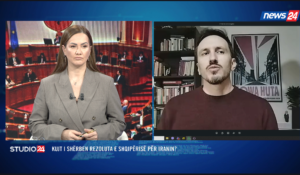
On the evening of 17 March, two opposition MPs sat for separate interviews on Studio24 and, without coordinating, made the same argument.
Erald Kapri of Mundësia was direct: “The one who benefits politically from this is Prime Minister Edi Rama, directly, because it connects directly to the bind he finds himself in with justice in Albania. Rama wants to present himself as America’s irreplaceable ally, hoping that the problem he has here will fade. SPAK has reached his doorstep.”
Redi Muçi of Lëvizja Bashkë, who abstained rather than voted against the Iran resolution, chose more careful language: “This great rush by Albania… appears to be simply moves to ease his position internationally — an attempt to be more Catholic than the Pope.”
Different parties. Different votes. Identical diagnosis: Rama is using Albanian foreign policy as personal legal insurance, and Washington is the underwriter. Follow that argument to its conclusion, and the target is not Rama. The target is SPAK.
The logic requires a corrupted institution
Kapri and Muçi are not arguing that Rama is cynically performing geopolitical loyalty for domestic consumption. They are arguing that the performance works — that a parliamentary resolution on Iran translates into prosecutorial leniency in Tirana. For that mechanism to function, SPAK cannot be what it was designed to be.
The design was deliberate and hard-won. The 2016 constitutional amendments created an institution insulated from executive pressure by architecture: a vetting process that removed compromised judges and prosecutors, an International Monitoring Operation that still oversees appointments, a Special Court with jurisdictional independence from the ordinary system. SPAK has since indicted Erion Veliaj, the sitting mayor of Tirana, and Belinda Balluku, a former defense minister and one of the most senior figures in Rama’s own government — officials who, not long ago, would have considered themselves beyond reach. That record is not nothing.
Kapri and Muçi’s argument requires you to set it aside entirely. It requires SPAK to be a weather vane, sensitive to diplomatic temperature, turning with the wind from Washington. If they are right, the vetting commissions, the IJC, the decade of painful institutional rebuilding — it all amounts to a facade. Behind the facade, the old logic still operates: legal jeopardy is a political variable, adjustable by the right phone calls and the right votes in the right assemblies. They may believe this sincerely. Many Albanians do. But sincerity does not make the argument less corrosive.
The rumor they are dignifying
The deeper irony is structural. Both MPs presented themselves as defenders of institutional integrity against a prime minister who subordinates everything to personal survival. Yet their own argument treats SPAK as an instrument, not an institution — one whose targeting decisions are readable as foreign directives, whose indictments are geopolitical signals, whose dropped cases are diplomatic favors.
This is a rumor ecology that already runs deep in Albanian political culture. The opposition does not invent it. Muçi’s abstention is worth pausing on. He did not vote against the resolution — he declined to endorse it while declining to oppose it, a position that requires its own justification. His justification was not procedural. It was motivational: he does not trust why Rama moved, and he does not trust that the timing is coincidental. That is a more careful formulation than Kapri’s, but it rests on the same foundation. If the motive is corrupt, the mechanism that makes the motive effective must also be corruptible.
But when elected representatives appear on prime-time television and argue that Rama can trade a parliamentary resolution for prosecutorial leniency, they give the rumors a respectable address. They do more damage to public confidence in Albanian justice than anything Rama has said — because Rama, at least, has an interest in projecting SPAK’s legitimacy. It is the institution pursuing him. Delegitimizing it would look self-serving. Kapri and Muçi have no such constraint. They are free to corrode it, and they are doing so while convinced they are defending it.
The systemic question they are avoiding
None of this means they are wrong about Rama’s motives. They are probably right. The Peace Board accession, the Iran designation, the careful cultivation of a pro-Washington image — these are consistent with a politician who understands that his legal exposure depends partly on whether powerful foreign actors decide his continued governance is useful to them. That calculation is real.
But if it is also decisive — if foreign governments genuinely can cool Albanian investigations — then the problem is not Rama’s cynicism. The problem is that Albanian institutions are not sovereign in the way the reform project promised. That is a systemic failure, not a personal one, and it demands a systemic answer: institutions insulated from the pressure that both sides of this argument assume is decisive.
Kapri and Muçi are not asking for that. They are asking for a different outcome from the same compromised system — one where the pressure runs against Rama rather than for him. That is not a defence of institutions. It is a bid to capture them.