A Belgrade security report barely mentions Albania. What it does say should alarm Tirana.
By Hajdi Xhixha (Tirana)
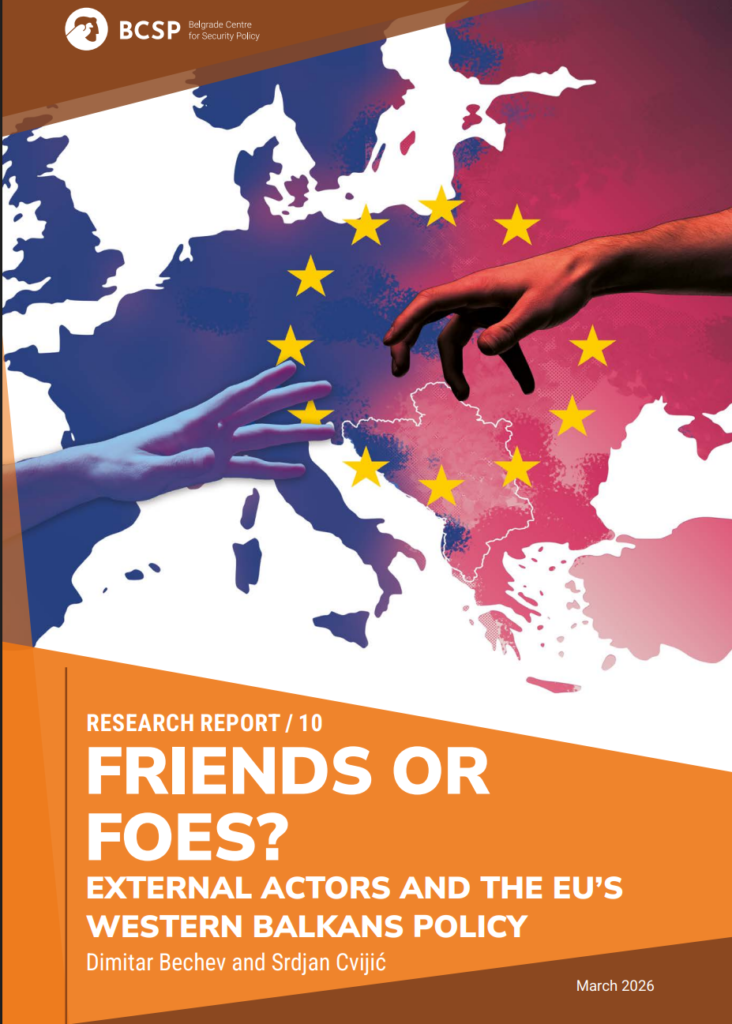
A research report published recently by the Belgrade Centre for Security Policy sets out to answer a question that Albania should be asking about itself but rarely does with sufficient rigour: who are the external actors shaping the Western Balkans, what do they want, and how compatible are their methods with the EU integration process that every government in the region claims as its primary strategic objective?
The report is titled “Friends or Foes?” Its authors are Dimitar Bechev, a senior fellow at Carnegie Europe, and Srdjan Cvijić, president of the BCSP’s International Advisory Committee. The analytical instrument they developed is called the Threatometer: a scoring framework that rates six external actors, Russia, China, Türkiye, the United Arab Emirates, Israel and Azerbaijan, across three criteria. The first measures how centrally the EU features in each actor’s regional strategy. The second measures how strongly each actor’s engagement threatens EU enlargement objectives, European values and the EU’s ability to act cohesively. The third measures the degree of overlap between each actor’s objectives and the EU’s stated priorities in the Western Balkans. Each criterion is scored on a five-point scale from very low to extremely high. The evidence base is 27 structured expert interviews conducted across the region in November and December 2025, combined with desk research and open-source triangulation.
The report was written primarily about Serbia. Albania appears in it as a data point: one of six Western Balkan countries navigating competing external agendas, a candidate hoping to join the EU by 2030, a recipient of Turkish mosque construction and Emirati real estate interest, a country whose prime minister is named, in a single charged phrase, alongside Aleksandar Vučić as one of the region’s aspiring strongmen. That phrase is not elaborated. It is not retracted. It sits in the Turkey chapter and the Tirana Examiner cannot afford to leave it there unexamined.
The BCSP’s central methodological claim, one that runs through every section of the report and underpins its entire analytical architecture, is that external influence does not operate primarily as an external imposition. It operates through domestic vulnerabilities and enablers: weak institutions, state capture by elites, polarised media environments. The report treats external influence and host-country conditions as analytically inextricable. This is the finding that makes a Belgrade-centred report directly relevant to Tirana. The question it forces is not what Russia or Türkiye or the UAE want from Albania. It is what conditions inside Albania make those wants satisfiable. The answers are not comfortable.
The Strongman Bracket and What It Costs
The report’s Turkey chapter contains the most politically significant Albania reference in the entire document. Describing Erdoğan’s cultivation of personal relationships across the Western Balkans, the authors write that the Turkish president maintains close ties with regional leaders, particularly the aspiring strongmen such as Aleksandar Vučić and Edi Rama.
The pairing is deliberate. Bechev and Cvijić are not polemicists. They are careful researchers with long regional track records. When they place Rama and Vučić in the same analytical bracket, they are making a structural observation about how Erdoğan reads and manages his Western Balkan relationships, and by implication about what those relationships reveal about the leaders he cultivates. Erdoğan does not invest personal diplomatic capital in leaders who are institutionally constrained, democratically accountable or procedurally predictable. He invests in leaders who have consolidated enough personal authority to deliver on commitments without legislative obstruction, judicial interference or civil society resistance. The aspiring strongman characterisation is not an insult in the BCSP’s usage. It is a description of the governance architecture that makes a leader useful to Ankara.
Applied through the report’s central methodological lens, the characterisation carries a specific implication for Albania’s EU accession trajectory. A consolidated executive with limited institutional countervailing power is precisely the domestic condition through which corrosive external engagement finds its most direct path. The report argues throughout that the highest combined risk profile emerges where three conditions coincide: the EU is a central reference point in an actor’s regional strategy, the actor has strong incentives and capabilities to exploit domestic governance gaps, and the actor’s objectives are in direct tension with EU conditionality and rule-of-law reforms. Albania under consolidated executive authority, attracting investment through elite-to-elite channels, pursuing a 2030 accession timeline conditioned on rule-of-law progress, satisfies all three conditions simultaneously for multiple external actors the report assesses.
Albania’s EU accession negotiations are advancing. The 2030 timeline has institutional backing from the European Commission and political support from key member states. The Growth Plan for the Western Balkans conditions increased financial assistance and market access on vigorous institutional reforms in rule-of-law areas. The tension between that conditionality architecture and the governance model the aspiring strongman characterisation implies is the central unresolved question of Albanian politics. This report names it from outside. What it names quietly and in passing, Albanian public debate should be naming loudly and continuously. Every month that passes without that reckoning is a month closer to 2030 and a month further from the institutional conditions actual EU membership requires.
Türkiye in Albania: Soft Power, Structural Footprint
The Turkey chapter gives Albania its most substantive direct treatment in the report, and the picture it assembles deserves more attention than Albanian commentary has given it.
The report scores Türkiye medium on EU prominence, medium on threat to EU enlargement and high on overlap with EU policy. The high overlap score reflects genuine contributions: Turkish troops serve in NATO-led peacekeeping missions in the region, Ankara has close bilateral ties with Albania and North Macedonia as NATO allies, and Türkiye’s cooperative turn in the early 2020s has positioned it as a regional security provider rather than a challenger to Western interests. These contributions are real. But the overlap score papers over dynamics that are Albania-specific and that a medium threat rating does not adequately capture.
Ankara exerts influence over Islam in the Balkans through the Directorate of Religious Affairs, the Diyanet, investing in Ottoman-era heritage restoration and supporting the construction of new mosques. The report singles out the grand mosque project in downtown Tirana as a specific example. This is not a bilateral cultural exchange between equals. The Diyanet is an instrument of Turkish state policy. Its expansion into Albanian religious life projects a specific model of state-managed Islam, one that serves Ankara’s regional influence objectives, into the institutional fabric of a country whose relationship to religious identity is historically layered and whose secular constitutional tradition has been among its more distinctive political achievements. The mosque in Tirana’s centre is not only a building. It is a permanent statement about whose soft power operates most visibly in the Albanian capital, and about who paid for it.
Türkiye’s soft power also operates through popular culture, television series and music, and through Istanbul’s pull as a global city. The report characterises this as part of Türkiye projecting an image of an alternative to the West and the EU. In Albania, where EU accession has historically commanded the strongest public consensus in the region, this projection competes with a deeply embedded pro-Western orientation. The competition is most effective not at the level of explicit geopolitical preference, where Albania’s Euro-Atlantic alignment remains firm, but at the level of cultural consumption, religious infrastructure and elite personal relationships. Public sentiment does not shift through declarations. It shifts through what people watch, where they pray, and who their leaders call when they need something done quickly and without procedural friction.
The defence dimension adds a further layer. The report describes Türkiye’s growing regional arms export presence, training relationships and joint exercises as instruments through which Ankara builds political leverage through security dependency. Albania is a NATO ally and formally aligned with Ankara on collective defence. But formal alliance and cultivated dependency are different things, and Erdoğan has demonstrated consistently that he manages both simultaneously without regarding them as constraining each other. For Albania, the question of what obligations that cultivated dependency creates, beyond the treaty obligations that are publicly legible, has not been examined with the rigour the depth of the relationship requires.
The report also documents, in its Kosovo section, that Turkish security services conducted seizures and transfers of individuals associated with the outlawed Gülen movement across the Western Balkans, in circumstances described as dubious and involving alleged cooperation of local security officials. This established a precedent for extraterritorial Turkish security operations in the region whose implications extend beyond Kosovo. Albania has its own relationship with the Gülen network and its own history of navigating Turkish pressure on that question. Those episodes sit in the background of every discussion about what Turkish security partnership actually means in practice for Albanian sovereignty. The Tirana Examiner has the sourcing and the obligation to bring them into the foreground.
UAE: The Waterfront Logic Arrives in Albania
The report’s UAE chapter is short and analytically dense, and every sentence of it that touches Albania should be read as a direct observation rather than a regional generalisation.
The authors score the UAE high on threat to EU enlargement (4 out of 5) despite scoring it only medium on EU prominence. That gap between prominence and threat is the chapter’s central finding. The UAE does not position itself as an ideological competitor to the EU. It does not run propaganda networks or cultivate nationalist sentiment. Its influence is structural and institutional, expressed through the governance arrangements underpinning large investment projects, and it is most damaging precisely because it does not announce itself as damaging. The threat pathway runs through governance: projects implemented through statutory exemptions, ad hoc legal regimes or preferential treatment deepen state capture dynamics and slow the reforms demanded under EU conditionality.
The report draws on a 2025 Carnegie Europe paper that states the argument in its starkest form: in systems where administrative capacity is weak and political discretion is strong, the race to attract capital erodes rather than strengthens institutions. Large-scale real estate and tourism projects are specifically identified as the highest-risk category, most exposed to discretionary exemptions, politicised zoning and limited public scrutiny. The Belgrade Waterfront is the flagship case. The report then states explicitly that potential UAE real estate developments have followed into Montenegro and Albania. Albania is named as part of the UAE’s active regional investment footprint, not as a future prospect.
The report also notes plainly that Dubai has become attractive not only for Western Balkans tourists and business interests but for the region’s organised crime, because of money laundering opportunities and the absence of extradition legislation. For Albania, whose organised crime exposure is among the most extensively documented in the region and whose relationship with Gulf financial centres has attracted sustained attention from European law enforcement and intelligence services, this is not regional background colour. It is a direct observation about the ecosystem within which Albanian-linked financial flows and UAE-linked investment interests intersect.
Corrosive capital does not require the investment to be explicitly corrupt. It requires the governance conditions under which it is negotiated to be opaque, discretionary and insulated from public scrutiny. The Belgrade Waterfront did not happen because Emirati investors are uniquely predatory. It happened because Belgrade’s governance conditions made it politically rewarding for the host government. The Tirana Examiner should ask, with specificity rather than with generality, whether Albania’s governance conditions are different in kind or only in scale. The aspiring strongman characterisation in the same report suggests the difference may be one of degree rather than of type.
Energy: The IAP Asset Albania Is Not Fully Using
The Azerbaijan chapter gives Albania its most concrete strategic reference in the entire report, and it points toward an opportunity that Albanian foreign policy has not translated into the leverage it warrants.
The report scores Azerbaijan high on EU prominence and high on overlap with EU policy, primarily because of its role in the Southern Gas Corridor, the infrastructure network the EU has prioritised since Russia’s 2022 invasion of Ukraine as its primary instrument for reducing dependence on Russian gas. The European Commission President made a high-profile visit to Baku in July 2022 and signed a memorandum of understanding committing Azerbaijan to deliver at least 20 billion cubic meters of gas annually to the EU by 2027. The completion of interconnector pipelines through Bulgaria has made Azeri gas physically available in the Western Balkans for the first time.
The report notes that Azeri gas might eventually supply Albania, Montenegro, Bosnia and Croatia if the long-discussed Ionian-Adriatic Pipeline is completed. Albania already hosts the Trans-Adriatic Pipeline. It is the most advanced Western Balkan country in terms of existing physical connectivity to the Southern Gas Corridor. The IAP’s completion would extend that connectivity through Albania to the Adriatic coast countries. The report’s “might eventually” formulation reflects the IAP’s long-pending status rather than any fundamental infrastructure barrier. The pipeline route exists. The political and commercial conditions for its completion have not been pursued with the urgency the EU’s energy diversification imperative now creates and rewards.
Countries that host critical EU energy infrastructure are not peripheral to EU strategic interests. They are embedded in them. That embeddedness is a form of leverage in accession negotiations and in bilateral relationships with key member states that Albanian governments have not consistently activated. The moment to make that translation is now, while EU energy diversification imperatives are at their peak and while the Southern Gas Corridor’s infrastructure map remains open to expansion. A window of strategic relevance that is not used is a window that closes.
There is also a diplomatic tension the report surfaces that Albanian foreign policy should be naming explicitly in Brussels. The Belgrade-Baku relationship was built on the analogy between Kosovo and Nagorno-Karabakh, with both governments consistently invoking territorial integrity as a shared organising principle in international forums. Azerbaijan has not recognised Kosovo. Albania has consistently supported Kosovo’s independence and international integration. The EU’s deepening energy dependence on Azerbaijan creates a structural tension between EU energy security interests and the political positions of EU candidates, including Albania, on questions where Baku and Belgrade are aligned against Pristina. This tension is not being addressed openly in European capitals. It should be. Albanian diplomacy is the natural voice to raise it.
The EU Credibility Test and the 2030 Bill
The report’s most consequential structural finding, the one that connects every section of this analysis and that Albanian politics should be unable to read without discomfort, concerns the conditions under which EU leverage operates and the conditions under which it fails.
EU leverage, the authors conclude, depends on presence, credibility and enforcement. Where accession timelines are uncertain or the EU’s presence is perceived as symbolic, external actors fill the void with faster capital and more emotionally resonant narratives. Research on corrosive capital, cited throughout the report, argues that delayed accession creates space for investors to exploit the gap between EU norms and domestic enforcement, particularly in real estate and strategic infrastructure. The EU’s competitors, Russia, China and Türkiye most explicitly, benefit from centralised decision-making where the personality of the leader plays an outsize role. They take advantage of transnational networks of political, business and civil society actors operating in conditions of non-transparency, poor legal oversight, clientelism and state capture. This is not a description of those external actors in isolation. It is a description of the interface conditions they exploit. Those conditions are most fully present where executive consolidation has reduced the institutional friction that democratic governance normally creates.
Albania’s position in this argument is different from that of Western Balkan countries with more distant or structurally blocked accession paths. Albania has candidate status, open accession clusters and a 2030 timeline with real institutional backing. The EU’s credibility as an anchor in Albania is not compromised in the way it is for countries where the formal preconditions for accession cannot be met without political decisions that lie outside the candidate’s control. In Albania, the preconditions are within reach. The question is whether the governing elite will make the choices those preconditions actually require, rather than the choices that preserve the consolidated executive discretion that makes Albania an attractive operating environment for external actors whose engagement is least compatible with EU membership.
The report identifies the interface conditions those actors exploit: strong executive discretion, weak institutional countervailing power, opaque investment processes, concentrated media, clientelist networks operating across borders. It then characterises Edi Rama as an aspiring strongman cultivated by Erdoğan precisely because those conditions are sufficiently present in Albania to make the cultivation worthwhile. The logical chain from that characterisation to Albania’s EU accession risk is not complicated. The conclusions it forces are not abstract.
Albania’s 2030 accession timeline is the most concrete test the EU’s Western Balkans enlargement policy faces in the near term. If Albania arrives at that date with its governance architecture substantially unreformed, with media concentration unaddressed, with investment processes that continue to prioritise elite relationships over transparent procurement, the date will pass and the timeline will be quietly extended. That outcome would not be a failure of EU policy alone. It would be the predictable consequence of Albanian politics choosing the short-term benefits of consolidated executive power over the institutional reforms that actual EU membership requires rather than merely claims. The EU has been willing in the past to reward the performance of compliance as a substitute for its reality. Albanian leaders know this and have sometimes relied on it. But the bill for that substitution is paid by Albanian citizens across decades of delayed institutional development, not by the leaders whose governance model makes the substitution necessary.
The Threatometer was designed to help policymakers, researchers and civil society identify where risks are most acute, recognise overlaps of interest and calibrate policy responses to sector-specific realities. Applied to Albania with the rigour Albania’s situation demands, it produces not a threat assessment but a mirror. What it reflects is a country with genuine EU accession momentum, genuine strategic assets in energy infrastructure, genuine Euro-Atlantic alignment, operating under governance conditions that are more hospitable to the wrong kind of external engagement than the 2030 timeline can absorb. The Threatometer scores external actors. It does not score the domestic conditions that make external influence possible. That scoring is the work of Albanian politics, Albanian civil society and this newspaper. The BCSP has provided the framework. The assessment is ours to make and ours to answer for.
Hajdi Xhixha is Assistant Professor and Dean of the Faculty of Political Science and Security Studies at the University for Business and Technology. Her research focuses on garrison state theory, grey-zone conflict, and democratic resilience under conditions of strategic competition. She writes on security architecture, authoritarian adaptation, and the geopolitics of the Western Balkans for academic and policy audiences. She is a regular contributor to the Tirana Examiner.