How Russian and Serbian state media built Albania into a threat narrative it has never thought to answer.
By Hajdi Xhixha
Albania does not feature prominently in its own information warfare threat assessment. It probably should.
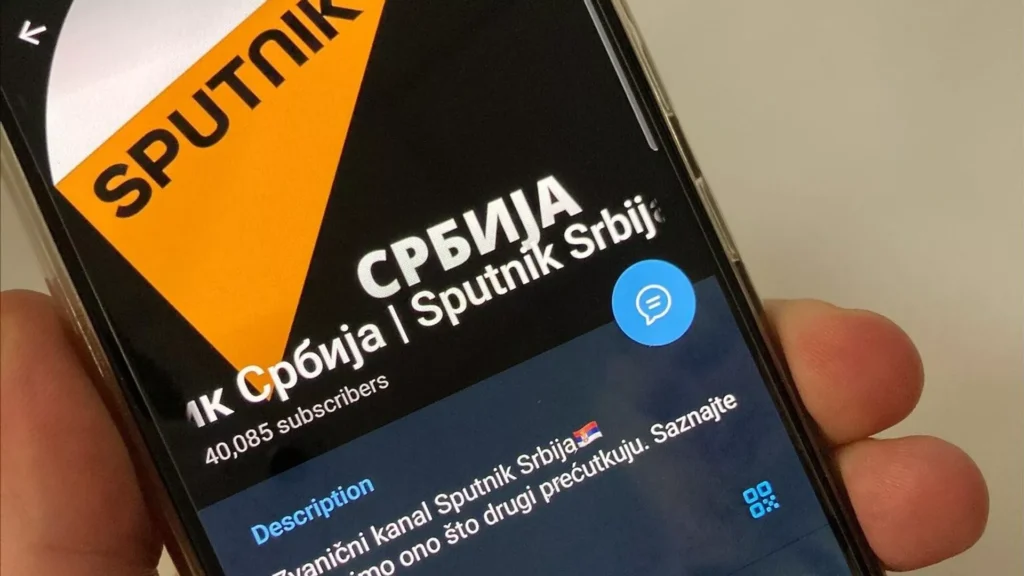
The Sputnik Serbia article published on March 24, ostensibly covering Kosovo Security Force participation in the NATO logistics exercise Mittelmark 2026, did not confine its threat architecture to Kosovo. It named, explicitly, what it called a “Trojni pakt Prištine, Tirane i Zagreba,” a triple alliance of Pristina, Tirana, and Zagreb, described as the most aggressively collaborationist formation in the new European order. The framing was not incidental. It was structural. Albania was not background context. It was a named co-conspirator in a narrative of civilizational aggression, placed alongside Croatia and Kosovo as the inheritors of wartime fascist collaboration, now operating as instruments of German-led European militarism directed at Russia and, by extension, at Serbia.
Tirana has not responded to this framing. It has not responded to any iteration of it. That silence has a cost that compounds with each repetition.
I. The construction of the axis
The “Pristina-Tirana-Zagreb axis” is not a description of a real political formation. Albania, Kosovo, and Croatia do not operate a joint foreign policy. They do not coordinate security strategy through a trilateral institutional framework. They share Euro-Atlantic orientation and, in the Albanian case, an ethnic and cultural solidarity with Kosovo that is both genuine and politically significant. None of this constitutes an axis in any meaningful sense of the term.
What Russian and Serbian state media have constructed is something more useful than a factual claim. They have built a symbolic formation, a shorthand that activates multiple memory registers simultaneously and requires no evidentiary support because it operates as association rather than argument.
The Croatian component invokes the Ustasha legacy, the wartime Independent State of Croatia and its documented atrocities, which remain among the most charged reference points in Serbian historical memory. The Albanian component invokes wartime collaboration with Nazi and fascist occupying forces in the Albanian territories, a contested and selectively deployed historical record that Serbian nationalist discourse has consistently instrumentalized to delegitimize Albanian political claims from the 1990s onward. The Kosovo component ties the formation directly to the institution whose NATO integration is the immediate occasion for the narrative’s latest activation.
Together the three components produce a symbolic object that does not need to be argued. It needs only to be named.
What is being constructed is not an alliance. It is a synthetic axis: a repeatable narrative device that requires no factual foundation because its function is not descriptive but operational. It does not map a political reality. It produces one.
Albania’s place in this construction is not peripheral. It is load-bearing. Without Tirana, the formation is bilateral, a Kosovo-Croatia alignment, which carries historical charge but lacks the weight of an Albanian state actor. With Tirana, the formation becomes a claim about Albanian state foreign policy, about the government of a NATO member and EU accession candidate as a participant in an aggressive anti-Slavic, anti-Russian project with fascist historical lineage. That is a categorically different claim, and it is the claim being made, repeatedly, in Serbian state media and its rebroadcasting ecosystem, about Albania.
II. What the framing does to Albania’s integration narrative
Albania’s EU accession process is at a delicate and consequential juncture. The opening of accession clusters, the conditionality architecture, the sustained institutional reform demands of the European Commission, all of this has proceeded against a backdrop of genuine political turbulence, judicial reform contestation, and the kind of internal governance pressures that make external narrative environments more consequential, not less. Albania’s claim on European integration rests substantially on the argument that it is a reliable, reform-committed, Western-oriented partner whose trajectory is irreversible.
The synthetic axis framing attacks that claim at its foundation. It does not argue that Albania’s reforms are insufficient, which is a legitimate debate conducted in Brussels and Tirana simultaneously. It argues something structurally different: that Albania’s Western orientation is itself the problem, that Euro-Atlantic integration is not a reform aspiration but a civilizational alignment with an aggressive anti-Russian project, and that Albania as a state actor is a willing instrument of that project rather than a sovereign nation pursuing its own interests.
This reframing has a specific target audience that is not Albanian. It is directed primarily at Serbian publics, at audiences in non-recognizing EU member states who are receptive to narratives about Western Balkans instability, and at the broader European right-wing information ecosystem that has shown consistent appetite for narratives positioning small Balkan states as proxies of American and German geopolitical ambition.
The accumulation of this framing over time shapes the political environment in which Albania’s EU accession is debated in European capitals. A European parliamentarian from a non-recognizing member state who has absorbed years of Serbian state media framing about the Tirana-Pristina-Zagreb axis does not encounter Albania’s accession candidacy neutrally. The frame has been installed. It does not announce itself. It simply shapes what feels plausible and what feels suspicious about Albanian foreign policy choices.
III. The Albanian institutional non-response
Albania has a Foreign Ministry. It has a government communications apparatus. It has diplomatic missions in every EU capital. It has a Prime Minister who is, by any measure, among the more media-fluent political operators in the region, and who has demonstrated capacity for rapid and sophisticated public communication when the political incentive is present.
None of these assets has been deployed against the synthetic axis narrative in any systematic way.
This is not a criticism of individual competence. It reflects a structural gap in how Albanian institutional actors conceptualize the information environment they operate in. The implicit assumption appears to be that Serbian state media narratives are a Serbian domestic problem, that their target audience is Serbian, and that Albanian engagement with them would dignify claims that are better ignored. This assumption is wrong on all three counts.
Serbian state media narratives about Albania are not confined to Serbian audiences. They enter the European information ecosystem through rebroadcasting networks, through politically aligned portals in Hungary, Slovakia, and elsewhere in Central and Eastern Europe, through social media amplification that does not respect linguistic boundaries, and through the secondary citation of their framing in European parliamentary debates and think tank publications that treat Serbian state media output as evidence of regional sentiment rather than as Kremlin-directed information warfare. By the time a narrative about the Tirana-Pristina-Zagreb axis reaches a policy discussion in Vienna or The Hague, it has been laundered through enough intermediary sources that its origin is invisible.
The argument that engagement dignifies the claim mistakes the operational logic of information warfare. The operation does not need a response to cause damage. It needs only an empty field.
There is a further dimension that the non-response fails to address. The synthetic axis framing circulates within the Western Balkans regional information environment, including in Bosnia and Herzegovina, in North Macedonia, and in Kosovo itself, where Serbian-language media ecosystems carry it to audiences whose political orientations are consequential to regional stability. Albania’s silence in these environments is not neutrality. It is absence. And absence in an information environment does not remain empty. It is filled by whoever is producing content.
IV. Why this moment is not like previous moments
The activation of the synthetic axis framing in the context of KSF NATO integration is not a routine iteration of a standing narrative. It is taking place at a specific convergence of pressures that makes its strategic logic more aggressive and its potential impact more consequential than previous cycles.
Kosovo’s security integration with NATO structures is accelerating. The KSF’s participation in Mittelmark 2026 is one data point in a trajectory that includes expanding bilateral security agreements, growing institutional presence in NATO exercise architecture, and the gradual normalization of KSF as a legitimate interlocutor in European security discussions. Each of these developments narrows the space in which the KSF’s legitimacy can be contested through conventional diplomatic means. Russia and the Serbian government have a shared structural interest in delegitimizing this trajectory before it becomes irreversible, and the information warfare toolkit is the primary instrument available to them.
Albania’s EU accession process creates a parallel pressure point. As Albania moves deeper into the accession architecture, its foreign policy choices become more scrutinized and more politically consequential in European capitals. The synthetic axis construction does more damage to Albania’s accession narrative at this stage of the process than it would have done five years ago, precisely because the stakes are higher and the audience more attentive.
The convergence of these two trajectories, KSF integration and Albanian accession, is not coincidental from the perspective of the information operation’s designers. Both processes threaten the same strategic interest: the consolidation of a Western-oriented, institutionally integrated Albanian political space that includes Kosovo as a legitimate security actor. The synthetic axis framing attacks both simultaneously, positioning Albania’s support for Kosovo’s security integration as evidence of the axis’s aggressive character rather than as a legitimate expression of Albanian foreign policy.
This is not episodic. It is coordinated pressure against a strategic objective, applied through a medium that leaves no diplomatic footprint and requires no official attribution.
V. What the silence costs
Albania will not be destabilized by Sputnik Serbia. That is not the relevant metric.
The relevant metric is cumulative reputational damage in the European policy environment where Albania’s accession candidacy is evaluated, where Albanian foreign policy choices are interpreted, and where the framing through which Albanian institutional actors are understood is shaped by years of narrative production that Tirana has chosen not to contest.
The synthetic axis is a fictional formation. But fictional formations, repeated with sufficient consistency across a sufficiently wide distribution network, acquire a kind of referential solidity. They become the shorthand through which actors who have not studied the question reach for an answer when Albanian foreign policy requires interpretation. They become the frame that shapes what questions get asked and what answers feel plausible.
Albania has the institutional capacity, the diplomatic presence, and the communicative assets to contest this framing systematically. It has not done so. The framing therefore operates without friction, iteration after iteration, exercise after exercise, each repetition deepening the interpretive infrastructure that the next repetition will activate.
The synthetic axis named Albania. Albania did not answer. The axis does not need the answer. It only needed the silence.
Hajdi Xhixha is Assistant Professor and Dean of the Faculty of Political Science and Security Studies at the University for Business and Technology. Her research focuses on garrison state theory, grey-zone conflict, and democratic resilience under conditions of strategic competition. She writes on security architecture, authoritarian adaptation, and the geopolitics of the Western Balkans for academic and policy audiences. She is a regular contributor to the Tirana Examiner.