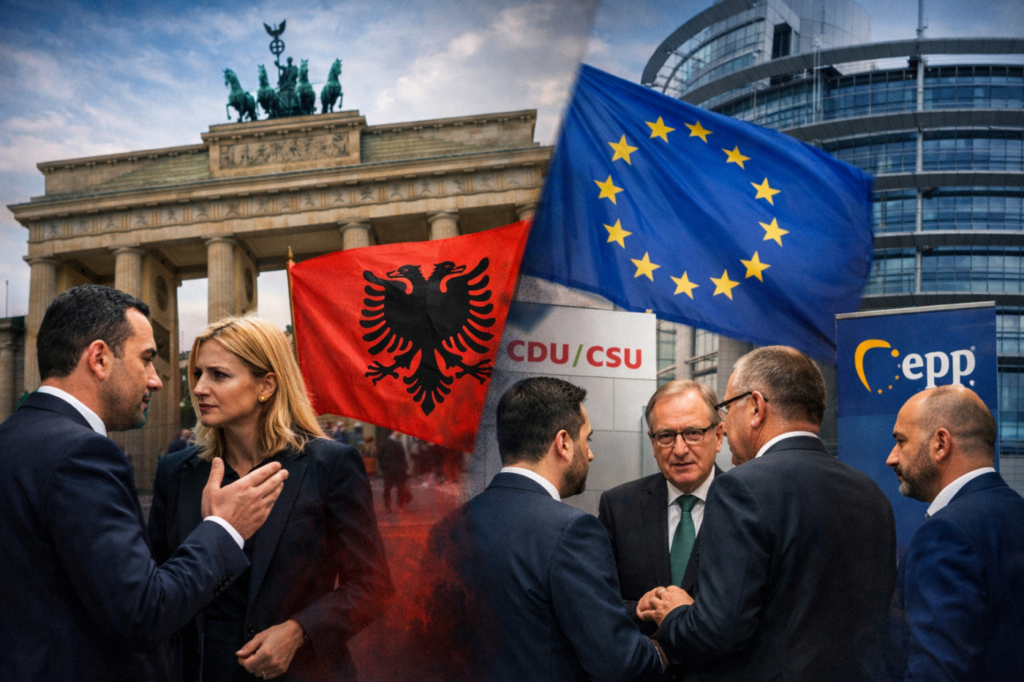
Albania’s opposition took its case to Berlin — but without a reform agenda, it risked shaping the country’s EU file as much as strengthening it.
By Ardit Rada (Tirana)
Gazment Bardhi, Jorida Tabaku, and Klevis Balliu flew to Berlin on Wednesday and spent a day telling German officials that Albania is failing. They said it to two CDU/CSU parliamentarians. They said it to the German Foreign Ministry’s Western Balkans director. Belind Këlliçi repeated it in Brussels the same day, to EPP colleagues. By their own readouts, the message was identical in every room: corruption unchecked, elections unfree, government shielding the corrupt from accountability. They were not wrong about any of it. That is precisely the problem.
Opposition parties in EU candidate states lobby European partners. This is normal, expected, and in principle healthy — European integration is a political process as much as a technical one, and the full range of a country’s political forces should be engaged in it. The question is not whether PD went to Berlin. The question is what they went there to do, and whether what they did crosses the threshold between reform advocacy and party positioning conducted at the country’s expense.
That threshold is definable. Opposition diplomacy that advances a policy position — here are the reforms we believe are necessary, here is our legislative programme, here is what we would do differently and why — serves the accession process regardless of which party benefits. What PD delivered in Berlin, by their own account, was a catalogue of governance failures with an implicit electoral attribution: the government is the obstacle, we are the alternative. There was no reported policy ask. No specific reform proposal. No concrete deliverable sought or announced. The trip cannot be evaluated as diplomacy in any meaningful sense because it had no strategic objective beyond depositing a political frame into the consultations of partners whose assessments matter.
Those assessments matter because of how EU accession decisions are actually made. The Commission produces progress reports, but member state positions are shaped by a broader accumulation of political inputs — bilateral diplomatic conversations, signals from party family networks, the informal weight of repeated interlocutions over time. CDU/CSU and EPP are PD’s political family. When PD’s parliamentary leadership tells those partners, in the rooms where Albania’s file is informally discussed, that the government is unreformable and the elections were a farce, that framing enters the political environment in which Germany calibrates its Albania position and EPP weighs how hard to press on accession benchmarks. The mechanism is not linear. But the Western Balkans enlargement record offers a cautionary precedent: in North Macedonia’s case, sustained opposition positioning within EPP channels — combined with other blocking factors — contributed to the political climate that allowed consecutive vetoes to hold for nearly a decade. No single input caused that outcome. But political environments are built from inputs, and those who supply them bear some responsibility for what gets built. PD knows this. That is why they went.
The messenger problem matters here not as a rhetorical point but as a structural one. Bardhi and Tabaku represent a party that governed Albania for most of the period between 1992 and 2013. European partners are not naive about this history — they have their own institutional memory. But when a party with that record presents itself in Berlin as the credibility anchor for reform advocacy, it asks its interlocutors to discount the messenger’s own contribution to the conditions being described. That discounting requires political work that weakens the analytical signal. The critique of the current government may be valid. Delivered by this messenger, in this format, it arrives in Berlin pre-discounted.
None of this means the failures PD described are not real. They are, and they are documented. But there is a difference — precise and consequential — between advancing a reform argument and advancing a party argument dressed in reform language, and between doing so at home where it can be tested in debate and doing so in partner capitals where it conditions your country’s file. Wednesday’s trip blurred that line deliberately. When a party’s diplomatic method becomes indistinguishable from its electoral objective, it has stopped doing diplomacy. It has started doing something else with diplomatic cover.
Ardit Rada is a Tirana-based journalist covering Albanian politics, governance, and institutional developments. His work focuses on the intersection of domestic political dynamics and Albania’s European trajectory.