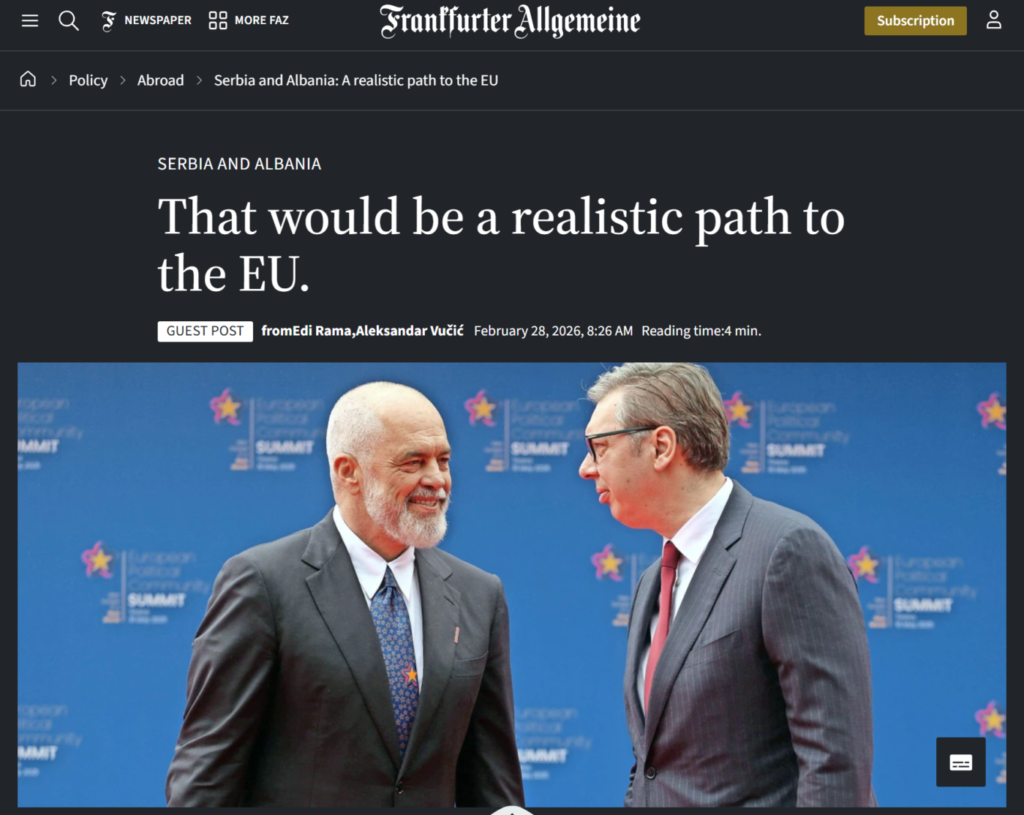
By signing alongside Serbia’s president, Albania’s prime minister forces the enlargement debate back to Europe’s center, and accepts the asymmetry that comes with it.
by Albatros Rexhaj (Prishtina)
When leaders from Tirana and Belgrade publish a joint appeal to Brussels, suspicion is inevitable.
Who benefits?
Who legitimizes whom?
Who miscalculated?
The joint Op-Ed by Edi Rama and Aleksandar Vučić calling for phased integration of the Western Balkans into the EU’s Single Market and Schengen is not a conceptual breakthrough. Variations of this approach have circulated for years in European policy debates — from the Berlin Process initiated under Angela Merkel to the Commission’s more recent Growth Plan.
What distinguishes this moment is not the content of the proposal.
It is the political authorship.
A Region in Limbo
EU enlargement has been effectively paused for more than a decade. The appetite in core member states remains cautious. Berlin worries about decision-making capacity. Paris worries about institutional cohesion. Brussels worries about credibility.
Meanwhile, the Western Balkans are geographically inside Europe but institutionally outside it.
The joint proposal reframes enlargement not as a binary choice — in or out — but as sequencing.
Economic integration first. Institutional participation later. Access without veto rights. Involvement without altering voting balances.
In short: integration without institutional shock.
The concept is not revolutionary. But it is carefully calibrated for a German debate shaped by concerns over governance, cohesion and control.
The Asymmetry
There is little value in pretending the optics are neutral.
In the short term, Vučić benefits. He appears constructive. He moderates a narrative that has recently been defined by escalation and strategic ambiguity. He gains space — domestically and externally.
That is real.
But Albania’s structural position differs fundamentally. Tirana does not balance between geopolitical poles. It does not hedge its Western alignment. It is a NATO member with a clear European trajectory.
The asymmetry matters.
For Serbia, this is tactical repositioning.
For Albania, it is strategic positioning.
By presenting itself as a facilitator of regional convergence rather than a reactive actor, Albania increases its weight in Berlin and Brussels. In European politics, credibility accumulates slowly — and once accumulated, it compounds.
That is the wager.
The Coupling Question
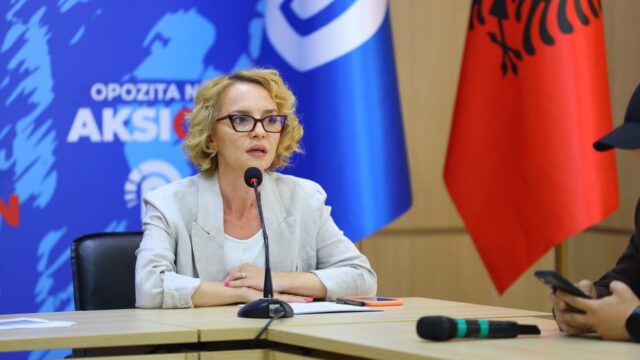
Critics in Albania argue that signing alongside Vučić creates political coupling — that Tirana risks reputational spillover from Belgrade’s domestic fragility and uneven foreign-policy signaling.
The concern is understandable.
But engagement on a defined European proposal is not political alignment. Refusing to engage Serbia does not diminish Serbia’s regional weight. It diminishes Albania’s leverage.
Serbia is a structural reality in the region. Geography does not disappear.
The underlying logic is straightforward: economic and regulatory integration increases exposure. Exposure increases cost. And increased cost moderates behavior — provided that conditionality remains intact.
Isolation can harden positions. Integration complicates them.
For Kosovo, that distinction is not abstract.
Kosovo and Conditionality
The unease in this debate centers on Kosovo.
Does phased integration reward Serbia without meaningful progress on normalization?
The proposal itself avoids institutional shortcuts. There are no veto rights, no commissioners, no alterations to EU governance structures. Participation would be economic and regulatory, not political.
But sequencing only functions if it remains conditional.
Foreign-policy alignment, rule-of-law benchmarks and visible de-escalation must remain measurable components of any phased approach. Without that linkage, integration risks becoming detached from reform.
That is the boundary.
Engagement without limits becomes entanglement.
Engagement with defined conditions remains strategy.
Tactical Gains, Strategic Capital
Regional commentary often focuses on immediate advantage.
Yes, Vučić gains tactically.
Yes, Serbia benefits from a moment of recalibration.
But Albania’s gain is slower and less visible: it becomes part of the European design conversation.
In EU politics, presence inside the conversation often matters more than headlines. Tactical space evaporates. Structural positioning endures.
The German Test
If the proposal is to move beyond symbolism, Berlin will examine it closely.
Three questions will inevitably arise:
Is integration tied to enforceable reform benchmarks?
Does it reinforce foreign-policy alignment with the EU?
Does it contribute to regional stabilization rather than freeze unresolved tensions?
Germany remains central to any enlargement trajectory. Without Berlin’s confidence, sequencing remains theory. With Berlin’s engagement, it becomes policy design.
It would therefore be logical — and arguably necessary — for Germany to initiate structured dialogue with Tirana and Belgrade to test the proposal’s parameters.
Such scrutiny would not weaken the initiative. It would confirm that it is being taken seriously.
A Strategic Intervention, Not a Gesture
The Western Balkans cannot remain indefinitely suspended between promise and postponement. Strategic vacuums rarely remain empty; they invite competing influences.
By reintroducing phased integration into the European debate, Rama is not offering Brussels a gesture. He is posing a structural question.
Can the European Union design a sequencing model that strengthens its geopolitical depth without overloading its institutions?
Can it anchor the region economically before absorbing it politically?
These are European questions, not Balkan grievances.
The joint Op-Ed brings them to the surface.
It carries political risk. It allows for short-term asymmetry. It invites scrutiny — especially from Berlin. But scrutiny is preferable to drift.
The initiative is not about symbolic reconciliation between Tirana and Belgrade. It is about whether Europe is capable of strategic design in its own neighborhood.
The idea itself may not be new.
The decision to advance it now — deliberately, visibly and in coordination — is.
And in a region where hesitation often defines policy, deliberate movement is already a statement.
About the author
Albatros Rexhaj is a well known author, playwright, and analyst whose work weaves literary prose, philosophy, and lived experience into thoughtful cultural and political insight. He trained in dramaturgy and screenwriting, holds advanced training in national-security studies, and has spent nearly three decades in political and security affairs before focusing on independent writing and research.