Kosovo’s constitutional crisis is not just Pristina’s problem
by Besa Ruka (Tirana)
The session was scheduled. The chamber was technically open. And then nothing happened.
On the morning Kosovo’s constitution required its Assembly to have set a presidential election in motion, opposition deputies simply did not take their seats. No quorum. No vote. No process. The deadline passed not with a dramatic failure but with an absence — and that absence has now triggered a constitutional crisis whose consequences extend well beyond Pristina.
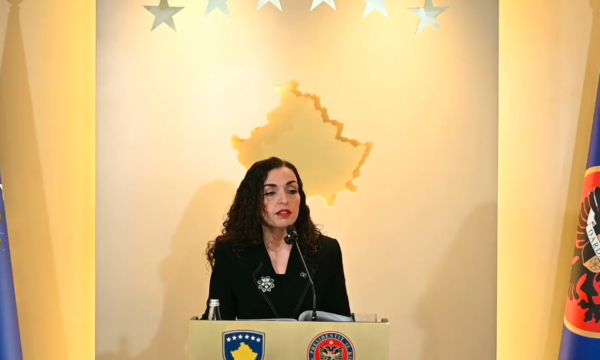
By Friday, President Vjosa Osmani had dissolved parliament and called snap elections. The Assembly’s speaker had filed an emergency request with the Constitutional Court of Kosovo. Kosovo’s governing coalition and its opposition were trading accusations about who had destroyed what. And in Tirana, the spectacle of a neighboring state consuming itself in procedural warfare landed with the quiet dread of someone watching a fire next door.
What the constitution says — and doesn’t
Kosovo’s constitutional framework for electing a president is precise about failure. If the election process begins but is not completed within sixty days, the Assembly dissolves. If the third round of voting produces no winner, the Assembly dissolves. The triggers are clear.
What the constitution does not regulate is the situation that actually occurred: a process that never began at all.
That gap — narrow in text, vast in consequence — is now the central legal question before the Constitutional Court. President Osmani, in dissolving parliament, effectively ruled that the deadline applied regardless: the clock ran out, and the constitutional consequence follows. The Assembly leadership, in filing with the court, argues the opposite: that the clock cannot run out on a race that was never started, and that what happened requires judicial interpretation rather than automatic institutional consequence.
Three readings are possible. The deadline applies regardless of whether the procedure formally opened. The constitutional clock begins only once the process starts. Or the constitution contains a genuine gap — one that neither side can fill by decree, and that only the court can resolve.
Osmani has acted on the first interpretation. She may ultimately prove correct. But she has acted before the court has spoken — in a country where the distance between constitutional clarity and constitutional assertion is sometimes shorter than it should be.
The boycott question
The deeper legal issue is not the dissolution. It is the argument advanced by Vetëvendosje in its court filing.
Speaker Albulena Haxhiu has asked the Constitutional Court to determine whether members of parliament have a constitutional obligation to attend sessions for the election of the president. The implicit claim is that the opposition’s boycott was not a legitimate political tactic but a violation of constitutional duty.
Parliamentary boycotts are a blunt instrument. They are also — across virtually every democratic tradition — a recognized one. Oppositions walk out. Minorities deny quorum. Legislatures stall. None of this is admirable. Most of it is legal.
If the Constitutional Court were to rule that deputies are constitutionally required to appear for presidential elections, the precedent would not stop there. Future governments — this one or the next — could invoke the same logic for government formation votes, constitutional amendments, or emergency legislation. The court would become not just an arbiter of laws, but a supervisor of how elected legislators choose to participate in political life.
That is a structural shift Kosovo’s young democracy can ill afford to make in a moment of institutional stress.
Why Tirana is watching
Albania has its own stake in what happens next.
The relationship between Prime Minister Edi Rama and Prime Minister Albin Kurti has never been easy. Kurti’s political identity is built in part on maintaining distance from Tirana’s influence — a stance that has periodically strained the symbolic unity Albanian leaders on both sides of the border are expected to project internationally.
What prolonged instability in Kosovo produces, whatever its origin, is a weakening of Kosovo’s institutional credibility in Brussels and Washington at a moment when that credibility matters enormously. Kosovo’s EU accession path already faces structural obstacles. A constitutional dispute requiring judicial resolution, an election called under contested circumstances, a parliament dissolved before completing its work — none of this is fatal to that process. But none of it helps.
For Tirana, a Kosovo that is institutionally weakened is a Kosovo that is a less effective advocate for shared Albanian interests in European forums. The two countries are not the same state. But in the eyes of the European Union and the United States they are politically linked — and that linkage means Kosovo’s institutional standing is never purely Kosovo’s problem.
The court’s burden
The Constitutional Court of Kosovo now carries the weight of a question the constitution’s drafters did not fully answer.
It can rule narrowly — clarifying the dissolution trigger without touching the boycott question. It can rule broadly — establishing whether deputies have enforceable attendance obligations. Or it can defer, returning the question to political actors who have already demonstrated they cannot resolve it themselves.
Each path carries risk. A narrow ruling may leave the core ambiguity intact for the next crisis. A broad ruling on attendance obligations could create a precedent more damaging than the crisis it resolves. Deference simply delays the problem.
Kosovo’s constitutional moment is, at its core, a stress test of whether institutions built in the first decades of statehood can hold when political actors decide the rules are inconvenient. That test is not unique to Kosovo. The Western Balkans has seen versions of it before.
What makes this iteration worth watching — from Tirana, from Brussels, from Washington — is that the answer the court gives will shape not just how this crisis ends, but how the next one begins.