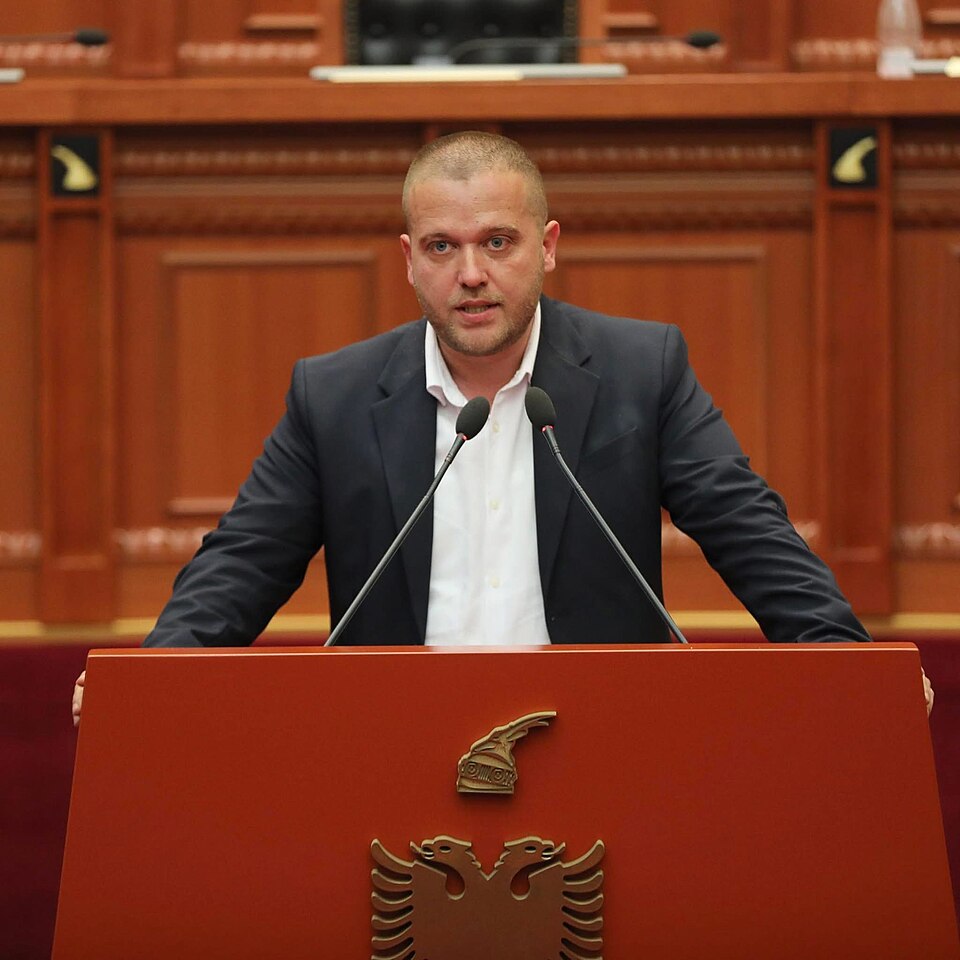
Albania has a pretrial detention problem. A Socialist MP saying so is only useful if he says it without flinching.
by Ardit Bido (Tirana)
The author is a Member of the Albanian Parliament (Socialist Party). The Tirana Examiner publishes contributors across the political spectrum; party affiliation is disclosed in the interest of transparency.
The debate that followed parliament’s vote on Belinda Balluku’s immunity was loud, sustained, and almost entirely beside the point.
Both sides performed their expected roles. The opposition declared the vote a scandal. The majority invoked procedure. Commentators chose their corners. What nobody did — on either side — was ask the question the case actually raises: whether Albania’s routine use of pretrial detention meets the standard a European democracy is supposed to hold itself to.
That question is worth asking.
Pretrial detention — arrest before conviction, before trial, before any final judicial determination — is the most severe restriction on liberty a democratic state can impose on a person who remains, in law, innocent. The European Court of Human Rights has been consistent and specific on this point for decades: detention pending trial is permissible only when concrete, case-specific evidence establishes a genuine risk of flight, destruction of evidence, witness interference, or reoffending. The presumption runs in the other direction. Liberty is the rule. Detention is the exception that must be affirmatively justified at every stage, with reasons anchored in the specific facts of the individual case — not in the gravity of the charges, not in political visibility, not in institutional habit.
Albania has not always treated it that way.
This is not a claim about Balluku specifically. It is a claim about an institutional culture in which the most restrictive measure has drifted, over time, toward routine. When detention before conviction becomes the default response to serious charges rather than the carefully justified exception, something has gone wrong — not with the prosecution of corruption, but with the procedural standards that are supposed to discipline how that prosecution operates.
I am a member of the Socialist Party writing in the aftermath of a case involving a Socialist deputy. I want to name that directly rather than paper over it.
The principle I am invoking applies regardless of which party the accused belongs to. It applied when Berisha was placed under house arrest. It will apply the next time SPAK’s request concerns a Democratic Party figure. It applies now. If I am willing to make this argument for a Socialist deputy, I am obliged to make it consistently — and to acknowledge that my own party has not always been eager to raise it when the accused sat in a different parliamentary group.
The honest version of this argument requires me to go further. When Sali Berisha was placed under house arrest in January 2024, and when Ilir Meta was taken into custody the following October, the reaction from my side of the chamber was satisfaction — not scrutiny. Nobody on the governing benches asked whether the most restrictive measures were proportionate to the specific risks established in those cases. The political logic was clear enough: these were men who had misused power for decades, and the law was finally catching up with them. That may well be true. But proportionality is not a standard that activates only for allies. If I failed to apply it then, I am obliged to say so now.
That double standard runs across Albanian politics, not only through the opposition. Pointing at the other side does not resolve it. It only confirms that the principle is being wielded as a weapon rather than applied as a standard.
The Grand Chamber’s ruling in Buzadji v. Moldova is explicit: the obligation to provide relevant and sufficient reasons for detention applies from the moment of first remand. Courts must engage with the specific facts of the individual case — not rehearse statutory grounds, not infer necessity from the seriousness of the offence. Whether Albanian courts meet that standard consistently is a question worth examining with data. How often is the most restrictive measure requested when less intrusive alternatives exist? How often are travel bans, document surrender, or electronic monitoring considered and rejected on stated, specific grounds? These are answerable questions. They are not being answered — because no political actor currently has an incentive to answer them.
A European standard on pretrial detention is not a procedural courtesy extended to the accused. It is a discipline imposed on the state — a requirement that coercive prosecutorial power be exercised with proportionality and precision rather than convenience. The justice reform of the past decade was premised on Albania building institutions capable of that discipline. The premise still holds.
This debate will move on. The political class will find the next confrontation, and pretrial detention will return to the background as an institutional assumption rather than an institutional question. What would remain, if anyone chose to hold onto it, is a specific and answerable problem: Albania arrests people before trial more readily than European standards require. That is a legal culture problem, not a partisan one. It will not be fixed by a parliamentary vote. It will be fixed when courts, prosecutors, and eventually the legislature treat proportionality as an obligation rather than an inconvenience — and when politicians on both sides of this chamber stop reaching for the principle only when their own people are in the dock.
Ardit Bido is a Member of the Albanian Parliament (Socialist Party) and a historian by training. He previously served as Director General of the General Directorate of Archives and has written extensively on institutional reform, historical accountability, and Albania’s European integration process.