Berlin received a delegation. The next night, Tirana burned.
The Editorial Board
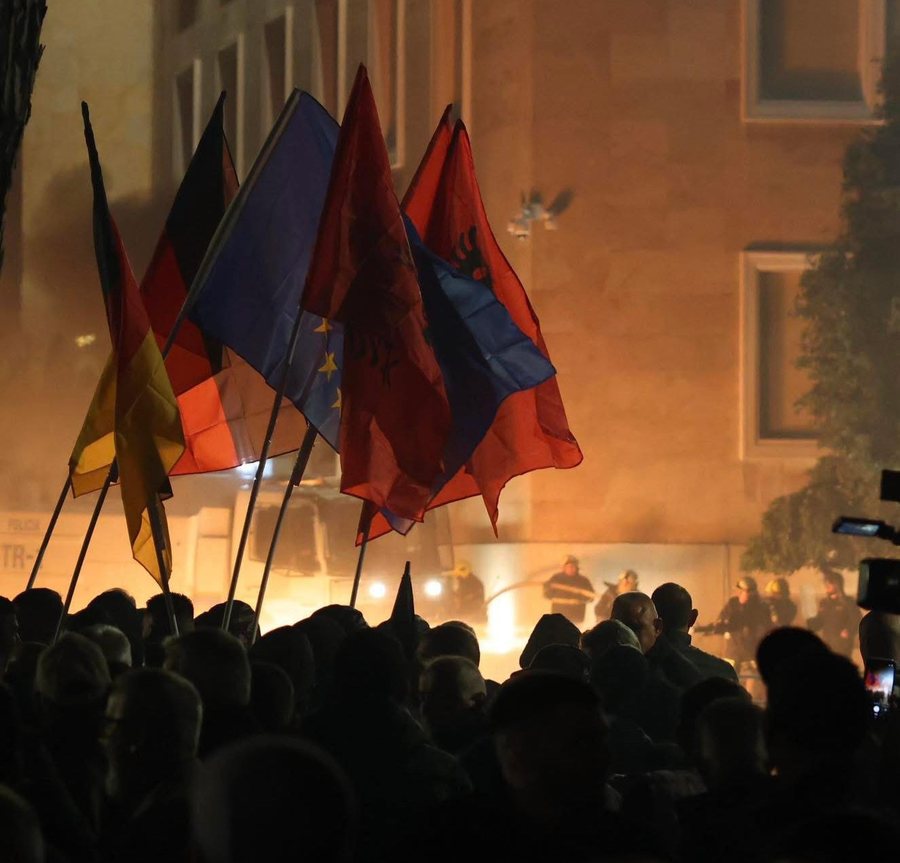
The photograph requires no caption.
A German flag. An EU flag. Two Albanian flags.
Behind them, riot police in formation, lit by fire.
A projectile suspended mid-air.
Tirana. March 22.
The night after the Democratic Party’s meetings in Berlin.
By evening, a senior figure inside the protest leadership had already explained the scene. The German flag was not incidental. It was placed. A signal. The violence around it was not spontaneous. It was known. It was accepted. It was, in his words, useful.
The pattern is not ambiguous.
January 25: stones and Molotov cocktails near parliament.
February 10: sixteen officers injured, twenty-two devices seized.
February 20: two hours of clashes, thirty arrests.
March 10: incendiary attacks on the Prime Minister’s Office.
March 22: Molotovs at party headquarters, a police vehicle burned, coordinated pyrotechnics across the government quarter.
Five protests. Each escalation deliberate.
Not once has the leadership condemned it. Each time, it is called peaceful.
In Berlin, the same week, the Democratic Party delegation met Günther Krichbaum — the German government’s Minister of State for Europe, a central figure in enlargement policy. They spoke about SPAK. About rule of law. About institutions.
They did not speak about Molotov cocktails.
This omission was mutual. It was not an oversight. It was the condition of the meeting.
Germany has every right to scrutinize Albania’s institutions. That is not in dispute. What is in dispute is what Berlin has now chosen to legitimize: a political actor that treats violence as an instrument, stages it, and exports its symbolism — including Germany’s own flag — into the theater of confrontation.
Berlin did not misread the signal.
It accepted it.
The question is no longer whether Germany is being misled.
The question is whether it consents.