How Albania’s protest movement traded its symbol of life for the oldest prop in the country’s political theater
Tirana Examiner
On the thirty fifth evening of Albania’s protest cycle, the boulevard produced two objects. The first was a birthday cake made of concrete, delivered with heavy irony to a prime minister who turned sixty two on the Fourth of July. The second was a coffin. It came draped in a banner reading “the political coffin of Edi Rama,” carried at shoulder height down Dëshmorët e Kombit, the Boulevard of the Martyrs of the Nation, toward the building where the government sits.
A movement that named itself after a bird chose, on day thirty five, to march behind a box built for the dead. The government responded with outrage, the protesters with a shrug, and both reactions miss what actually happened on the asphalt. In Albania, a coffin on that boulevard is a citation. The text it cites is one of the darkest in the country’s democratic history.
What the flamingo meant
The movement’s symbol was not chosen by a communications agency. It walked out of the Vjosa-Narta lagoon on its own legs. The protests that began over the Zvërnec coastal development gathered around the flamingos of the protected wetland, a creature of improbable elegance that knows nothing of politics and stood to lose everything to concrete. As the movement widened from environmental grievance into a general indictment of the government, the flamingo carried its original meaning with it. We are here for what lives, the image said, and whatever one thinks of the movement’s demands, no Albanian public square had seen anything like it in three decades of recycled iconography, the flag, the fist, the portrait, the pyre.
The coffin is the opposite of new. It is the most heavily used object in the Albanian repertoire of political theater, and every Albanian over forty five knows precisely where it leads.
The boulevard remembers
The genealogy runs deeper than the government’s own telling of it. Before the coffin everyone now invokes, there was one almost nobody does. In 1997, after killings in Tropoja, supporters of the Democratic Party marched down this same boulevard carrying the actual coffin of Avdyl Matoshi, halted before the prime minister’s office, and accused Fatos Nano’s government of murder. Among the mourners marching behind that coffin were Sali Berisha and a deputy from Tropoja named Azem Hajdari.
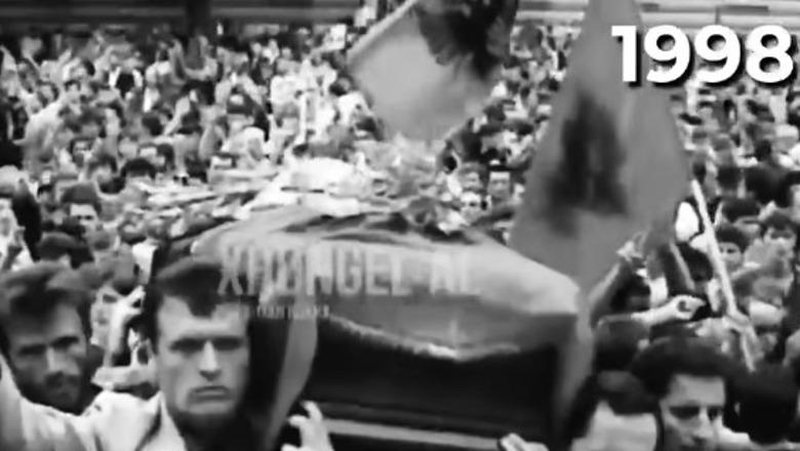
One year later, Hajdari was assassinated outside his party’s headquarters, and his own coffin became the instrument of the most serious assault on Albania’s constitutional order since the fall of communism. On September 14, 1998, the funeral cortege of roughly three thousand people did not turn toward the Sharra cemetery. It turned toward the Council of Ministers. Along the way, weapons were looted from a military depot. By midday the crowd had stormed the government building, seized the state broadcaster, taken tanks from the Republican Guard, and thrown a grenade into the office of the Speaker of Parliament. History preserved one detail with the coldest clarity. The coffin bearing Hajdari’s body was abandoned on the steps of the prime minister’s office the moment the door gave way. It had served its purpose. The man inside it was buried later at Sharra by municipal workers, attended only by his family. The attempted overthrow collapsed only after Washington declared it would recognize no power born of violence.
That is the citation a coffin on this boulevard makes, whether or not the people carrying it on July 4 intended it. In Albanian political grammar, a coffin before the Kryeministria has never meant mourning. It has meant: the state is inside this box, and we have come to bury it.
The government’s telling of this history stops one chapter early, because the boulevard’s dead are not the property of one side. On January 21, 2011, four unarmed protesters, Aleks Nika, Ziver Veizi, Hekuran Deda and Faik Myrtaj, were shot dead in front of the same building by the weapons of the state, under a Democratic Party government. They were later declared Martyrs of the Nation, folding them into the boulevard’s own name. Every January, Edi Rama lays flowers on the asphalt where they fell, a ritual of memory that is also, unavoidably, a ritual of political positioning against Sali Berisha. The boulevard is the ceremonial necropolis of Albanian politics, and no major party has declined to draw power from it. When government voices now express horror at death imagery on Dëshmorët e Kombit, the horror is real, but the innocence is not.
Four registers, one score
The government answered in four voices, each pitched to a different audience, none improvised. Erion Braçe supplied the raw emotion, declaring in capital letters that a coffin is not poetry and means one thing everywhere on earth. Taulant Balla supplied the partisan attribution, claiming the coffin arrived with Democratic Party supporters from Durrës and reminding the country that Berisha had done the same shameful thing twenty eight years ago with Hajdari’s body. Foreign Minister Ferit Hoxha supplied the disciplined diplomatic version for external consumption, tracing a fall from flamingos to coffin, from environmental concern to intimidation, and insisting that the Albania of 2030 will be built by dialogue. And the prime minister supplied the literature.
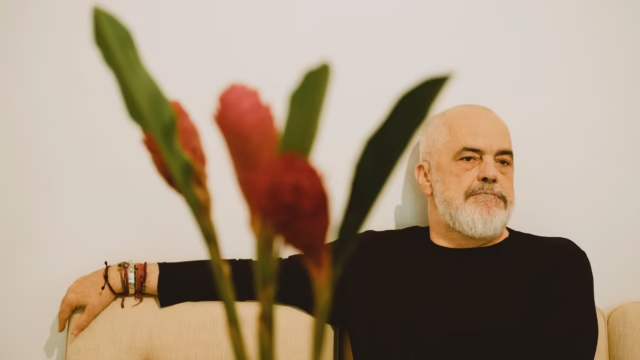
Rama’s long address to his “dear flamingos” is the most sophisticated text the government has produced in five weeks of crisis, and it moves with the cold precision of a man who trained as a painter and governs as a dramaturg. It absolves the protesters three times over, thanks them for the light of their alarm, promises a longer conversation soon, and then announces that their protest no longer belongs to them. The coffin, in his telling, is the emblem of a curse trailing Albania since 1912, and the people who carried it have made the sincere crowd into an alibi. It is a separation operation: dignity for the base, damnation for the captors, and a government working group as the door held open for anyone ready to walk back inside the institutions.
None of this is built on sand. The coffin is a documented escalation, foreign amplification of the protest wave has been independently established by Blackbird.AI’s reporting and Meta’s takedowns, and the violence at police station number three and outside Parliament is not invented. Even observers with no sympathy for the government reached the same verdict on the prop itself; one widely read commentary called it a figuratively macabre find that damages the protest more than it serves it, noting that a “new Albania” marching beside a coffin is a hard image to celebrate.
What the swap reveals
In a movement without leaders, the symbol does the work of a constitution. For thirty five days the flamingo did what no spokesman could have done: it told the country, every evening, that this crowd was something Albanian politics had not produced before. The coffin undoes that sentence in a single image. It reaches into the oldest and bloodiest drawer of Albanian stagecraft and announces continuity with everything the movement claimed to have left behind.
The question of who actually carried it is now contested, and it matters less than either side pretends. In this country the coffin has always been an instrument of legitimacy dressed as a symbol of death. Everyone who has raised it on this boulevard has claimed the same thing, that the box holds not a body but the state itself, and twice that claim has ended in fire. The flamingo argued the opposite case, that legitimacy could be drawn from a lagoon rather than a grave.
Flamingos are migratory birds. They stay where the water is clean, and they leave when it sours. Thirty five days in, the question hanging over the boulevard is no longer who carried the coffin. It is whether the flamingos are still there at all, or whether, without anyone quite noticing, they have already flown, leaving the boulevard to the object that has always been waiting to reclaim it.