A Legal Analysis of the SPAK Request Before Albania’s Parliament
By The Tirana Examiner Legal Desk
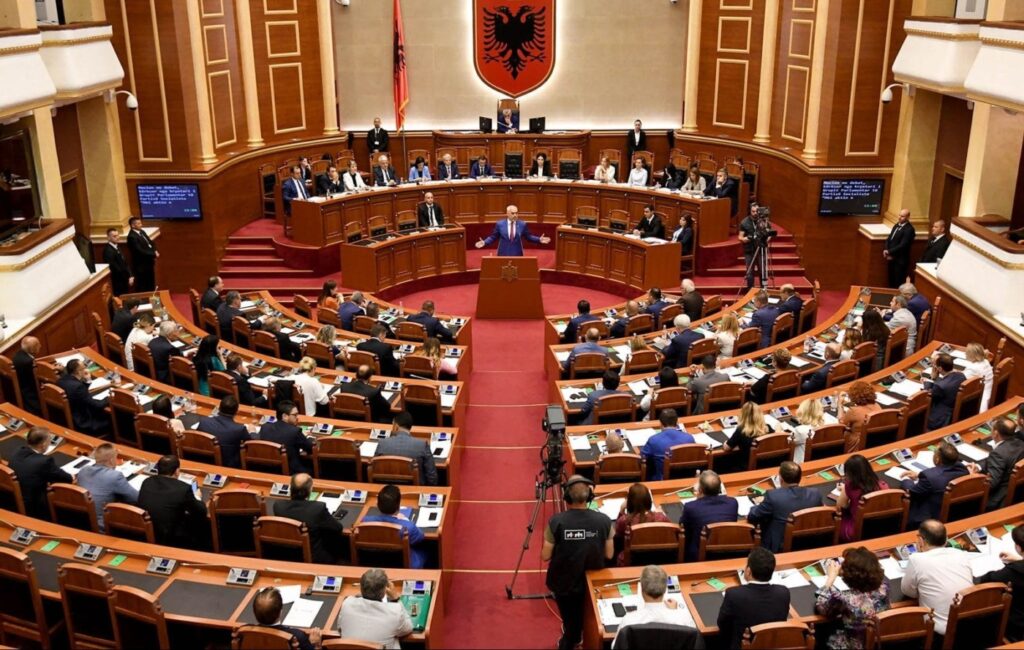
Albania’s parliament is scheduled to vote on Thursday on whether to authorize SPAK’s request to arrest former Deputy Prime Minister Belinda Balluku, who holds a parliamentary mandate. The political noise surrounding that vote has been considerable. The legal substance has received less attention than it deserves.
This analysis does not assess Balluku’s guilt or innocence. That is a question for courts, and it should be answered there. What this analysis examines is the prior question: whether the procedural and evidentiary record, based on the information currently available, clearly meets the proportionality threshold that Albanian and European law require before immunity may be lifted for the purpose of detention.
Our assessment is that it does not — and that the reasons why matter for Albania’s rule-of-law trajectory far beyond this case.
I. What Parliamentary Immunity Is For
Parliamentary immunity is not a personal privilege. The Constitutional Court’s reasoned decision of March 3, 2026 made this explicit, and the Examiner agrees with it unreservedly. Immunity does not place elected officials above the law.
What immunity does is impose a procedural threshold. Article 73 of Albania’s Constitution establishes that a deputy may not be arrested or detained without authorization of the Assembly, unless caught in flagrante delicto. The provision does not require parliament to approve every prosecutorial request that arrives before it. It requires parliament to verify that the legal threshold for such measures has actually been satisfied — that a legally regular criminal proceeding exists, and that there is no credible basis to conclude the proceeding is politically motivated.
If both conditions are satisfied, the constitutional logic of immunity is exhausted, and parliament must authorize the judiciary to proceed.
This framework reflects what the Venice Commission, in its 2014 Report on the Scope and Lifting of Parliamentary Immunities (CDL-AD(2014)011), describes as immunity’s core function: not to shield individual legislators from accountability, but to protect the institution of parliament from becoming an instrument of political persecution through prosecutorial timing. The Commission draws a sharp distinction between immunity as an institutional safeguard — which parliaments are obliged to maintain — and immunity as a personal privilege — which they are not. That distinction governs the threshold question here.
Where the analysis becomes more complex — and where the current case strains the framework — is not at the threshold but in what follows from it: the nature of the measure being requested, and whether it is proportionate to the circumstances that actually exist.
II. The Sequence That Defines This Case
To assess proportionality, the sequence of events matters. It has been widely misreported, and the misreporting has distorted the public debate.
The accurate sequence is as follows.
SPAK formally charged Balluku on October 31, 2025, over the Llogara Tunnel tender, a procurement worth approximately €190 million. The allegation was that she intervened to predetermine the winning bidder.
On November 17, 2025, an intercepted telephone call took place between two third parties — not between Balluku and a witness — which prosecutors would later characterize as evidence of witness intimidation.
On November 20, 2025, SPAK aggravated the security measure: it obtained a passport confiscation and a suspension from office, based partly on the November 17 call and partly on the expansion of charges to cover seven Ring Road tenders from September 2021.
On December 12, 2025, the Constitutional Court overturned the suspension and reinstated Balluku to office.
Four days later, on December 16, SPAK filed its request with parliament for authorization to arrest Balluku, citing risk of evidence destruction and witness intimidation as the grounds for detention.
This sequence is the analytical heart of the case.
On the public record, no new evidence appears to have prompted the escalation from suspension to arrest request. What changed between November 20 and December 16 was not the evidentiary picture — it was the judicial one. The Constitutional Court had removed SPAK’s primary coercive measure. Within four days, SPAK sought a more drastic one — parliamentary authorization for arrest — before the Constitutional Court had even published its reasoned decision explaining why the suspension had been overturned.
If new evidence existed that independently justified the escalation, the prosecution has not made it public. Parliament is entitled to ask whether that evidence exists, and to require that it be demonstrated rather than assumed.
III. The Strongest Argument for Detention — and Why It Falls Short
Before assessing the proportionality of the measures requested, intellectual honesty requires that the strongest case for detention be stated clearly.
SPAK’s defenders argue that corruption investigations involving senior officials pose risks that are qualitatively different from ordinary criminal cases. The hierarchical nature of government procurement networks means that witnesses are frequently subordinate to the accused — professionally, financially, and sometimes personally dependent on them. In such environments, intimidation is structurally embedded and difficult to detect. A travel ban and contact prohibitions may be insufficient when the channels of influence operate through institutional loyalty, shared political exposure, or the implicit threat of career consequences rather than explicit communication. From this perspective, detention is not sought as punishment but as a preventive safeguard for the integrity of an investigation that involves an extensive network of potential witnesses and co-defendants, and where the accused has demonstrated, through years in office, the capacity to manage subordinates and control information flows.
This is a serious argument. It reflects a genuine tension in European detention jurisprudence between the individual rights framework of the ECHR and the structural realities of high-level corruption investigations. It should not be dismissed.
But it does not withstand doctrinal scrutiny when applied to the specific circumstances of this case, for three reasons.
First, the argument proves too much. If hierarchical authority over subordinates were sufficient in itself to justify pre-trial detention, every senior official under investigation would be detainable on structural grounds alone. The European Court of Human Rights foreclosed precisely this reasoning in Letellier v. France (Application no. 12369/86, 1991), holding that the gravity of the offense and the nature of the accused’s position cannot, by themselves, justify detention. Risk must be demonstrated through concrete facts, not inferred from role.
Second, the structural risk argument has been materially weakened by events. Balluku is no longer minister. The hierarchical relationships the argument depends upon have been formally severed. Whatever residual influence she may retain through personal relationships cannot be assumed to replicate the institutional leverage she exercised while in office — and McKay v. United Kingdom (Application no. 543/03, 2006) requires that changed circumstances be reassessed rather than assumed to persist.
Third, the argument fails to engage with the intermediate measures available. If the concern is that contact prohibitions are insufficient because influence operates implicitly rather than through direct communication, that concern must be demonstrated with reference to specific evidence of implicit pressure — not asserted as a structural feature of procurement networks in general. Ilijkov v. Bulgaria (Application no. 33977/96, 2001) is explicit on this point: risk arguments must be grounded in concrete, case-specific facts, not generalized reasoning about the type of offense involved.
IV. The Proportionality Standard Applied
Under Albanian criminal procedure, European Convention on Human Rights jurisprudence, and the Venice Commission standards that informed Albania’s justice reform, precautionary measures restricting liberty must satisfy three cumulative conditions: legality, necessity, and proportionality.
Legality is not seriously in dispute. SPAK has the legal authority to make this request. The charges are formally registered. The proceeding is legally constituted.
Necessity and proportionality are another matter.
The European Court of Human Rights Grand Chamber, in Buzadji v. Moldova (Application no. 23755/07, 2016), established the controlling modern standard: reasonable suspicion that an offense has been committed is a necessary but not sufficient condition for detention. The authorities must also demonstrate that detention is justified by at least one recognized ground — risk of flight, risk of interference with evidence or witnesses, or risk of reoffending — and that justification must rest on concrete, specific facts, not general assumptions derived from the gravity of the offense or the defendant’s former status. Letellier v. France established the same principle in an earlier generation of the Court’s jurisprudence, and it has not been qualified since.
SPAK’s argument for necessity rests on three pillars, each of which requires examination.
Evidence destruction. At the time the request was filed, Balluku had been reinstated to office by the Constitutional Court. The prosecution argued that her ministerial position gave her continued access to documents and subordinates relevant to the investigation. That argument had some force in December, when she remained in post. It has no force now. Balluku was formally dismissed from office on March 4, 2026. She is no longer minister, controls no ministry, and has no institutional access to procurement files or authority over subordinates involved in the investigation. Under the McKay principle, a changed factual circumstance requires a fresh necessity assessment. That reassessment has not been conducted. Parliament is being asked to authorize an arrest on the basis of a risk argument whose factual foundation has since been removed by events.
Witness intimidation. The prosecution’s primary exhibit is the intercepted call of November 17, 2025. Three details are essential. First, the call took place between two third parties — not between Balluku and a witness directly. Second, it occurred three days before the suspension measure of November 20, meaning it predated rather than responded to the judicial proceedings it is said to have been motivated by. Third, it is a single intercepted call whose participants and precise content have not been established in any public proceeding. The opposition’s parliamentary report also references alleged pressure through intermediaries and offers through cabinet officials to purchase witness silence — serious allegations, but ones made in closed session, attributed to prosecutorial characterizations not subjected to adversarial testing, and unexamined by any court. Under Buzadji and Ilijkov, this does not clearly satisfy the requirement that risk be specific and individualized.
Coordination with other suspects. Prosecutors may also argue that detention is required to prevent Balluku from coordinating with co-defendants or other persons under investigation — a ground that the parliamentary record suggests has been referenced, if not fully articulated, in closed proceedings. The European Court has addressed this ground directly. In Ilijkov v. Bulgaria, the Court held that the risk of coordination must be supported by specific evidence of attempted coordination, not merely inferred from the existence of co-defendants or the complexity of the alleged criminal network. The existence of multiple suspects in a procurement investigation does not, without more, justify the detention of any one of them on coordination grounds.
Against all three pillars, the less intrusive alternatives have not been publicly assessed and dismissed as insufficient. Contact prohibitions are a standard precautionary measure in European criminal procedure precisely for cases where interference through intermediaries is alleged. Enhanced monitoring can detect ongoing intimidation attempts. The travel ban already in force addresses flight risk. In France, the levée d’immunité procedure under Article 26 of the Constitution requires authorization by the Bureau of the National Assembly, and prosecution of sitting legislators for corruption routinely proceeds without detention unless concrete and imminent evidence interference is demonstrated. In Germany, Article 46 of the Basic Law establishes a comparable authorization requirement, and Bundestag practice has consistently distinguished between authorizing investigation — which it grants readily — and authorizing detention, which requires a substantially higher showing. Idalov v. Russia (Application no. 5826/03, 2012) requires that where detention is sought on evidence interference grounds, the prosecution must demonstrate not merely that interference is theoretically possible but that it cannot be adequately addressed through less intrusive measures. That demonstration has not been made publicly in this case.
V. The Judicial Defeat Problem
There is a structural concern that the public debate has largely avoided.
When a court overturns a prosecutorial measure, the appropriate institutional response in a rule-of-law system is one of two things: the prosecution accepts the ruling and adjusts its strategy within the existing framework, or it appeals through available legal channels.
What is not appropriate — what represents a genuine institutional danger — is for the prosecution to respond to a judicial defeat by immediately seeking a more coercive measure from a different institution, before the reasoning of the first institution has even been published.
That is precisely what happened here.
The Constitutional Court overturned the suspension on December 12. SPAK filed its parliamentary arrest request on December 16. The Constitutional Court’s reasoned decision was not published until March 3, 2026 — nearly three months later.
SPAK sought arrest authorization from parliament without knowing, and without parliament or the public knowing, the full constitutional reasoning behind the court’s decision. The prosecution was asking a second institution to authorize a more drastic measure, in response to a legal defeat whose implications had not yet been publicly explained by the institution that delivered it.
This is not institutional discipline. It is institutional pressure — an attempt to recover through a different forum the coercive ground lost in the courts, before the constitutional significance of that loss had been fully established.
The justice reform Albania has spent nearly a decade constructing rests on a principle the Venice Commission has articulated as foundational: that anti-corruption institutions derive their credibility from procedural rigor, not prosecutorial forcefulness. An institution that responds to judicial defeat by escalating to a more coercive measure before absorbing the reasoning of that defeat has subordinated procedural integrity to prosecutorial outcome. That is precisely the institutional pathology the reform was designed to eliminate. It cannot be permitted to re-enter through the new institutions the reform created.
VI. The Parliamentary Process Cannot Legitimate What the Substance Lacks
The parliamentary process through which this vote is being conducted does not meet the standard of independent constitutional deliberation that the Venice Commission’s 2014 Report identifies as the minimum requirement for a legitimate immunity procedure.
The Commission is explicit: immunity proceedings must constitute “genuine institutional scrutiny” of the prosecution’s request — an independent assessment of whether the legal threshold has been met — rather than political endorsement of a prosecutorial position. A parliament that functions as a transmission mechanism for party instruction in immunity proceedings has ceased to perform its constitutional role under Article 73, regardless of whether the underlying prosecution is meritorious.
The process here falls short of that standard in ways that are not merely procedural but structural.
Members of the Socialist parliamentary group have been summoned to a mandatory meeting under party instruction ahead of Thursday’s vote. The report before parliament was drafted by Ulsi Manja — a member of the Mandates Council itself, tasked with providing independent assessment, and simultaneously one of the ruling party’s senior procedural operators, whose assignment to draft the majority report signals that the majority’s conclusion was reached before its deliberation began. The sequencing of the vote has been managed in ways that reflect political calculation rather than the internal logic of the legal question.
A majority acting under instruction does not constitute independent parliamentary judgment. It constitutes the appearance of procedure masking the reality of political management — which is precisely the dynamic that the Venice Commission’s immunity doctrine, and Article 73 of Albania’s Constitution, are designed to prevent.
VII. Conclusion
The rule of law is not served by protecting the guilty. It is equally not served by bypassing the procedural safeguards that distinguish accountability from persecution — even when the underlying investigation may be well-founded, and even when the political pressure to act is considerable.
Based on the information currently available, the evidentiary record does not clearly meet the proportionality threshold required for detention under the standards that Albanian constitutional law, ECHR jurisprudence, and Venice Commission doctrine collectively establish.
The evidence destruction argument has been materially weakened by Balluku’s removal from office. The witness intimidation argument rests on a single third-party call predating the triggering judicial measure, and on unverified allegations presented in closed session. The coordination argument, to the extent it has been advanced, lacks the specific evidentiary foundation that Ilijkov requires. And the institutional process through which parliament is being asked to act does not satisfy the “genuine institutional scrutiny” standard that gives immunity proceedings their constitutional legitimacy.
What the rule of law requires here is specific. It requires SPAK to demonstrate publicly, against the Buzadji standard, why arrest is necessary rather than merely useful — and why the less intrusive alternatives have been considered and found insufficient. It requires parliament to exercise the independent constitutional judgment that Article 73 assigns to it, rather than to function as an instrument of party discipline. And it requires that changed circumstances — Balluku’s dismissal from office, the removal of the institutional mechanism identified as the vehicle for ongoing interference — be assessed under the McKay principle rather than ignored.
Those requirements have not been met.
Lifting immunity on Thursday, under the process as currently constituted and on the evidentiary record currently public, would not vindicate the rule of law. It would demonstrate that Albania’s reformed institutions are capable of producing the appearance of due process while bypassing its substance — which is the most dangerous form of institutional failure, because it is the hardest to see.
The Tirana Examiner Legal Desk provides analysis of legal and constitutional questions bearing on Albania’s governance and EU accession trajectory. This analysis reflects the editorial position of the Tirana Examiner.
Serious analysis for a serious Albania.