By The Tirana Examiner Legal Desk
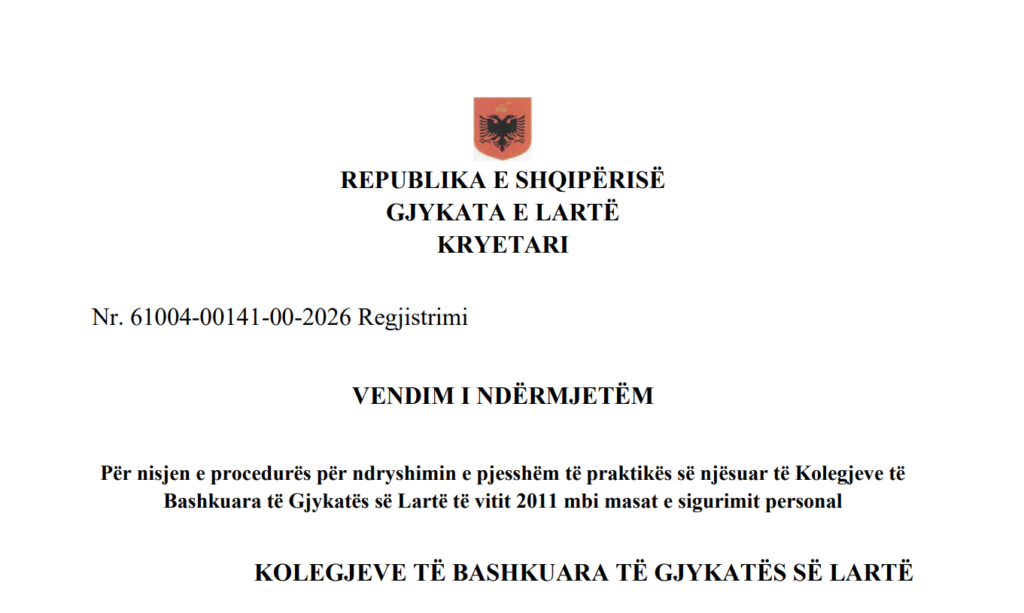
On 9 March 2026, Supreme Court Chief Justice Sokol Sadushi issued an interim decision initiating a formal procedure to partially revise Unified Decision No. 7 of 14 October 2011 — the ruling of the United Collegiums that has governed Albanian judicial practice on pre-trial detention for nearly fifteen years. The United Collegiums will convene on 9 April 2026 to hear the matter. The questions are technical in form but fundamental in substance: who bears the burden of justifying imprisonment before conviction, whether offence gravity can substitute for individualised reasoning, and whether courts must genuinely consider less restrictive alternatives before ordering detention.
Under Article 5 § 3 of the European Convention on Human Rights, pre-trial detention must remain an exceptional measure justified by reasons that are both “relevant” and “sufficient.” As will be shown, the doctrine enshrined in the 2011 unified decision has failed that standard — in the text of Albania’s own procedural law and in the judgments of the European Court of Human Rights. As of December 2025, 2,569 of Albania’s 4,503 prisoners — 57 percent — had not been convicted of anything. That figure, drawn from Sadushi’s own published analysis, is consistent with a detention system operating without adequate doctrinal constraint; whether the 2011 decision is its primary cause is a question this piece does not need to resolve. What the record does establish is that the doctrine has not prevented the problem and that the law requires something better.
The short answer to the questions before the United Collegiums, as the interim decision persuasively argues, is that the current doctrine is wrong — legally, constitutionally, and as a matter of basic procedural fairness. The United Collegiums should not merely revise the 2011 decision; they should use the opportunity to build a detention jurisprudence that is durable, rights-consistent, and capable of withstanding scrutiny from Strasbourg.
A System Built Backwards
To understand why this matters, it is necessary to understand what the 2011 unified decision actually established — and how its three core positions interact.
The first position held that when ordering pre-trial detention, “the court has no obligation to analyse why other types of security measures are not appropriate; it suffices to argue that the measure it has chosen is appropriate.” The second held that in cases involving serious crimes, “by virtue of the very nature of these criminal offences,” the element of high dangerousness is already present — meaning offence gravity effectively operates as a proxy for individual risk. The third held that pre-trial detention “may be assessed as inappropriate only if the suspect or his defence counsel present to the court positive evidence” rebutting the risk.
Taken individually, each of these positions is problematic. Taken together, they form a closed loop. Gravity triggers presumed risk. Presumed risk justifies detention. The court need not analyse alternatives. The defendant must affirmatively disprove a risk the court never had to prove in the first place. The structure is not a legal framework for evaluating detention necessity — it is a jurisprudential shortcut that formally invokes proportionality while structurally preventing it from operating.
This matters because Albania’s own Code of Criminal Procedure has always said something different. Article 230 is unambiguous: arrest në burg applies “only when every other measure is inappropriate.” That word — only — is not rhetorical. It establishes the exceptional character of pre-trial detention as a matter of positive law. A doctrine that permits courts to skip the analysis of alternatives, presume risk from offence category, and place the rebuttal burden on the defence does not merely bend Article 230 — it inverts it.
Fifteen Years of Adverse Findings
Albania did not need to wait for this initiative to know that the 2011 doctrine was producing outcomes incompatible with European human rights standards. The European Court of Human Rights told it so, in cases brought by Albanian citizens who had experienced the consequences of that doctrine directly.
In Hysa v. Albania (Application no. 52048/16, 21 February 2023), the Court found that domestic courts had failed to provide reasons containing “references to specific facts and personal circumstances” justifying continued detention, and that “the gravity of the offence or its consequences do not constitute independent reasons justifying imprisonment” (§ 74). The Court further found that while domestic decisions formally declared that alternative measures had been considered, they “did not really indicate what weight was given to alternative measures” beyond that declaration (§ 76) — a finding that strikes directly at the practice of treating the alternatives analysis as a procedural checkbox rather than a substantive obligation.
In Gëllçi v. Albania (28 August 2023), the Court criticised reliance on abstract evidence-tampering risk “in the absence of concrete factual evidence” of actual attempts to interfere with proceedings, noting that the courts had not responded to the applicant’s submissions that the prosecution already held all relevant documents (§ 23). The Court also noted that the applicant’s personal circumstances — voluntary return to Albania, surrender to authorities — “were not properly weighed” (§ 24), and concluded that “it does not appear that those courts have properly assessed any alternative security measures beyond a purely formal declaration” (§ 25).
The same pattern appears in Muçaj v. Albania, where the Court found that domestic courts had continued to invoke flight risk as the basis for extended detention without demonstrating how that risk applied concretely to the individual before them — exactly the abstract, categorical reasoning that Hysa and Gëllçi had already condemned.
Across all three cases, the Court criticised the same structural failure: reasoning by formula rather than by fact, treating offence gravity as self-sufficient justification, and offering only formal declarations that alternatives had been considered. These are precisely the characteristics that flow naturally from applying the 2011 doctrine as written. The ECtHR findings are not isolated incidents — they are a consistent pattern of consequences traceable to a jurisprudential architecture that was defective at its foundation.
From this line of cases, five operative principles emerge that directly frame the revision now before the United Collegiums: first, reasonable suspicion alone is insufficient to sustain continued detention after a certain period; second, risk must be concrete, individualised, and grounded in verifiable facts specific to the case; third, the abstract gravity of the offence cannot independently justify imprisonment; fourth, alternative measures must be genuinely assessed, not merely formally invoked; and fifth, the burden of justification rests with the authorities for every period of deprivation of liberty.
The Burden Question as the Heart of the Matter
Of the three positions targeted for revision, the most consequential is the third: the burden of proof.
The 2011 decision held that pre-trial detention can be deemed inappropriate “only if” the defendant or defence counsel present positive evidence negating the risk. Pre-trial detention is a provisional measure imposed before any finding of guilt, justified — where it is justified at all — by specific instrumental needs: preventing flight, protecting evidence, preventing reoffending. These are forward-looking assessments about future risk that, by their nature, rest on inference and prediction. Requiring the defendant to disprove a risk that the prosecution has not had to prove beyond a formal assertion is not a procedural balance. It is a presumption of detention necessity masquerading as one of innocence.
The correct legal position — confirmed by the ECtHR in Hysa — is that “justification for any period of imprisonment must be convincingly demonstrated by the authorities” (§ 63). The burden runs one way: from the state toward the individual whose liberty it seeks to restrict. That the Supreme Court’s own chief justice now acknowledges, in a formal procedural document, that the doctrine he is asking to revise has been generating ECtHR-inconsistent outcomes is itself a measure of how far the gap between doctrine and obligation had grown.
What the Legislative Changes Require
The 2011 decision was issued before two sets of amendments to the Code of Criminal Procedure that speak directly to the reasoning standard, though not to all three contested positions equally.
Article 228/3/a, as amended, requires that when detention is justified on evidence-tampering risk, that risk must be supported by “factual circumstances that must be specifically indicated in the reasoning of the decision.” The adverb is doing real legal work. A risk assessment derived from offence gravity rather than from specific factual circumstances is not merely insufficient — it is procedurally non-compliant with the text of the provision as it now stands.
Law 35/2017 reinforced the reasoning requirement in Articles 244 and 245, explicitly demanding that the detention decision explain not only why the chosen measure is appropriate but why lighter measures were considered and rejected — a direct legislative response to the formal-declaration failure mode the ECtHR has repeatedly condemned.
These amendments speak most clearly to the first two contested positions: the duty to analyse alternatives and the prohibition on deriving risk from offence gravity alone. They do not directly resolve the burden of proof question, which rests on the Convention standard rather than on domestic legislative text. That is not a weakness in the case for revision; it means the three questions before the United Collegiums draw on different sources of authority that together cover the full ground.
The Organised Crime Objection
The most serious counterargument is not simply that loosening detention standards enables flight — it is that requiring individualised factual reasoning in every detention decision creates an administrative burden that under-resourced courts cannot realistically meet, risking either rubber-stamped individualisations or systematic under-detention in serious organised crime cases where genuine risk is present but difficult to articulate with precision.
The objection does not hold under scrutiny. The ECtHR standard does not require perfect reasoning — it requires verifiable reasoning grounded in the specific facts of the case. That is a professional obligation judges already bear in every other domain of their work. What the revised standard would prohibit is not careful reasoning under time pressure; it is the substitution of formulaic references to offence gravity for any reasoning at all.
The deeper point is that the current doctrine undermines the prosecution’s position. Every Albanian detention decision that reaches the ECtHR on formulaic grounds is a lost case, a cost to the state, and evidence of systemic failure that damages the credibility of the justice system as a whole. A detention doctrine requiring fact-grounded reasoning is harder to challenge in Strasbourg precisely because it is harder to fault. Rigour is not the enemy of effective prosecution — it is the condition under which detention decisions in serious cases become genuinely defensible.
What the United Collegiums Should Do
The questions submitted by the interim decision point in a clear direction, and the United Collegiums should follow it fully.
On Question 1, they should hold that courts are required to conduct a genuine analysis of alternative measures — not merely declare that alternatives were considered. On Question 2, they should hold that offence gravity and sentencing range are relevant factors but cannot function as independent or self-sufficient justifications; every detention decision must rest on a concrete, individualised assessment of the specific person before the court. On Question 3, they should hold unambiguously that the burden of justifying pre-trial detention rests with the prosecution and the court, not with the defence.
Beyond these three questions, the United Collegiums have the authority — and arguably the responsibility — to go further and establish a methodological framework for what adequate detention reasoning looks like in practice: what it must contain, in what sequence, and against what standard. That fourth step, which the interim decision leaves open, would be the most durable contribution the April 9 hearing could produce. Providing it would do more than correct the past — it would make a recurrence structurally harder.
Institutional Significance
The mechanism of Article 438 CPC — which allows the Chief Justice to initiate revision independently — exists precisely to prevent unified doctrine from calcifying after the legal landscape has shifted. Its use here, with explicit acknowledgment that the court’s own prior doctrine has been generating ECtHR-inconsistent outcomes, is a meaningful exercise of institutional responsibility.
The initiative has not been received without controversy. Some Albanian commentators have read it through the lens of current high-profile detention cases, attributing political motivation to the timing. That commentary is part of the landscape. It does not, however, alter the legal merits. The three questions before the United Collegiums stand or fall on the compatibility of the 2011 doctrine with Albanian procedural law and the Convention — a question that was true before any particular defendant was detained and will remain true after. An institutionally legitimate process can produce a legally correct outcome regardless of the political noise surrounding it.
Conclusion
The initiative launched by Chief Justice Sadushi on 9 March 2026 is legally sound, institutionally significant, and long overdue. For fifteen years, Albanian pre-trial detention practice has operated under a doctrine that inverted the burden of justification, permitted courts to skip the analysis the law requires, and derived individual risk assessments from offence categories rather than from the facts of particular cases. The 57 percent pre-trial detention rate is consistent with a system operating without adequate doctrinal constraint — whatever its full causal story, it is not a rate compatible with a doctrine that genuinely treats imprisonment before conviction as the last resort.
The United Collegiums now have the opportunity to correct this through the exercise of their own constitutional and statutory authority. The argument for going forward is not merely that the 2011 doctrine is inconsistent with ECtHR case law, though it is. It is that the doctrine is inconsistent with what Albanian law has always required: that imprisonment before conviction be the last resort, not the presumptive response to a serious charge. That principle has been on the books for the entire period during which courts were bypassing it. It is time for the court that wrote the doctrine enabling that neglect to write a better one.
The Tirana Examiner Legal Desk provides analysis of legal and constitutional questions bearing on Albania’s governance and EU accession trajectory. This analysis reflects the editorial position of the Tirana Examiner.