A North Macedonian deputy prime minister accuses Albania of holding a political prisoner. The claim says more about Skopje’s past than Tirana’s present.
By Albatros Rexhaj (Tirana)
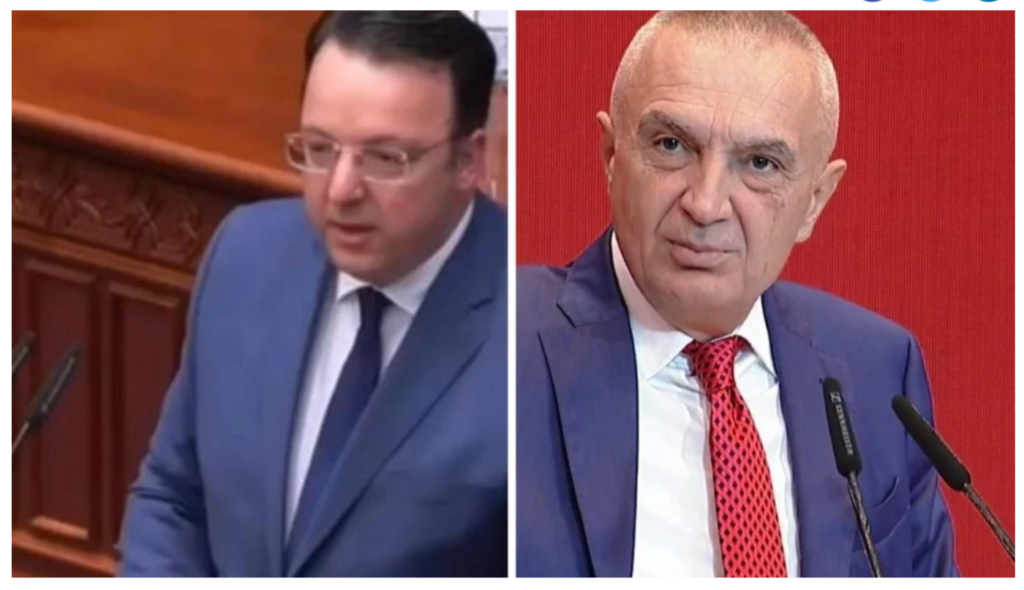
On Friday, in the parliament of North Macedonia, a deputy prime minister stood before his colleagues and declared that Albania is holding a political prisoner. Alexandar Nikolovski, a senior figure in VMRO-DPMNE and minister of infrastructure in the current Skopje government, told the plenary session that Ilir Meta, former president of Albania, has been kept in pretrial detention for two years without a case file. He compared Prime Minister Edi Rama to the legacy of Enver Hoxha. He asked his colleagues whether they truly admire such a man.
It was a remarkable performance. It deserves a precise response.
The Messenger
Alexandar Nikolovski does not speak from neutral ground. He is one of the most prominent figures in VMRO-DPMNE, the party that governed North Macedonia for over a decade under Nikola Gruevski and built, in that time, one of the most comprehensively documented cases of democratic backsliding in the Western Balkans. Under VMRO-DPMNE, the state wiretapped thousands of citizens including journalists, opposition politicians, judges, and diplomats. It captured the judiciary, subordinated the prosecution to political instruction, and dismantled independent media through financial pressure and regulatory harassment. The record is not disputed. It was documented by the European Commission, by international monitors, and by the courts that later processed it.
Nikola Gruevski, the architect of that system and Nikolovski’s political patron, was convicted of corruption and abuse of power. He did not serve his sentence. He fled to Budapest, where he has lived for years under the protection of Viktor Orban, the Hungarian prime minister who has done more than any other European leader to obstruct Western Balkans enlargement and democratic reform in the region.
This is the tradition from which Nikolovski speaks when he invokes political prisoners and democratic values. The irony is not incidental. It is structural.
The Accusation
Nikolovski’s specific claim is that Ilir Meta is being held without a case file. This is a claim made regularly by Meta’s lawyers and political allies, and it is a claim that Albanian courts have repeatedly reviewed and rejected. Meta faces charges including incitement to violence, connected to events surrounding the June 2023 elections. The prosecution was brought by SPAK, the Special Anti-Corruption Prosecutor’s Office, an institution built under intensive international supervision with American and European technical and financial support, designed with extraordinary care precisely to insulate prosecution from political manipulation.
One may contest SPAK’s conclusions. That is what courts are for. What one cannot credibly do is describe SPAK as an instrument of political persecution while standing in a parliament whose own governing party spent a decade actually building one. The categories are not equivalent. The institutional realities are not equivalent.
The Hoxha Comparison
The invocation of Enver Hoxha requires direct treatment because it is not an ordinary political comparison. Hoxha’s name in Albanian political discourse carries the full weight of nearly five decades of totalitarian rule, of labor camps, of executions, of a society sealed from the world and broken into informants and victims. To reach for that name in a foreign parliament, to attach it to a sitting Albanian prime minister before a European audience, is not commentary. It is a deliberate act of historical violence against Albanian memory, deployed for political effect.
It should be named as such. Not with anger, which is what such provocations are designed to produce, but with clarity. Nikolovski knows exactly what he was doing. So does his audience.
The Pattern
None of this happened in isolation. Ilir Meta’s camp has spent the past year systematically cultivating an international network of political solidarity built primarily from the illiberal right. The connections run through Budapest, through Belgrade’s sympathetic media apparatus, and now through Skopje. Nikolovski himself is a known Orban ally. The statement from the North Macedonian parliament did not emerge from principled concern for Albanian judicial standards. It emerged from a converging pattern of aligned political messaging whose effect, intended or not, is to damage Albania’s credibility at the most consequential moment of its EU accession process.
The timing is not coincidental. The forum is not coincidental. The choice to invoke Hoxha before a European parliamentary audience at this particular moment is not coincidental.
Albania’s Answer
Institutions are not defended by shouting about them. They are defended by surviving scrutiny. Albania has spent fifteen years dismantling the kind of system that VMRO-DPMNE constructed and Gruevski perfected. It has built, imperfectly and under sustained pressure, institutions that now operate under international oversight. SPAK exists because Albania chose accountability over convenience. That choice was difficult and it remains contested. But it is Albania’s choice, made through its own constitutional and political processes, supported by its transatlantic partners.
A deputy prime minister whose party’s founder is a fugitive from justice sheltered by an EU member state has nothing to teach Albania about the rule of law. His statement on Thursday was not a contribution to democratic discourse. It was a provocation, a deliberate act of regional hostility timed to cause maximum damage, and it should be understood and recorded as exactly that.
Albania is not obliged to answer every insult. But it is entitled to name them.
Albatros Rexhaj is an author, playwright, and national-security analyst with nearly three decades of experience in political and security affairs.